Sunday, February 22, 2015

Wisconsin Library Bulletin 1905-1984

In addition to my contributions to the Library History Buff Blog I am also the primary contributor the Wisconsin Library Heritage Center blog. I'm re-posting below a contribution to that blog about the Wisconsin Library Bulletin. Publications of state library agencies and state library associations contain a wealth of library history source material. Many of these publications have been digitally scanned through the efforts of Google and the Hathi Trust. Much of that material is not available in full view, however. The Hathi Trust has a process for the holders of copyright to material still protected by copyright to provide permission for its full view. Doing so for state library and state library association publications would be a major contribution to a greater knowledge and understanding of library history in the United States. Wisconsin is working on doing that for the Wisconsin Library Bulletin. Other states should do likewise.

Post to the Wisconsin Library Heritage Center blog for February 22, 2015:


In January, 1905, just over 110 years ago, the Wisconsin Free Library Commission (WFLC), the predecessor to the Wisconsin Division for Libraries and Technology, published the first issue of the Wisconsin Library Bulletin (WLB). The new monthly publication was described as "A Magazine of Suggestion and Information" and was devoted to the improvement of Wisconsin's libraries. It reported on library activities and development within the state and provided a wealth of  practical information primarily for public libraries. The WLB was edited by WFLC Secretary Henry E. Legler. The first issue of the magazine can be found on the Hathi Trust website. That issue contained a summary of library progress in Wisconsin and a variety of articles and news items written by leaders in public library development and extension in Wisconsin. These included Wisconsin Library Hall of Fame members Lutie Stearns and Cornelia Martin. The WLB ended with a special issue in 1984. A complete file of the WLB can be found on the Hathi Trust website but not all issues are available in "full view". Efforts are being by the Division for Libraries and Technology to rectify that situation. The image to the left shows the cover of the Sept.-Oct. 1909 issue.

Wednesday, February 18, 2015

Library Trustees Handbook 1902


Governance of public libraries by an independent board of trustees is a model that dates back to the establishment of the Boston Public Library in 1852. It continues to be the dominant form of public library governance today. The Massachusetts Free Public Library Commission was established in 1890. It was the first of many state level library organizations that had a primary mission of advancing public libraries and public library service on a statewide basis. Wisconsin established the Wisconsin Free Library Commission in 1895. Minnesota established the Minnesota Library Commission in 1899, and Iowa followed suit in 1900. These three library commissions were leaders in promoting the education of public library trustees. In 1902 they published the Hand Book of Library Organizations. I have a copy of that publication and it is available in digital form on the Hathi Trust website. The Introduction of the handbook states: "This handbook is addressed primarily to library trustees, and is not intended to give full directions for the technical work necessary in a public library. Its purpose is to give all the information which is necessary for the board of directors to have before the trained organizer or permanent librarian arrives, and to serve as a guide to the untrained librarian in the administration of a small library." Notwithstanding this disclaimer the 79 page publication contains a wealth of information prepared by some of the most experienced public library extension leaders in the nation. I've included a scan of the contents page of the handbook above. I worked for 23 years at the successor to the Wisconsin Free Library Commission and we developed and updated a public library trustees manual on several occasions. The latest version is online HERE. It represents a strategy for educating library trustees that dates back for more than a century. 

Tuesday, February 17, 2015

Wooden Library Postcard, Redlands,CA, 1905


Perhaps the most unusual postcard in my collection of library postcards is the one shown above. It is made of wood and depicts the A.K. Smiley Public Library in Redlands, CA. The postcard was mailed in 1905 when postcards were called "mailing cards" and only the address could appear on the non-picture side of the card. This wood "Souvenir Mailing Card" was copyrighted in 1903 by the California Souvenir Co. in Los Angeles, CA. To say wooden postcards are scarce is an understatement. Out of over two million postcards listed on eBay I could find only a few that were made of wood and none that depicted a library. There was one California Souvenir Co. mailing card similar to this one and it was unused and depicted grapes on the front. The building depicted on this postcard was dedicated in 1894 and was made possible by the generosity of A.K. Smiley. With additions it is still in use today. The story of how the library building came to be can be found HERE.

Friday, February 6, 2015

New Book About New York City's Early Libraries

I've just completed reading Tom Glynn's new book Reading Publics: New York City's Public Libraries, 1754-1911 (Empire State Editions, Fordham University Press, 2015). I highly recommend it to library history buffs everywhere. The term "public libraries" used in the sub-title of the book refers to all types of libraries other than private/personal libraries not just free public libraries as we know them today. Indeed the New York Public Library was not legally established until 1895. As the sub-title indicates the time period for the book begins in 1754 with the founding of the New York Society Library and concludes with the construction of the flagship New York Public Library building at 5th Ave. and 42nd Street. As Wayne Wiegand indicates in a cover blurb the book is: "A deeply researched, well-written, and solid contribution to library history literature that will interest not only members of the library profession but also scholars and students of intellectual, cultural, social, urban, and print culture history whose own research has been heavily influenced by the rich collections Glynn discusses." I found the book to also be a good read. The complicated development of libraries in the nation's major urban city is a fascinating story, and Tom Glynn has done an excellent job of telling it.  Purchase from Amazon.

Friday, January 30, 2015

Library Card Predecessors

1733 receipt for subscription fee. Image used by permission of The Library Company of Philadelphia
One of my blog readers recently asked me if I knew why library cards were created and if I had any information about the first library card/s. Here is my stab at answering those questions. Basically. a library card (also ticket, certificate of membership) is proof of the right to access a library. Although not always, it is most commonly the authorization to borrow or remove books (and other items) from the library. It is also usually tied to information about the holder of the library card that is kept on file at the library to facilitate the retrieval of materials taken if not returned on time.  Libraries requiring payment for access were most likely the first libraries to require a document of some kind to gain access to the library (and to remove materials).  Those libraries, broadly described as membership libraries, first developed in the 18th century. The first of these libraries in the United States was the Library Company of Philadelphia which was founded by Benjamin Franklin and friends in 1731. There were earlier examples of membership libraries in England. It is my contention that the first library cards were probably receipts for payment of membership dues to these libraries. The receipt for payment of a subscription fee for "use and service" of the Library Company of Philadelphia dated January 20, 1733 (shown above) is one of the earliest examples of those receipts. Library cards or tickets developed because they were more practical. The larger the library the more critical was the need for library users to have a document identifying themselves as an authorized user of the library. This was especially the case for free public libraries which developed in the later half of the 19th century in the United States. Klas August Linderfelt, Librarian of the Milwaukee Public Library, wrote in 1882: "In the great majority of libraries, when a new member becomes entitled to the privilege of using its contents, whether through some other person's guaranty, a money deposit, or an annual fee, a card is given him as a certificate that he has complied with all the requirements of the management and which must be produced in all his transactions with the library ...". Further: "In some libraries this card serves no other purpose than the one indicated, or possibly as a reminder to the borrower of the time when his book must be returned, while in other libraries it forms an integral part of its charging system. This latter is a risky arrangement, as my experience, at least, is that an ordinary borrower has even less regard, if possible, for the card than for the book itself, and considers its loss of no importance whatever." The American Library Association website has a nice page about library cards. The Library History Buff website has a page showing examples of vintage library cards. I would be happy to hear from others with more information about the early use of library cards and/or receipts for membership payments.
1841 version of a Library Company of Philadelphia receipt from my collection.

Wednesday, January 28, 2015

Osage, Iowa's Carnegie Library


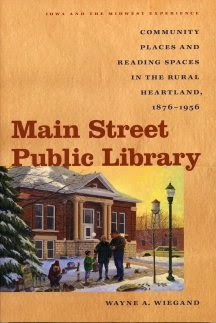
Osage, Iowa's Carnegie library first came to my attention with the publication of Wayne Wiegand's book Main Street Public Library (Univ. of Iowa Press, 2011). The Osage, IA public library is one of four Midwest libraries featured in the book. In his book Wiegand documents the multi-year struggle that Osage went through to obtain a Carnegie grant and to build the library. The $10,000 Carnegie grant was awarded on March 27, 1905, but efforts to get the grant were initiated in February, 1903. The actual dedication of the building didn't take place until August 1, 1911. The postcard above (from my collection) shows the building under construction in 1910. A painting of the Osage Carnegie library by David Rottinghaus appears on the cover of Wiegand's book. Wiegand also facilitated the construction and sale of a birdhouse modeled on the Osage Carnegie library (see below). I have one of the birdhouses in my collection of librariana.  The Carnegie building is currently occupied by the Osage City Hall. An online article about the Carnegie library in Osage and Wiegand's book was published by the Mitchell County Press News on October 5, 2010.


Monday, January 26, 2015

Leather Library Postcard, Arcola, IL


Leather postcards are unusual. Leather library postcards are even more so. Out of just under 14,000 library postcards listed on eBay, I could find only six that were made out of leather. I'm fortunate to have a few examples of these postcards. The most unusual of the ones I have is a postcard depicting the Carnegie Library in Arcola, IL (shown above). It includes color lettering which is rare. The postcard actually went through the mail on January 3, 1907. Arcola received a $10,000 grant for a public library building from Carnegie, and the building was dedicated on October 18, 1905. The public library in Arcola still occupies the building. I have a previous post about a leather postcard in my collection for Sedalia, MO. That postcard also includes some color.

Wednesday, January 21, 2015

Merchant Marine Library Postal Card, 1947


As a collector of postal librariana I am interested in both the postal history and library history of artifacts that have been sent through the mail. Of course, as a library history buff, library history takes precedence over postal history for me. Stamp dealers on the other hand mostly could care less about library history. They value their postal artifacts based on postal significance. I recently acquired a postal card mailed by the American Merchant Marine Library Association (AMMLA) in NY,NY in 1947 (shown above). The AMMLA came into being after World War I largely as a result of the work of the American Library Association's Library War Service in providing books on merchant marine ships during the war. I was happy to get a postal artifact related to this organization. The postal card has a great message. The New York AMMLA is notifying representatives of the S.S. George Bancroft that they can't deliver books to the ship because the railroad tracks near the pier "knock hell out of our tires", but the ship's representatives can come over to the (AMMLA) library and pick them up. Unfortunately the front side of the postal card indicates that the message never got through. And there lies the postal significance of the card. The postal card was mailed special delivery to get the card delivered fast, but the address was insufficient and the card was "returned to sender". I like the fact that a U.S. Merchant Marine commemorative stamp was used to help achieve the correct postage rate for special delivery. Too bad it didn't work.

Tuesday, January 20, 2015

Library Dedication Day, Alexandria, PA, 1900


Alexandria, PA is a small community of a few hundred people, but in 1899 two native sons donated $16,000 for the construction and ongoing support of a public library. The men making the donation were William Woolverton of New York and William Thompson of Philadelphia. The library was dedicated on May 1, 1900. The occasion is documented by the postcard shown above. The library building was substantial with space for 20,000 books, and a second story performance hall with seating for 400 people. Library Journal for January, 1900 reported on the donation and the upcoming dedication. 

Monday, January 19, 2015

Biblioteca Carnegie in San Juan, Puerto Rico


I started off the month of January with a cruise in the Caribbean with a stop in San Juan, Puerto Rico. One of the buildings I saw while in San Juan was the Carnegie Library or the Biblioteca Carnegie (shown on the postcard above). In 1914 Andrew Carnegie made a grant of $100,000 for the construction of a public library building in San Juan. The building was completed in 1916. The library building was closed in 1965 due to disrepair but reopened in 1965 after renovation. The building received significant damage in 1989 as a result of Hurricane Hugo. The building underwent extensive renovation and reopened in 1995. More information about the Biblioteca Carnegie can be found HERE