Showing posts with label postal cards. Show all posts

Sunday, January 23, 2022

Edna Isabel Allyn and the Hawaii State Library

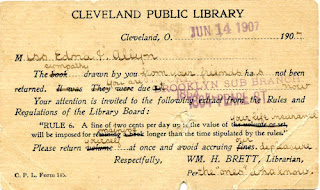
 The significance of the nondescript postal card below rests with its connection to one of the most important people in the history of the Hawaii State Library – Edna Isabel Allyn (1861-1927).  When this card was sent to Allyn by her former staff at the Brooklyn Sub Branch of the Cleveland Public Library, she had just become librarian of the Honolulu Library and Reading Room Association.  Allyn would transition this library into a free public library and then the Hawaii State Library. She would become Hawaii’s first State Librarian.  The card is a pre-printed overdue book notice that has been adapted in a humorous way – “Please return yourself at once and avoid accruing our displeasure.”  The postal card is dated June 14, 1907 and addressed to “The Truant”. It has no postage or postmark and was probably enclosed in another envelope for delivery to Honolulu.

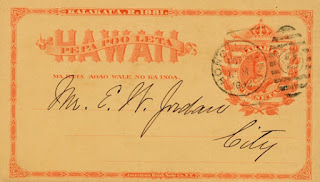
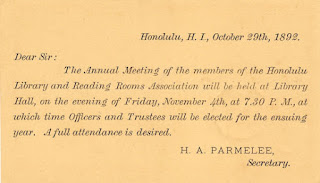
The Honolulu Library & Reading Room Association was established in 1879 when Hawaii was still a country with a king and its own postal system. H. A. Parmelee was one of the founders of the library. This postal card was mailed locally in Honolulu on Oct. 31, 1892. 


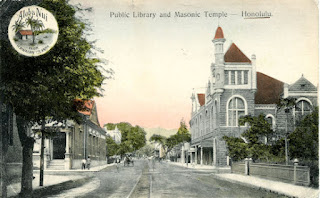
Postcard shows the library in Honolulu directed by Edna Allyn.  Message on the back reads in part: “The building on the left is the library.  We hope for a better one some day.” Mailed from Honolulu, Hawaii to the Public Library in Newark, NJ, March 16, 1908. 


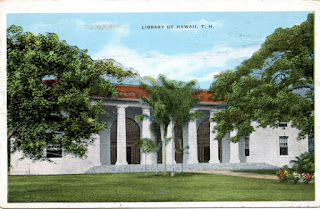
In 1909 the Hawaii Library and Reading Room Association transfered its assets to the newly formed Library of Hawaii which received a $100,000 grant from Andrew Carnegie for a building. That building opened (shown below) to the public on February 1, 1913. Edna Allyn was appointed the first librarian, a post she held until her death in 1927. The children's section of the library is named in her honor.  Postcard mailed on March 5, 1931. 


After statehood in 1959 the Library of Hawaii became the Hawaii State Library.
Thursday, December 30, 2021

St. Louis Mercantile Library 125

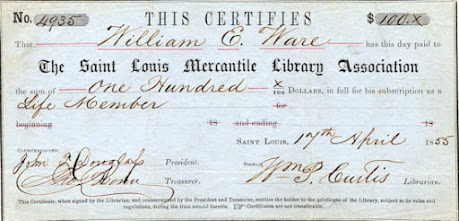
 The St. Louis Mercantile Library celebrated its 125th anniversary in 2021. According to its website: “Founded in 1846 and chartered by the State of Missouri in that year, the St. Louis Mercantile Library is the oldest general library in continuous existence West of the Mississippi River.”  The library is now located on the campus of the University of Missouri – St. Louis. Mercantile libraries are one of the major types of membership libraries. They were started by businessmen in behalf of young merchants’ clerks embarking on their careers. They began in Boston and New York in 1820 but were eventually established in most major cities in America including St. Louis. I have a philatelic exhibit featuring America’s membership libraries and mercantile libraries constitute a major component of the exhibit. I have a number of artifacts in the exhibit relating to the St. Louis Mercantile Library, some of which are shown below.  I have a previous blog post which discusses the bookplates of the Mercantile Library.  I also have a blog post about my visit to the library in 2015.

Life membership certificate for William E. Ware dated 1855. 

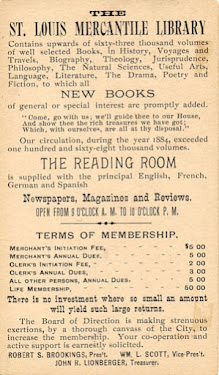
1895 postal card listing services and membership terms.


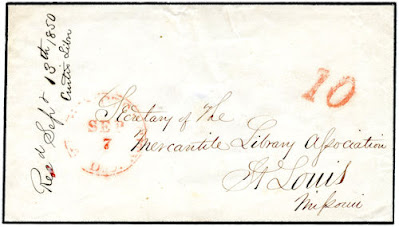
Stampless mourning cover sent to the St. Louis Mercantile Library on Sept. 7, 1850.


Saturday, March 18, 2017

Helen Marot, Progressive Librarian & Labor Activist


Helen Marot (1865-1940) was a librarian who worked to improve the working conditions of women.  She helped to establish the Free Library of Economics & Political Science in Philadelphia in 1897.  In my collection of library related postal cards I have a postal card (see above and to the left) that was mailed by Marot from the Free Library of Economics & Political Science on November 23, 1898 to a London publisher.  In trying to find out more about Marot I was delighted to find a well written and researched article about her on Wikipedia. The article has a good description of the Free Library of Economics and Political Science which provided a specialized collection of government publications, labor society reports, magazines, and pamphlets related to economics and political science. Later Marot served as executive secretary of the New York branch of the national Women’s Trade Union League.  Her labor activism included organizing the strike of the shirtwaist makers and dressmakers in 1909.

Monday, June 6, 2016

1874 Boston Public Library Overdue Book Notice


In a previous blog post I claimed to have the world’s largest collection of overdue notices on postal cards. Postal cards are the pre-stamped cards sold by the post office which were first issued in 1873. I also wrote posts about possibly the oldest (December, 1873) and second oldest (May,1874) overdue notices mailed on postal cards. I now have another contender for the second oldest overdue notice mailed on a postal card. It was mailed by the Boston Public Library on February 5, 1874, and is shown above and to the left. The postal card itself was printed for use in 1873 but the “3” has been struck out and replaced with a “4”.  It is an especially elaborate overdue notice citing the library’s rules about overdue books in their entirety. The library staff member taking ownership for sending the overdue notice was Edward Capen, Keeper of the Lower Halls.  The postal card notes that, “In charging yearly several hundred thousand volumes to borrowers, the utmost precaution will not prevent an occasional mistake; and borrowers are particularly requested to notify the Superintendent promptly of any errors on the Library’s part.” Although Edward Capen is listed on the postal card as the "Keeper of the Lower Halls" he had been appointed as the first "Librarian" of the Boston Public Library in 1852 by the Boston City Council and continued to officially hold this designation until 1874. In 1858 a position designated as "Superintendent" was created over the "Librarian" position. The first Superintendent was Charles Coffin Jewett. Although the overdue notice was not mailed on a postal card, I have in my collection of librariana an overdue notice mailed on Jan. 7, 1832 by the Sir P. Dun's Library in Dublin, Ireland. 

Friday, June 3, 2016

Melvil Dewey’s Shorthand


Melvil Dewey was obsessed with efficiency. One of the devices that he used to improve his personal efficiency was writing in shorthand.  The form of shorthand that he used was called tachygraphy, a system promoted by David P. Lindsley.  Dewey taught himself the system while at Amherst College, and became so adept at it that he began teaching other students how to use the system.  Dewey recorded his personal diaries using tachygraphy which has posed an obstacle to his biographers.  As a collector of postal librariana I was delighted to recently acquire a postal card (see above) in which Dewey used shorthand to communicate with George W. Cole in Fitchburg, MA in 1886.  At the time Cole was working on the catalog of the Fitchburg Public Library, and he obviously was also familiar with tachygraphy. Although the postal card is pre-printed with the logo of the Columbia College Library for which Dewey was the Chief Librarian, the card was mailed from Mackinac Island, MI on September 18, 1886.  I haven’t been able to determine why he was in Michigan on that date, perhaps for a holiday. Dewey's diaries are in the archives of the Columbia University Library.

Wednesday, January 21, 2015

Merchant Marine Library Postal Card, 1947


As a collector of postal librariana I am interested in both the postal history and library history of artifacts that have been sent through the mail. Of course, as a library history buff, library history takes precedence over postal history for me. Stamp dealers on the other hand mostly could care less about library history. They value their postal artifacts based on postal significance. I recently acquired a postal card mailed by the American Merchant Marine Library Association (AMMLA) in NY,NY in 1947 (shown above). The AMMLA came into being after World War I largely as a result of the work of the American Library Association's Library War Service in providing books on merchant marine ships during the war. I was happy to get a postal artifact related to this organization. The postal card has a great message. The New York AMMLA is notifying representatives of the S.S. George Bancroft that they can't deliver books to the ship because the railroad tracks near the pier "knock hell out of our tires", but the ship's representatives can come over to the (AMMLA) library and pick them up. Unfortunately the front side of the postal card indicates that the message never got through. And there lies the postal significance of the card. The postal card was mailed special delivery to get the card delivered fast, but the address was insufficient and the card was "returned to sender". I like the fact that a U.S. Merchant Marine commemorative stamp was used to help achieve the correct postage rate for special delivery. Too bad it didn't work.

Monday, July 28, 2014

Gilbert H. Doane, Librarian and Monuments Man


The story of the World War II "Monuments Men", a special Army unit created to help recover art treasures looted my the Nazis, has become well known due to the George Clooney film this year. One of the monuments men was Gilbert H. Doane (1897-1980), Librarian of the University of Wisconsin - Madison from 1937 to 1956. Doane took a leave of absence in 1943-1945 to serve in what was officially known as the Army's Monuments, Fine Arts, and Archives (MFAA) program. Although I knew that Doane had served as Librarian of UW-Madison, I didn't know about the monuments men connection until I did some research as the result of a recently acquired airmail letter postal card  sent to Doane from Mexico in 1940 (see above). The letter was sent by a friend of Doane's with the initials D.P. The friend is an artist and the letter updates Doane on the friend's artistic activities including an upcoming show in San Francisco. Doane left the Army with the rank of Major. When he stepped down from his post as UW Librarian he was ordained as an Episcopal priest, and in 1957 he returned to UW as the University Archivist, a post he held until 1962. There is an excellent post about Doane on the UW Archives blog, and also a great post on the Bibliophemera blog.    

Tuesday, May 6, 2014

University Club Library Postal Card 1900


According to its website the University Club is "New York’s premier social club offering unparalleled services to members - from gracious dining, luxurious accommodations and a variety of social events, to extensive athletic facilities and the world’s largest and finest club library." The club received its charter in 1864, but its roots date back to 1861. It's current building located at West 54th Street at 5th Avenue was completed in 1899 and includes an incredibly beautiful library. The postal card above which was mailed by the library on Sept. 26, 1900 is a recent addition to my postal librariana collection. The Librarian W. H. Duncan, Jr. is responding to a request from one of the club's members. Duncan had just become librarian after serving as a branch librarian for the Brooklyn Public Library.

Tuesday, January 21, 2014

Hiram E. Deats (1870-1963) of New Jersey Revisited


I have written two previous posts about Hiram E. Deats (click HERE and HERE), but a recent addition to my postal librariana collection (shown above) has prompted me to write another. The reason I am so interested in Deats is that he played a prominent role in both the library world and the philatelic world, two of my passions. Deats was a true "Renaissance man". A farmer by vocation, he was a prolific collector of stamps, coins, bookplates, and books. He held key offices in national organizations that promoted these collecting interests. His interest in libraries led him to become the first president of the Flemington (NJ) Library Association, a predecessor to the Flemington Free Public Library. The postal card above is addressed to Deats at the Flemington Library Association. The postal card which was mailed on March 6, 1905 is an acknowledgement for his payment to The Publishers' Weekly for subscriptions (including Library Journal) for himself and for Elizabeth Van Liew, the first librarian of the Flemington Library Association. It was good that Deats paid for Liew's $2 subscription to Library Journal since she only received $1 per week as salary. Deats served as President of the New Jersey Library Association in 1909-1910. He donated the land for the first Flemington Free Public Library building. The Hiram E. Deats Reference Library, a genealogical library, in Doric House in Flemington, NJ is named for him. I also have a page on the Library History Buff website with more information about Deats.

Wednesday, November 27, 2013

The Rise and Fall of the Philadelphia Commercial Museum

Unlike the American Library Association members who celebrated ALA's jubilee in Philadelphia in 1926, members attending the ALA Midwinter Meeting in Philadelphia in January 2014 will be unable to visit one of America's most influential commercial museums and libraries. According to a history of the Philadelphia Commercial Museum on the website of the Independence Seaport Museum, "Opened in 1897 at 34th and South Streets, the Commercial Museum was the turn of the century United States' greatest resource for international trade information, essentially serving the role of the not-yet-existent federal International Trade Administration." The website history indicates that when the Commercial Museum finally closed on July 1, 1994, "it was a shadow of its former self". I became aware of the Philadelphia Commercial Museum after acquiring a 1919 postal card (shown above) mailed by the museum's library to the Swiss Information Office for the Purchase and Marketing of Goods in Zurich, Switzerland in which it acknowledges the receipt of a publication. The Annual Report of the Mayor of Philadelphia for 1913 describes the museum's library as follows: "This is a public reference library comprising the principal commercial publications of all governments, and a great variety of trade literature, consular reports, books, magazines and periodicals bearing on geography and commerce. In its special line it is recognized to be the best equipped library in the United States." As the Commercial Museum scaled down and finally closed its collections were dispersed to other museums and libraries in the Philadelphia area including the Independence Seaport Museum. It is a sad thing when a once great institution is no more.

Tuesday, September 3, 2013

1931 Postal Card to the Library of Congress


One of my favorite categories of postal librariana is pre-stamped government issued postal cards. Libraries made heavy use of these cards to conduct library business, and they provide an interesting look at library procedures of the past. The postal card (see above) featured in this blog post concerns interlibrary loan and was mailed to the Library of Congress by the Cornell University Library on August 14, 1931. The hand written note on the message side of the card indicates that three books borrowed on interlibrary loan are being returned "express prepaid". A notation at the top of the cards indicates that the books were received by the Library of Congress. The front of the card has several special markings. All mailed received by the Library of Congress was stamped with a date received stamp by the Mail & Delivery Division. In addition to that stamp this card has a date received stamp for the Secretary's Office. There are also "Reading Room" stamps and an "Inter-Library Loan" stamp. Interlibrary loan was initiated by Librarian of Congress Herbert Putnam in 1900. It was a major factor in establishing the Library as a national library and not just a library for Congress.

Saturday, August 17, 2013

A Place Called "Library" Revisited


There is a community in Pennsylvania that is named "Library". It was named in honor of the first library established in the area by John Moore in 1833.  I wrote about Library, PA in a blog post on February 4, 2009.  I recently added a couple of postal items related to Library, PA to my collection of postal librariana.  The first is an envelope mailed to Deacon Joseph Philips in Library, PA on February 17, 1862.  The second is a postal card mailed from Library, PA on January 12, 1940.  The message side of the postal card provides an explanation for the name of the Library Post Office which was established in 1842.  Both items are shown above.  My Library History Buff website has a page that show several other postal items related to Library, PA. 

Thursday, May 30, 2013

Bookplates and Hiram E. Deats

Hiram Edmund Deats (1870-1963) was an important figure in both the philatelic world and the library world which makes him of special interest to a collector of postal librariana. I wrote a previous post about Deats on March 12, 2011. This post is prompted by my acquisition of two artifacts that relate to the interest of Deats in bookplates. The first is his personal bookplate (on the left). The bookplate was designed by Edmund Henry Garrett. The bookplate shows the Greek deity Hermes bowing before four women representing four continents. On the lower right of the bookplate is a group of books including a stamp album. A copy of the bookplate is included in the collection of the Rare Book & Manuscript Library of the University of Illinois Champaign-Urbana.  [Note: This bookplate also exists in a reddish color. Deats had at least three other personal bookplates at various times in his life.] The second artifact (see below) is a postal card mailed from Plymouth, England to Deats at his home in Flemington, NJ on July 20, 1893. The postal card was mailed by W. H. K. Wright, Secretary of the Ex Libris Society in London, England (which became defunct in 1908) and Editor of the Journal of the Ex Libris Society. Wright covers two topics in his message on the postal card to Deats. The first topic relates to the book Ex Libris Imaginaire which he has purchased for Deats from its author L. Joly of Paris, France. The second topic concerns a lot of 1800 bookplate examples which Wright has sent to Deats in "three packets securely fastened and sealed".  Wright refers to this lot of bookplates as the "last lot" which indicates that previous lots had been sent. I came across an entry in WorldCat for a publication authored by Deats titled The collection of American and foreign bookplates of H. E. Deats ...sold 1909. A microfilm copy is located in the New York Public Library. More about the philatelic and library connections of Hiram E. Deats can be found in this article in the American Philatelist.   I also have a page on the Library History Buff website with more information about Deats.


Saturday, May 11, 2013

Reserve Book Notice Sells for $54,625


During World War I the cost of sending a government issued postal card in the U.S. was increased from one cent to two cents to help pay for the war effort. After the war the cost was lowered back to one cent. During the war the two cent Grant postal card which was intended for international mail destinations was frequently used for domestic mail. The postmaster of Long Beach, CA wrongly overprinted the Grant international postal cards at the reduced one cent rate for domestic mail after the war. He inadvertently created a philatelic rarity. Only three to four of these miss-marked cards are known to exist. Two of those were mailed by the Long Beach Public Library in 1921to notify patrons that reserve books were waiting for them.  At a philatelic auction conducted by Robert A. Siegel Auction Galleries on March 21 in New York one of the Long Beach Public Library reserve book notices sold for $54,625. A preliminary value for the postal card was set at $100,000 by Siegel which means that the buyer got a real bargain. I previously wrote about these rare postal cards in a post on January 30, 2011. In that post I reported on the second of the two Long Beach Public Library postal cards which sold for $95,000 in 2010. In that post I also noted that I actually had the chance to buy one of the postal cards for $30,000.  I still don't understand why my wife wouldn't let me do it. The auction catalog for the Siegel auction on March 21, 2013 can be found HERE (large pdf file). The listing for the for the Long Beach Public Library postal card in on page 72.

Sunday, May 5, 2013

Postal Items from a German WWII POW Camp


Woldenberg Oflag IIC was a German World War II prisoner of war camp for Polish officers. The Articles of the Geneva Convention entitled POWs to the right of self-government which led to the development of postal services and library services in some POW camps including Woldenberg. As part of the postal services at Woldenberg, the prisoners developed their own postage stamps and postmarks. A special postmark (shown above) was designed for DNI KSIAZKI or Book Week which took place August 29 to September 4, 1943 to celebrate the 400th anniversary of the printing of the first Polish book.  An exhibit at the camp library was also organized by the the Council for the Camp's Library for Cultural Instructions to celebrate the occasion.  The postmark and stamp above are on part of an envelope given to me by friend and fellow bibliophilatelist Jerzy Duda of Krakow Poland. It was Jerzy who also made me aware of the story behind the items on the envelope. Roman Sobus is an expert on the postal history of Woldenberg Oflag IIC and has developed a philatelic exhibit on this topic. Ironically,
as Sobus points out in the
introduction to his exhibit, the postage stamps and special postmarks that were created by the Polish prisoners of war "are most often of a strong cultural or religious nature, depicting events or persons from Poland's history, and its battles for independence, a fact seemingly lost on the prisoners' captors." I also have in my collection a postal card sent by the camp library to one of the prisoners (shown below). For more on these and other similar postal items click here.

Wednesday, April 10, 2013

ALA and the 1893 World's Fair in Chicago

Postcard showing building where ALA exhibit was located
When the members of the American Library Association gather in Chicago on June 27th it will mark the 120th anniversary of ALA's meeting in conjunction with the World's Columbian Exposition of 1893. It was one of the most significant annual conferences in ALA's history, and it was the first of many ALA conferences in Chicago. It marked a high point in the prominence of Melvil Dewey in ALA and the library profession. Dewey was serving as President of ALA during the conference and played a major role in the Association's active involvement in the Exposition.  For the Exposition, ALA sponsored an exhibit of a model library with a collection of 5,000 of the "best" books available to libraries. A catalog of this collection was later published by the U.S. Bureau of Education as the Catalog of the A.L.A. Library [Hathi Trust link]. The model library and published catalog were the fulfillment of a Dewey idea that had been proposed in 1876. The U.S. Bureau of Education also published a book of the papers presented for what was described as the "World's Library Congress" [Hathi Trust link]. Although Dewey was a major force behind ALA's involvement in the Exposition of 1893, it was largely due to the efforts of Mary S. Cutler, one of Dewey's subordinates at the New York State Library School, that the model library exhibit was successfully implemented. For more on ALA's model library collection click HERE. Of the 250 people who registered for the ALA conference, 150 were women. Also on display at the conference were examples of all manner of library equipment and supplies. One item was of special interest. It was the "Rudolph Continuous Indexer" a machine that housed an alternative version of a card catalog. See my post on this unusual machine. Check it out yourself at the Newberry Library while in Chicago. The World's Columbian Exposition marked the beginning of the golden age of souvenirs. The "pioneer" picture postcard on the back of a government issued postal card shown above includes an image of the Government Building at the Exposition which housed ALA's exhibit. Another significant exhibit at the Exposition was the Woman's Building Library. For my online exhibit on the history of ALA click HERE. My sources: "Best Foot Forward: Representation of American Librarianship at World's Fairs 1853-1904" by Budd L. Gambee in Library History Seminar No. 3, Proceedings, 1968 (The Journal of Library History, 1968) and Irrepressible Reformer by Wayne A. Wiegand (ALA, 1996). 

Wednesday, September 19, 2012

Honolulu Library and Reading Room Association


My exhibit of postal librariana titled "America's Public Libraries and Their Forerunners 1731 to 1956" includes a section on membership libraries. It begins with artifacts related to Benjamin Franklin's Library Company of Philadelphia which was established in 1731. The Peterborough Town Library in New Hampshire, the first public library in the U.S. was established in 1833 and the Boston Public Library, the first large municipal public library, was established in 1854. Even as free public libraries began to replace fee based membership and subscription libraries there were still membership libraries that were being established. One of these was the Honolulu Library and Reading Room Association (HLRRA) which was established in 1879 when Hawaii was still a country ruled by a king. Hawaii also had its own postal system, and in my collection of postal librariana I have two postal cards that were issued by Hawaii that were mailed by the HLRRA. One is an 1892 printed notice of the annual membership meeting sent by H. A. Parmelee, the Secretary of the HLRRA and a founding member, and the other is an 1898 hand written second overdue book notice from the librarian.  The library component of the HLRRA became a free public library in 1903 when the Territorial Government appropriated $10,000 annually for its support (Hawaii became a Territory of the U.S. in 1900). The Association component of the HLRRA continued as a fundraising and support organization and eventually became the Friends of the Library of Hawaii. Hawaii received a $100,000 grant from Andrew Carnegie in 1909 for a library building which opened as the Hawaii State Library in 1913. I found two online resources on the history of the HLRRA. One is the website of the Friends of the Library of Hawaii and the other is a library school class paper by Avis Poai at the University of Hawaii Manoa. Incidentally, if you are in the Milwaukee area this weekend you can see my postal librariana exhibit on display at the Milwaukee Stamp Show.

Friday, July 13, 2012

Szabo to ALA in 1915 - Where's my Booklist?


Ervin Szabo (1877-1918) was Hungary's most famous librarian. Hungary has issued two postage stamps in his honor and has named one of its largest libraries for him. He was the first director of the Municipal Library in Budapest which is now the Metropolitan Ervin Szabo Library. I recently acquired a government issued postcard from Hungary that was mailed on July 12, 1915 to the Publishing Board of the American Library Association. The postcard was mailed by the Budapest Municipal Library and it indicates that the A.L.A. Booklist for 1915 issue 1 "has not come to hand". There is a printed signature on the card for Ervin Szabo as Director of the Library. ALA began publishing Booklist, a book reviewing journal, in 1905. More about Szabo who has been described as a "socialist theoretician" can be found in the online YIVO Encyclopedia of Jews in Eastern Europe. More librarians on postage stamps can be found HERE.

Wednesday, June 27, 2012

The Fenton Metallic Mfg Company Fire of 1892


The Fenton Metallic Manufacturing Company of Jamestown, NY was one of the early manufacturers of steel stacks for libraries. On October 20, 1892 the company's plant in Jamestown was totally destroyed by fire. The company sent out the postal card above on October 22 to its customers and potential customers announcing the destruction of the plant and its intent to immediately rebuild. It did indeed rebuild and continued to provide steel stacks for libraries among its other metal products. The ad for the company's stacks shown below was included in the publication announcing the American Library Association's conference for 1898 which took place at Lakewood-On-Chautaugua, NY near Jamestown. The company later became the Art Metal Company and continued to operate a plant in Jamestown until 1969.

Monday, April 16, 2012

Exhibit About Melvil Dewey's Postal Card


In 1898 the United States Post Office Department (now the United States Postal Service) issued a pre-stamped postal card that was the exact size of a catalog card. Melvil Dewey claimed that the issue of the postal card was the result of his lobbying of the Post Office Department for a card of that size. I have written a previous blog post about Dewey's postal card. I've been collecting examples of these postal cards used by libraries for over 15 years. Last year I put together a one frame, 16 page exhibit of these postal cards for the big stamp show in Chicago, and last month the exhibit was displayed at the St. Louis stamp show. In both cases the exhibit received a silver medal which was less than I hoped for, but I received some good feedback on improving the exhibit. Yesterday at the stamp show of the Wisconsin Federation of Stamp Clubs in Madison, the exhibit received a first place award (more than one first place awards are given). I will also be displaying the exhibit at the Denver stamp show next month. The exhibit varies considerably from traditional postal stationery exhibits in that it concentrates on library uses of a postal card instead of the postal uses. Postal cards were important tools in conducting day to day library business. The largest use for the Dewey cards in my collection was for the acknowledgment of gifts. Of course there are examples of overdue book notices and reserve book notices. Libraries also used the cards for requests to magazine publishers for missing issues of periodicals, and for requesting copies of publications. There are a host of miscellaneous uses ranging from meeting notices to the collection of library statistics. I have a previous post about the use of the card to announce a meeting of the New York Library Club, and a post about a card to collect data for the California State Library.