One of the most impressive World War I posters is one that promotes the American Library Association's participation in the United War Work Campaign which took place the week of November 11, 1918. The poster was designed by the prominent illustrator John E. Sheridan. I'm fortunate to own one of the posters which is shown below. Recently I came across a Real Photo Postcard (shown above) which included one of the posters being used for what it was intended - helping to raise money for books for soldiers and sailors. The postcard appears to show some kind of rally or parade. The most prominent aspect of the postcard is the depiction of of a man in uniform on a donkey. I surmise that it was intended to ridicule German soldiers. There are a number of young boys around the man on the donkey who appear to be amused. Even though the United War Work Campaign opened on the same date of the Allied victory it was still a huge success. The goal was to raise a total of $170 million and it raised $35 million more than that. ALA received $3.8 million as its share.
During World War I the cost of sending a government issued postal card in the U.S. was increased from one cent to two cents to help pay for the war effort. After the war the cost was lowered back to one cent. During the war the two cent Grant postal card which was intended for international mail destinations was frequently used for domestic mail. The postmaster of Long Beach, CA wrongly overprinted the Grant international postal cards at the reduced one cent rate for domestic mail after the war. He inadvertently created a philatelic rarity. Only three to four of these miss-marked cards are known to exist. Two of those were mailed by the Long Beach Public Library in 1921to notify patrons that reserve books were waiting for them. At a philatelic auction conducted by Robert A. Siegel Auction Galleries on March 21 in New York one of the Long Beach Public Library reserve book notices sold for $54,625. A preliminary value for the postal card was set at $100,000 by Siegel which means that the buyer got a real bargain. I previously wrote about these rare postal cards in a post on January 30, 2011. In that post I reported on the second of the two Long Beach Public Library postal cards which sold for $95,000 in 2010. In that post I also noted that I actually had the chance to buy one of the postal cards for $30,000. I still don't understand why my wife wouldn't let me do it. The auction catalog for the Siegel auction on March 21, 2013 can be found HERE (large pdf file). The listing for the for the Long Beach Public Library postal card in on page 72.
Woldenberg Oflag IIC was a German World War II prisoner of war camp for Polish officers. The Articles of the Geneva Convention entitled POWs to the right of self-government which led to the development of postal services and library services in some POW camps including Woldenberg. As part of the postal services at Woldenberg, the prisoners developed their own postage stamps and postmarks. A special postmark (shown above) was designed for DNI KSIAZKI or Book Week which took place August 29 to September 4, 1943 to celebrate the 400th anniversary of the printing of the first Polish book. An exhibit at the camp library was also organized by the the Council for the Camp's Library for Cultural Instructions to celebrate the occasion. The postmark and stamp above are on part of an envelope given to me by friend and fellow bibliophilatelist Jerzy Duda of Krakow Poland. It was Jerzy who also made me aware of the story behind the items on the envelope. Roman Sobus is an expert on the postal history of Woldenberg Oflag IIC and has developed a philatelicexhibit on this topic. Ironically, as Sobus points out in the introduction to his exhibit, the postage stamps and special postmarks that were created by the Polish prisoners of war "are most often of a strong cultural or religious nature, depicting events or persons from Poland's history, and its battles for independence, a fact seemingly lost on the prisoners' captors." I also have in my collection a postal card sent by the camp library to one of the prisoners (shown below). For more on these and other similar postal items clickhere.
The Central Library of the New York Public Library (NYPL) on 5th Ave. appears on many postcards as I have written in a previous blog post. I recently acquired two postcards depicting interior views of the library. They were of particular interest to me because they both show people using the library, a postcard subject of special appeal. The address sides of the postcards also contain interesting information, another postcard aspect of special appeal. The first postcard shows the adult circulation room of the Central Library. It was mailed to the Circulation Dept. of the Kansas City (MO) Public Library (KCPL) by "three travelers" who were probably staff members of the KCPL. Perhaps they were visiting other libraries or were attending a library meeting. The postcard was at one time in the Art File of the Reference Dept. of the KCPL. The second postcard shows the famous main reading room of the NYPL's Central Library. The postcard was mailed to Hiawatha, KS and the message reads: "This is some library and reading room. Thought you might want one to add to your collection." Perhaps the recipient was a collector of library postcards, like me.
My favorite "linen era" library postcard (shown above) was produced by the Curt Teich Company and depicts four Chicago libraries. The Curt Teich Company of Chicago was founded in 1898 and ceased producing postcards in 1978. This postcard was first published in 1937 and was mailed in 1942. The four libraries on the postcard are the Chicago Public Library, the Newberry Library, the John Crerar Library, and the Harper Memorial Library of the University of Chicago. The postcard is addressed to Miss Betty Frances Bryant and the message on the card reads: "How would you like to work in one of these? There is a chance. Dad". The Chicago Public Library building on the postcard is now the home of the Chicago Cultural Center. The Newberry Library continues to occupy the same building that is depicted on the postcard. That is also true for the Harper Memorial Library. The John Crerar Library is now affiliated with the University of Chicago and occupies a building on the university campus. The John Crerar Library occupied the multistory building on the postcard, located on Randolph Street, from 1921 until 1962. The building was demolished in 1981. The American Library Association was located for a period in both the Chicago Public Library building and the John Crerar Library building (see my digital history of ALA). The Chicago Cultural Center, the Newberry Library, and the Harper Memorial Library are all worth a visit if you have time while attending the American Library Association conference in Chicago in June.
I'm a big fan of presidential libraries and museums so I'm excited that the George W. Bush Presidential Library and Museum is being dedicated on Thursday. It will open to the public on May 1st. This will make the 13th library and museum that falls under the purview of the Office of Presidential Libraries of the National Archives and Records Administration (NARA). I've been able to visit eight of these and I'm looking forward to visiting the rest. Although these libraries have been described by some as presidential temples or pyramids, I think they provide valuable looks at important segments of our history. The Franklin D. Roosevelt Library and Museum, dedicated in 1939, was the first of the NARA presidential libraries. The Herbert Hoover Library and Museum was created retroactively. Up until 1978 the archives and artifacts of a president were actually considered to be the personal property of the president. So the papers of early presidents were often dispersed widely and inconsistently. Fortunately the Library of Congress has managed to acquire extensive archival materials for the first 23 presidents. The presidential libraries and museums are well represented in my collection of librariana and I even have a philatelic exhibit about them. Many postal artifacts were created as a result of the 2005 presidential libraries postage stamp which added significantly to my collection. Click HERE to see a previous blog post about presidential libraries.
Each year since 2003 I have participated in the competitive exhibiting component of several national level stamp shows. All of my philatelic exhibits are related to the history of libraries in the United States. The content of the exhibits varies from year to year. In 2012 I had a very successful exhibit titled "America's Public Libraries and Their Forerunners 1731-1956". This year I significantly revised that exhibit and it is now titled "Libraries in 19th Century America". The new exhibit includes only 19th century material and includes artifacts for all types of libraries, not just public libraries and their predecessors. The first showing of the revised exhibit took place at the stamp show in Plymouth, MI (just west of Detroit) this past weekend. I was pleased to receive a gold medal for the exhibit and a special creativity award. I will also be showing the exhibit at stamp shows in Denver, Minneapolis, and Milwaukee this year. For a summary of the evolution of this exhibit, click HERE. For information on some of my other library history related philatelic exhibits, click HERE.
In response to my previous post about ALA and the 1893 World's Fair, Tom Ray, Collections Management Coordinator of The Library of Virginia, informed me that The Library of Virginia had recently acquired one of the actual books from ALA's model library collection at the Fair. The book that they have is The Colonel's Daughter by Charles King. The really neat thing about the book is that it has an example of the bookplate used for the model collection (shown above). All 5,000 books in the model collection were donated by book publishers. Originally, the U.S. Bureau of Education was going to pay for the collection, but at the last minute couldn't do it. A successful appeal to publishers of the books saved the day. The bookplate in The Colonel's Daughter indicates that it was donated by the J. B. Lippincott Company. The collection of books was arranged half by the Dewey decimal classification system and half by the Cutter classification system. The bookplate shows that The Colonel's Daughter was classified by the Cutter system with the call number K58c based on the author's last name (King). I wonder what happened to the other 4,999 volumes in the collection. Any thoughts or insights out there?
Postcard showing building where ALA exhibit was located
When the members of the American Library Association gather in Chicago on June 27th it will mark the 120th anniversary of ALA's meeting in conjunction with the World's Columbian Exposition of 1893. It was one of the most significant annual conferences in ALA's history, and it was the first of many ALA conferences in Chicago. It marked a high point in the prominence of Melvil Dewey in ALA and the library profession. Dewey was serving as President of ALA during the conference and played a major role in the Association's active involvement in the Exposition. For the Exposition, ALA sponsored an exhibit of a model library with a collection of 5,000 of the "best" books available to libraries. A catalog of this collection was later published by the U.S. Bureau of Education as the Catalog of the A.L.A. Library [Hathi Trust link]. The model library and published catalog were the fulfillment of a Dewey idea that had been proposed in 1876. The U.S. Bureau of Education also published a book of the papers presented for what was described as the "World's Library Congress" [Hathi Trust link]. Although Dewey was a major force behind ALA's involvement in the Exposition of 1893, it was largely due to the efforts of Mary S. Cutler, one of Dewey's subordinates at the New York State Library School, that the model library exhibit was successfully implemented. For more on ALA's model library collection click HERE. Of the 250 people who registered for the ALA conference, 150 were women. Also on display at the conference were examples of all manner of library equipment and supplies. One item was of special interest. It was the "Rudolph Continuous Indexer" a machine that housed an alternative version of a card catalog. See my post on this unusual machine. Check it out yourself at the Newberry Library while in Chicago. The World's Columbian Exposition marked the beginning of the golden age of souvenirs. The "pioneer" picture postcard on the back of a government issued postal card shown above includes an image of the Government Building at the Exposition which housed ALA's exhibit. Another significant exhibit at the Exposition was the Woman's Building Library. For my online exhibit on the history of ALA click HERE. My sources: "Best Foot Forward: Representation of American Librarianship at World's Fairs 1853-1904" by Budd L. Gambee in Library History Seminar No. 3, Proceedings, 1968 (The Journal of Library History, 1968) and Irrepressible Reformer by Wayne A. Wiegand (ALA, 1996).
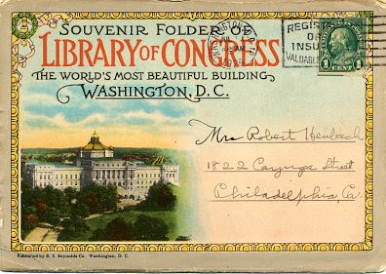
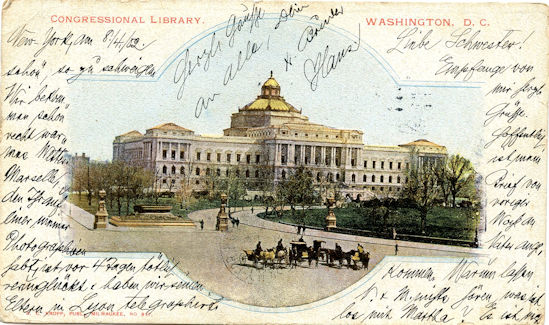
April is the month that we celebrate National Library Week. This year it is April 14 -20. I'm helping to celebrate this event with an exhibit about the Library of Congress at my local library, the Middleton (WI) Public Library. It features various items from my collection related to the Library of Congress. It will be on display for the entire month of April. Some images of the exhibit are shown below.