Showing posts with label Black history. Show all posts

Monday, February 28, 2022

More Carnegie HBCU Libraries on Postcards

 Andrew Carnegie funded library buildings at fifteen Historically Black Colleges and Universities (HBCU). I have previous posts about the library at Tuskegee Institute in Alabama and the library at Fisk University. The other libraries are located at: Alabama A&M in Normal, AL; Atlanta University in Atlanta, GA; Benedict College in Columbia, SC; Johnson C. Smith Univ. in Charlotte, NC (formerly Biddle Univ.); Cheyney State University in PA; Florida A&M in Tallahassee, FL; Fort Valley Normal and Industrial Institute Fort Valley, GA; Howard University in DC; Knoxville College in Knoxville, TN;  Livingstone College in NC; Talladega College in AL, Wilberforce University in Wilberforce, Ohio; and Wiley College in TX. Postcards for the libraries are difficult, if not impossible, to find. Below are postcards showing Carnegie HBCU libraries in my collection.

Carnegie Library, Alabama A&M Univ. in Normal, AL

Carnegie Library, Atlanta University in Atlanta, GA
Library is building on the left.
Carnegie Library, Benedict College in Columbia, SC
Carnegie Library, Florida A&M in Tallahassee, FL
Fort Valley Normal and Industrial Institute Fort Valley, GA
Carnegie Library is building on the left.
Carnegie Library, Howard University in DC

Johnson C. Smith Univ. in Charlotte, NC (formerly Biddle Univ.)
Carnegie Library is building on the right.


Monday, February 14, 2022

Fisk University Libraries


Fisk University is a Historically Black College and University (HBCU) located in Nashville, TN which was established in 1866. The University was the recipient of a grant for $20,000 from Andrew Carnegie for a library building in 1905. The library opened in 1909. It was designed by black architect Moses McKissack III, and it was one of the first major structures designed by a black architect in the U.S. An image of the library is shown above. The building currently serves as the Fisk University Academic Building. The image is from an online article by John Baldwin titled "Fisk University Academic Building (formerly Carnegie Library)" which is part of Clio: Your Guide to History for May 18, 2018. An interesting aspect of the Fisk University Carnegie library building was that it was made available to Nashville's "colored citizens" under the same rules as it served Fisk students. I learned this information from an excellent historical overview of Fisk University libraries by Jessica Carney Smith in Tennessee Libraries. At the time Smith wrote the article she was the Librarian for Fisk. 


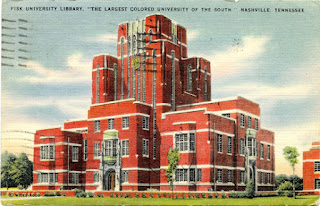
By the late 1920s the Carnegie building was inadequate and a $400,000 grant from the General Education Board made a new library building possible. That building which is shown on the postcard above was completed in the fall of 1930. It was designed by architect Henry C. Hibbs. Then University Librarian Louis S. Shores played a major role in its planning. The building was designed to also serve nearby Meharry Medical College. Provision was also made to include a "Carnegie branch library" for Nashville's black residents. A significant feature of the interior of the building was murals painted by Harlem Renaissance artist Aaron Douglas. 

According to Jessica Carnie Smith's article Arna Bontemps, a Harlem Renaissance writer, became Fisk's first black head librarian in 1943. Bontemps added professional staff and built up special collections at the library. He left Fisk in 1965 and was replaced by Jessica Carney Smith. The need for an even larger library facility resulted in a new 74,000 square foot building that opened in January 1970. it was named the John Hope and Aurelia E. Franklin Library in 2000.

I attended George Peabody College (now part of Vanderbilt University) in Nashville from 1961 to 1965. From 1963 to 1965 I worked part time at the Public Library of Nashville and Davidson County. During that period Arna Bontemps served on the Board of Trustees of the public library. For part of the time his son was also a part-time employee of the public library. In 1965 I applied to the University of Illinois Library School and part of the application process involved an interview with an alumni of the school. Jessica Carney Smith was working at what is now Tennessee State University in Nashville when I applied to the U of I. She had just received her doctorate from the University of Illinois Library School, the first African American to do so, and she conducted my interview. Soon after that Smith became the Librarian at Fisk University.

Tuesday, February 8, 2022

Hampton Institute's Library School


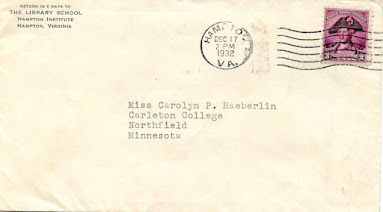
The otherwise unremarkable envelope above which I recently added to my collection of postal librariana has an interesting black history connection. Hampton University (formerly Hampton Institute) in Hampton, VA is one of America's Historically Black Colleges and Universities (UBCUs). The envelope was mailed from The Library School Hampton Institute in Hampton, VA on Dec. 17, 1932 to Northfield, MN. A cooperative effort involving the American Library Association (ALA), the Carnegie Corporation, and other philanthropic foundations resulted in the establishment of a library school at the then Hampton Institute in 1925.  It was the nation's first and only library school to serve African Americans. The library school was initially funded with a grant from the Carnegie Corporation and was accredited by the American Library Association to issue a bachelor's degree in library science. The library school lasted until 1939 when it was cut due to lack of funding. An article on "The Passing of the Hampton Library School" by S.L. Smith appeared in the January, 1940 issue of the Journal of Negro Education. Also under consideration for the library school were Fisk University in Nashville, TN and Atlanta University in Atlanta, GA. The decision to select the Hampton Institute for the library school is explored in an article titled "Hampton, Fisk, and Atlanta: The Foundations, the American Library Association, and Library Education for Blacks, 1925-1941" by Robert Martin and Lee Shiflett in the Spring 1966 issue of Libraries and Culture. After the demise of the library school at Hampton Institute a  library school was established at Atlanta University in 1941. That library school ceased to exist in 1991. A history of the Atlanta University school is located HERE.

In 2018 when Hampton University celebrated its 150th anniversary the University's Library conducted a forum on "Minority Recruitment and Retention in the Library & Information Science Field." 


Wednesday, February 2, 2022

Charles Winter Wood, Tuskegee Institute Librarian


The un-mailed undivided back postcard above has several different stories to tell. It includes a picture of Charles Winter Wood (1869-1953) who is identified as the Librarian for the Carnegie Library of the Tuskegee Institute in Alabama. There is little information, however, about Wood's role as a librarian on the Internet. There is an article about Wood's connection with Beloit College in Wisconsin, something that caught me by surprise. Booker T. Washington hired Wood as head of Tuskegee Institute's English and Drama Departments in 1897, a capacity in which he served for over 30 years. In 1900 the Tuskegee Institute received the first of 15 grants made by Andrew Carnegie for  library buildings for  Historically Black Colleges & Universities (HBCUs). The Carnegie Library building is shown on the postcard above. Wood assumed the additional role of Librarian for the Tuskegee Institute in 1904. It is not clear how long he maintained this dual responsibility but the postcard was copyrighted in 1907. Outside of his academic responsibilities at the Tuskegee Institute, Wood is most noted for his acting career which was significant. The Charles Winter Wood Theater at Florida A&M University is named for him. Shaundra Walker has written an interesting article about Andrew Carnegie's library grants to HBCUs. There is also an interesting project at the University of Southern Mississippi about Carnegies grants for public library buildings that served African Americans. 

First day cover for the 1948 Booker T. Washington stamp. Includes a picture of the Tuskegee Institute faculty in front of the Carnegie Library. 

Monday, January 17, 2022

Martin Luther King Jr. Memorial Library Postcard


The Martin Luther King Jr. Memorial Library , Washington, DC's central public library, is one of the most significant and appropriate memorials to Martin Luther King, Jr. The Board of Library Trustees named the library in memory of King in 1971 before the new building opened on August 21, 1972. The building was designed by world-famous architect Ludwig Mies van der Rohe. The postcard above which shows the library was mailed in 1978. Based on the message on the back of the postcard it was probably sent by a library school student at the nearby Catholic University of America. The postcard was sent to a librarian in Geneva, Il. The message reads: "Here's a library postcard to add to your collection - or is it a friends? Anyway was down here today trying to find Maurice Tauber's Technical Services in Libraries. Do you believe it was out. BORING! which sums up most of my 15 credits - a letter will follow!" Two personal connections to me - library postcard collector and former library school student.

In 2020 the Library completed a massive $211 million rehabilitation. It still serves as an appropriate memorial to Martin Luther King, Jr.


Thursday, January 6, 2022

Two Additional Library People on Postage Stamps


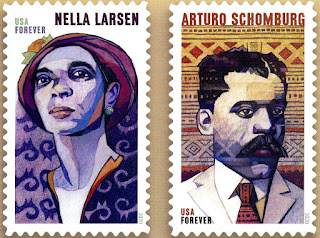
I’ve been collecting libraries and library people on postage stamps for more than 25 years.  I haven’t been as aggressive in my pursuit of these stamps in recent years so I was slow to realize the connection to libraries of two of the stamps in the United State Postal Service “Voices of the Harlem Renaissance” issue of 2020.  Both individuals on the stamps had strong connections to the New York Public Library (NYPL). The first person was Nella Larsen (1891-1964) who was honored as a novelist, but also was a librarian at the NYPL. She worked at three different branch libraries – the 135th Street Branch, the Seward Park Branch, and the Countee Cullen Branch.  She was the first black woman to graduate from the NYPL Library School.  Although not honored as a librarian, Larsen was the first (and only) person with professional librarian credentials to appear on a United States postage stamp.  Wikipedia has a comprehensive entry for Nella Larsen.  The “Little Known Black Librarian Facts” blog has an entry for Larsen with an excellent list of sources.  Bob Sink’s “NYPL Librarians” blog has an interesting post about Ernestine Rose’s role in the integration of branch library staffs including her connection to Larsen. 

Arturo Alfonso Schomburg (1874-1938) was the second person on a stamp with a library connection.  The USPS description of his contributions: “By tirelessly collecting books, documents, artwork, and other materials, Schomburg rescued black history from obscurity and preserved priceless cultural knowledge for future generations.”  His collection was acquired by the New York Public Library and was the foundation for what became the Arthur Schomburg Center for Research in Black Culture. Wikipedia has a nice entry for Schomburg. It is noteworthy that the previously mentioned Ernestine Rose also played a significant role in acquiring and building the Schomburg collection at NYPL. 

Library people especially librarians are rarely recognized on postage stamps for their contributions as library people. Those who are on postage stamps are usually recognized for some other contribution.  On my Library History Buff website which I no longer update because of obsolete software I have several sections devoted to the topic of library people on postage stamps.  They include “Library People on Postage Stamps – An Introduction”, “A Postage Stamp to Honor America’s Librarians”, “U.S. Library People on Postage Stamps”, and “World Library People on Postage Stamps”.

As a collector of libraries and library people on postage stamps I have benefited in my search for these stamps by my membership in the American Topical Association and the Graphics Philately Association.  The Graphics Philately Association publishes a comprehensive list of these and other graphics related postage stamps titled Winnegrad’s Printing on Stamps compiled by Bruce L. Johnson. The Graphics Philately Association also publishes a quarterly publication titled Philateli-Graphics which includes listing of new stamp issues of graphic interest which includes libraries.

Friday, May 5, 2017

The Great Falls (MT) Public Library and Alma Smith Jacobs


Researching a recent acquisition to my postal librariana collection I discovered the story of African American librarian Alma Smith Jacobs (1916-1997) of Montana.  The postal artifact is an envelope (shown above) with an image of the interior of the Carnegie Library in Great Falls, MT covering the entire face of the envelope.  The back of the envelope which was mailed on December 2, 1917 has the address information.  The Great Falls Public Library has an excellent history of the library on its website. It was there that I learned that after serving as a catalog librarian for eight years Alma Jacobs became head librarian in 1954, a post she held until 1973. She left Great Falls to become the Montana State Librarian in Helena where she ended her library career in 1981.  She was the first African American to hold that post. While in Great Falls she led the effort which resulted in the replacement of the Carnegie Library with a new library building in 1967.  The Women’s History Matters website has an excellent overview of Jacobs’ contributions to library and community service in Montana.  In an unusual coincidence of timing I discovered that on April 28, 2017 the Great Falls Public Library dedicated a mural of Jacobs. The library had previously named the library plaza in her honor.  Alma Jacobs was the first African American elected as President of the Montana Library Association, the first elected as President of the Pacific Northwest Library Association, and the first to serve on the Executive Board of the American Library Association. Jacobs’ sister Lucille Smith Thompson was also a prominent African American librarian (Little Known Black Librarian Facts Blog).  

Tuesday, January 17, 2017

ALA’s Atlanta Conference 1899


Later this week the American Library Association will hold its Midwinter Meeting in Atlanta, GA.  The first ALA conference in Atlanta took place on May 8-12, 1899.  It was also ALA’s first conference in the South.  William C. Lane, Director of the Harvard University Library, was President of ALA.  Attendance at the conference was 215. The conference hotel was the Kimball House (see postcard below).  The rationale for an ALA conference in the South was stated in the conference brochure (see cover illustration above): “It is to be hoped that this southern meeting will be the means of largely increasing the membership [in ALA] from a section hitherto almost entirely without representation.” The brochure included a section touting Andrew Carnegie’s bequest in 1898 for new library buildings in Atlanta. This section which was written by someone with the initials A.W. included the following statement: “The people of the South, perhaps the purest strain of the Anglo-Saxon to be found on this continent, are conservative, intelligent, and need only the educational advantages that wealth can bestow to reach a degree of culture heretofore unrivaled.”  No mention of the African American population of the South. Andrew Carnegie’s bequest, however, did include funds for a separate library for African Americans. The racial climate in the South was reflected in ALA’s planning for the 1899 Atlanta conference. There was an initial proposal for a presentation on “How to Make the Library Do Its Part in Negro Education” by W. E. B. Du Bois.  According to Dennis Thomison in his A History of the American Library Association 1876-1872, a decision was made not to have the presentation “to avoid the risk of angering the association’s southern hosts”. It was not until the 1922 ALA conference in Detroit that an African American gave a speech at an ALA conference. The lineup of featured speakers at this year’s Midwinter meeting shows the dramatic change in ALA’s 21st century outlook on diversity in its programming and membership.


Monday, February 22, 2016

Detroit and ALA

The American Library Association has held its annual conference in Detroit, Michigan on four different occasions. The first of these was in 1922 when ALA met from June 26 to July 1. The attendance at the conference totaled 1,839, and those individuals participated in thirty or more associations, sections and round tables which took place at eleven different locations. One of those locations was the newly completed Detroit Public Library’s main building. Conference attendees were also treated to a special day in Ann Arbor, Michigan where they were able to visit the new library building of the University of Michigan. A report on the conference in Library Journal for July, 1922 noted that this was the first conference where none of those who attended ALA’s first meeting in 1876 were not in attendance (although there were still nine survivors of that conference). George B. Utley took office as ALA’s 36th president at the conference. Utley had previously served as ALA’s Executive Secretary from 1911 to 1920. Among those in attendance was Sallie Lou (Mrs. Joseph A.) Thompson whose conference badge is part of my collection of librariana (see below).  On June 27 the first Newbery Medal, for the most distinguished contribution to American literature for children published in the preceding year, was awarded to Henrick Van Loon for The Story of Mankind.  A publicity committee at the conference recommended the establishment of a National Library Week, something which didn’t take place for another 36 years. At the conference Reverend Thomas Fountain Blue (1866-1935) who served as the first African American to head a branch library (Louisville Free Public Library 1905-1935) also became the first African American to give a speech before the American Library Association. ALA did not meet again in Detroit until 1965. It also met there in 1970 and 1977, two conferences which I personally attended. The 1970 conference was especially memorable for me since it was my second ALA conference and my first as an employed librarian.


Saturday, August 16, 2014

75th Alexandria (VA) Library Sit-In of 1939 Anniversary Event


On August 21, 2014 the Alexandria (VA) Library will commemorate the 75th Anniversary of the historic civil rights sit-in which took place at the Library. The commemoration will take place at the Kate Waller Barrett Branch, where the sit-in originally took place on August 21, 1939. I published a previous post about the sit-in in 2010.The following is from a library press release:

"On August 21, 1939, five African American men individually entered the segregated building and requested library cards. When denied, each man calmly took a book off of a shelf to read. After two hours, library authorities had the men arrested for their act of 'civil disobedience'.

'Due to the bravery of these men, 75 years later our library is a community hub that supports all individuals by providing equal access to books, technology, culture, and so much more', says Director of Libraries, Rose T. Dawson. Dawson also happens to be Alexandria’s first African American Library Director. 

The Alexandria Library was founded first as a subscription library in 1794 and became Alexandria’s public library in 1937. Two years later, Attorney Samuel Tucker organized and defended sit-in protesters, William (Buddy) Evans, Otto L. Tucker, Edward Gaddis, Morris Murray, and Clarence Strange. Though the men were charged with disorderly conduct, the city delayed the case and no ruling was ever issued. 

The public is invited to join Alexandria Library in recognizing this significant local event. The program will feature keynote speakers Frank Smith, Ph.D., Director, African American Civil War Museum and Patricia Timmons-Goodson, North Carolina Supreme Court Justice (Ret.) and who is a newly appointed Commissioner, United States Commission on Civil Rights. Visitors can also enjoy music, children’s activities, food and refreshments, gift bags, and more on Thursday, August 21, 2014, from 10 a.m. - 2 p.m. at the Kate Waller Barrett Branch Library, 717 Queen Street, Alexandria, Virginia, 22314!"

Wednesday, February 26, 2014

Library Service to African Americans in the South

There was a recent discussion on the ALA Library History Round Table (LHRT) listserv about the Alexandria Library in Virginia honoring the 75th anniversary of the 1939 Civil Rights sit-in at the library. I have written a previous post about the sit-in. In the listserv discussion it was noted that the most definitive study about library service to African Americans in the South prior to 1941 was conducted by Eliza Atkins Gleason. Gleason was the first African American to receive a PhD in Library Science and the study was the basis for her dissertation at the University of Chicago. Her study also resulted in the publication of the book The Southern Negro and the Public Library (Univ. of Chicago, 1941). I have a copy of the book in my personal library and Gleason's description of library service to African Americans in the South during this period is appalling to say the least. Gleason found that in 1939 only 99 out of 774 public libraries in the 13 southern states provided library service to African Americans, and that only 21 percent of the total African American population had access to such service. That service was substantially inferior to the service provided to the white population in those states. Eliza Atkins Gleason (1909-2009) was an exceptional librarian and her contributions to the library profession have been documented in the blog Little Known Black Librarian Facts. Two other interesting items came out in the LHRT listserv discussion. The doctoral dissertation of Brenda Mitchell-Powell, a  student at the Graduate School of Library and Information Science at Simmons College, will address the 1939 sit-in at the Alexandria Library. Also Wayne Wiegand and his wife Shirl are in the process of finishing research on a book about the desegregation of public libraries in the American South which should get published in 2015. I will look forward to the publication of both of these efforts. 

Tuesday, January 15, 2013

Postmaster Burleson's Magazines and the ALA Library War Service

During World War I Postmaster General Albert S. Burleson implemented a program that allowed used magazines from individuals to be placed in the mail at a special rate of one cent. The Post Office Department would then arrange to have the magazines delivered to organizations which would distribute the magazines to the members of the Armed Forces. The ALA Library War Service played a major role in the distribution of these magazines and its camp libraries were significant beneficiaries of this program. Magazines during this period often carried a "Burleson notice", a short statement from Burleson about the program and the procedure for its implementation (see at left). While certainly of benefit to the camp libraries and those that used them, the program also had some negative aspects. The major one being that the libraries were often overwhelmed by the sheer volume of magazines, many of which were not of great  interest to the men in uniform. As many as twenty sacks of magazines weighing a hundred pounds each were received by some camp libraries in a single day. The library at Camp Dix (NJ) ended up selling some of the older magazines for waste paper and using the funds received to purchase current in-demand magazines. The photograph below shows sacks of magazines being handled at the ALA Library at Camp Custer (MI). The magazine distribution program was a positive program implemented by  Postmaster General Burleson. Burleson was also responsible for some especially negative activities. One involved his efforts to segregate and eliminate African-American postal workers. The source for much of the information in this post and the photograph below is Theodore Wesley Koch's Books in The War: The Romance of Library War Service (Houghton Mifflin, 1919).

Saturday, June 2, 2012

A Branch and a Bookmobile for African Americans in Carrollton, GA

I recently acquired a postcard (see above) which shows the Delta Sigma Theta bookmobile in front of the King St. Branch Library of of the West Georgia Regional Library in Carrollton, GA. The caption on the back of the postcard indicates that the bookmobile served Carroll, Douglas, Haralson, and Heard Counties in Georgia. The postcard was mailed on September 5, 1956. The Delta Sigma Theta sorority was founded in 1913 at Howard University and has a long history of public service as it relates to the African American community. In 1937 it initiated the  National Library Project which had the goal of providing library service to African Americans in the rural South.  In doing some background research on the postcard I came across a history of the West Georgia Regional Library titled Yonder She Comes! A Once Told Li'bry Tale by Edith Foster (Gateway Printing Co., 1985) which has been placed online in pdf format. Edith Foster was the original director of the West Georgia Regional Library and served in that capacity from 1944 to 1976. Chapter 8 of the book tells about Foster's efforts to establish the King Street Branch Library and the bookmobile service to serve the African American community at a time when the South was still segregated. For two years Foster drove the Delta Sigma Theta bookmobile herself and set up service points for African Americans in all counties. Foster recounts that in order to be prepared to respond to the question "Are you mixing the books?" each book for the King Street Branch was marked with a triangle symbol. The King Street Branch Library ceased operation in 1967 with the completion of the Neva Lomason Memorial Library in Carrollton which served the entire community.  

Tuesday, April 24, 2012

Herbert Putnam and ALA's Library War Service

The United States declared war on Germany and entered World War I ninety-five years ago this month. In the same month Herbert Putnam, Librarian of Congress, initiated events that led to the creation of the American Library Association's Library War Service, perhaps ALA's most ambitious and successful undertaking in its history. According to Arthur P. Young in Books for Sammies: The American Library Association and World War I (Beta Phi Mu, 1981), Putnam presented his idea of furnishing books to the American army in a meeting with Secretary of War Newton D. Baker who responded positively to the idea. Following that meeting, the ALA Executive Board established a Committee on Mobilization and War Service Plans and Putnam was appointed chair of the committee on April 30, 1917. Putnam presented the committee's recommendations at ALA's annual conference on June 22 in Louisville, KY. The committee felt that an ALA operation on a "vast scale" was desirable. ALA members responded favorably to the recommendations of the committee, and at the end of the conference ALA President Brown appointed a permanent War Service Committee headed by James I. Wyer. Putnam assumed the leadership for the administration of the ALA Library War Service while continuing as Librarian of Congress. The Library War Service was administered from a conference room in the Library of Congress. Putnam managed the Library War Service until December 13, 1919. Young writes about Putnam's role: "Few individuals are indispensable, but it is difficult to imagine another librarian who could have galvanized the Association's war program as Putnam did. Self-assured, meticulous, and urbane, Putnam was a formidable administrator and an equally good judge of character. He was able to identify and to attract to his staff many of the nation's most promising librarians who were at the threshold of distinguished careers." Jain Aikin Rosenberg in The Nation's Great Library: Herbert Putnam and the Library of Congress, 1899-1938 (Univ. of Illinois Press, 1993) also discusses Putnam's role with the Library War Service. She notes one negative aspect of that role. When selecting camp librarians, Putnam refused to consider applications from African Americans, German Americans, or women. A female librarian was finally hired in May, 1918 shortly before eight "angry female librarians protested the War Service employment policy at the ALA conference that summer."

Monday, February 13, 2012

Poet Laureates on Postage Stamps

Poets to be honored on postage stamps on April 21
On April 21 the United States Postal Service will issue a set of 12 stamps depicting twentieth century poets. Included among the poets selected to be so honored are four that were appointed by the Library of Congress as Consultant in Poetry, now called Poet Laureate. The four and the dates they served in this position at the Library of Congress are Elizabeth Bishop (1949-50), William Carlos Williams (1952, appointed but did not actually serve), Robert Hayden (1976-1978, first African American to be appointed), and Gwendolyn Brooks (1985-1986). Previously Robert Frost (1944-45) who served as Consultant in Poetry appeared on a postage stamp issued in 1974. Honored on a postage stamp in 2005 was Robert Penn Warren. Warren served as Consultant in Poetry in 1944-45, but also had the distinction of being designated as the first official Poet Laureate in 1986-87. Click HERE to see all of the postage stamps that are currently planned for issue in 2012. The Library of Congress has a section of its website devoted to past Consultants in Poetry and Poet Laureates with short biographies of each. I am always hopeful that at some point the USPS will actually issue a postage stamp honoring a librarian or librarians for their service in the library profession. With the recent decision by the USPS to make living Americans eligible to appear on postage stamps that seems unlikely (it's hard enough to compete for this honor with the dead much less the living). I have a link on my Library History Buff website regarding the possible depiction of a librarian on a postage stamp. I also have a list of "library people" who have been honored on U.S. postage stamps for reasons other than being a library employee or supporter.

Sunday, December 18, 2011

Happy 125th Birthday Althea Warren


Today is the 125th anniversary of the birth of Althea Hester Warren (1886-1958), a former president of the American Library Association (1943-1944) and Los Angeles City Librarian (1933-1947). I learn about significant birth anniversaries of former library leaders from the Dictionary of American Library Biography (Libraries Unlimited, 1978) and its two supplements. The excellent entry in the DALB for Warren was written by Martha Boaz. Warren also served as Head Librarian for the San Diego Public Library (1916-1926). The book Turning the Pages: San Diego Public Library History (1882-1982) by Clara E. Breed (Friends of the San Diego Public Library, 1983) has a nice chapter about Warren and her time at San Diego. For an online biography of Warren by Leeanne Morrow check HERE. Althea Warren's career spanned two world wars and she played a significant role in each. Under Warren's leadership at the San Diego Public Library during World War I, the library provided a wide range of services to the members of the armed forces. These included supporting branch libraries at nearby military bases. During World War II Warren took a leave as Los Angeles City Librarian to head up the national Victory Book Campaign supported by the American Library Association. That effort resulted in the collection of millions of books for men and women in the armed services.  While president of ALA, Boaz indicates that Warren worked hard to get federal aid for libraries and for changes in the ALA organization. One of her major concerns was the discrimination against African Americans in hotels of some cities that hosted ALA meetings. Breed includes several quotes from Warren that reflect her administrative philosophy. I liked this one: "The welcoming attitude of a library staff is fortunately contagious, and once a librarian has rooted out all assistants with drooping mouths and snappy voices, she will find that new employees quickly absorb an equable atmosphere. Never hesitate to discharge the most competent of workers if she is incurably sulky, for one will corrupt a multitude, and only she rightly belongs in our profession who is not only willing, but glad to 'smile off her face and run off her feet for the minimum wage.'"  The postcard above showing the Central Library of the Los Angeles Public Library was mailed in 1942 while Warren was City Librarian.

Friday, June 24, 2011

Little Known Black Librarian Facts


It gives me great pleasure to introduce a new library history blog. "Little Known Black Librarian Facts" is the creation of Michele T. Fenton and it is devoted to the history of African American Librarians and library services to African Americans. As noted in the introductory post to the blog: "Here you'll learn about the pioneers in the library profession, and the triumphs and struggles in making library services available to African Americans."  Michele is also the editor and compiler of the publication Little Known Black Librarian Facts, 2nd Edition (Indiana Black Librarians Network, 2011) which is available in digital form on the blog site. Welcome Michele to the very small group of library history bloggers.

Friday, April 1, 2011

Augusta Baker, Master Storyteller

Today marks the 100th anniversary of the birth of Augusta Braxston Baker (1911-1998).  Baker began working at the New York Public Library (NYPL) in 1937 where she developed into one of our nation's greatest children's librarians and storytellers.  Her first position was as an assistant children's librarian at the Countee Cullen Branch (at that time it was the 135th Street Branch) in Harlem. She retired from NYPL in 1974 after a 13 year stint as Coordinator of Children's Services. Among her many contributions was the raising of awareness about the detrimental nature of stereotypes in children's literature, and the need to include positive images of minority children. Baker's storytelling specialty was telling folktales from Haiti and Africa. In 1980 she became the first storyteller-in-residence at the University of South Carolina's School of Library and Information Science (SLIS). SLIS along with the Richland County Public Library in Columbia, S.C. began sponsoring an annual storytelling festival in 1987 called "A(ugusta) Baker's Dozen". SLIS has an Augusta Baker page and oral interview on its website (source of the photo above). The storytelling festival this year will occur on April 14-16 and will make special recognition of Baker's 100th birthday. Because of Baker's contributions to children's services, she was one of the library people I thought would be worthy of a United States postage stamp. The source for much of the information in this post is Julie Commins' entry for Baker in the Dictionary of American Library Biography, Second Supplement (Libraries Unlimited, 2003).   

Monday, January 17, 2011

A Tribute to Ruth Brown on MLK Day


I came across the postcard above which shows the library of the Piney Woods School in Mississippi and it reminded me of Louise S. Robbins' wonderful book The Dismissal of Miss Ruth Brown: Civil Rights, Censorship and the American Library (University of Oklahoma Press, 2000). After Ruth Brown was dismissed as Director of the Bartlesville (Oklahoma) Public Library in 1950 for the inclusion of certain materials in the library and her involvement with the civil rights movement, she worked for a time as the librarian of Piney Woods School. In Robbins' book she quotes Brown on how she decided to take the position at Piney Woods School: "I had lost my 30 years' position as Public Librarian in a Border Town because I became most actively interested in the Negroes of this town and, unlibrarian like couldn't 'keep my mouth shut' or my actions from showing.  The last straw was probably asking to be served, with two lovely Negro high school teachers, at a drugstore." Brown described her three years at Piney Woods School as "the wonderful experience of my life."  Both Ruth Brown and Louise Robbins have been designated as Oklahoma Library Legends by the Oklahoma Library Association.

Friday, November 12, 2010

Texas State Library & Archives - the Good & the Bad


The Texas State Library and Archives Commission is celebrating the completion of a $20 million renovation of the Lorenzo de Zavala State Archives and Library Building today. Author and historian H. W. Brands will speak at the ceremony, which will take place on the front steps of the de Zavala building, at 1201 Brazos St., across from the east side of the State Capitol. The de Zavala building was dedicated as a national Literary Landmark last year. The State Library & Archives also celebrated its centennial in 2009. A short history of the State Library & Archives is located on its website. The Texas State Library and Archives, A History 1835-1962 by David B. Gracy II was published in June of this year by the University of Texas Press.

The current issue of Libraries & The Cultural Record includes an article by Pamela R. Bleisch entitiled "Spoilsmen and Daughters of the Republic: Political Interference in the Texas State Library during the Tenure of Elizabeth Howard West, 1911-1925". This is a compelling article which paints a picture of an extremely dedicated librarian who is dealt a terrible hand of cards. Paid almost nothing, West promoted county library service, library service to the blind, and accommodated use of the state library by African Americans. Almost destitute after paying for extensive travel with her own funds, West resigned when the Texas State Legislature funded a sinecure on the State Library staff for a daughter of Sam Houston. With little public complaint, West accepted a position as Librarian of Texas Tech University. For her article, Bleisch was awarded the Justin Winsor Prize for the best essay in library history in 2009-10 by the Library History Round Table of the American Library Association.