Showing posts with label library people. Show all posts

Monday, February 14, 2022

Fisk University Libraries


Fisk University is a Historically Black College and University (HBCU) located in Nashville, TN which was established in 1866. The University was the recipient of a grant for $20,000 from Andrew Carnegie for a library building in 1905. The library opened in 1909. It was designed by black architect Moses McKissack III, and it was one of the first major structures designed by a black architect in the U.S. An image of the library is shown above. The building currently serves as the Fisk University Academic Building. The image is from an online article by John Baldwin titled "Fisk University Academic Building (formerly Carnegie Library)" which is part of Clio: Your Guide to History for May 18, 2018. An interesting aspect of the Fisk University Carnegie library building was that it was made available to Nashville's "colored citizens" under the same rules as it served Fisk students. I learned this information from an excellent historical overview of Fisk University libraries by Jessica Carney Smith in Tennessee Libraries. At the time Smith wrote the article she was the Librarian for Fisk. 
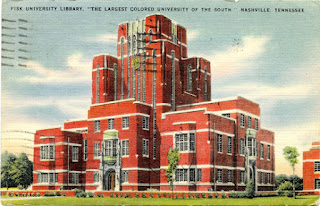

By the late 1920s the Carnegie building was inadequate and a $400,000 grant from the General Education Board made a new library building possible. That building which is shown on the postcard above was completed in the fall of 1930. It was designed by architect Henry C. Hibbs. Then University Librarian Louis S. Shores played a major role in its planning. The building was designed to also serve nearby Meharry Medical College. Provision was also made to include a "Carnegie branch library" for Nashville's black residents. A significant feature of the interior of the building was murals painted by Harlem Renaissance artist Aaron Douglas. 

According to Jessica Carnie Smith's article Arna Bontemps, a Harlem Renaissance writer, became Fisk's first black head librarian in 1943. Bontemps added professional staff and built up special collections at the library. He left Fisk in 1965 and was replaced by Jessica Carney Smith. The need for an even larger library facility resulted in a new 74,000 square foot building that opened in January 1970. it was named the John Hope and Aurelia E. Franklin Library in 2000.

I attended George Peabody College (now part of Vanderbilt University) in Nashville from 1961 to 1965. From 1963 to 1965 I worked part time at the Public Library of Nashville and Davidson County. During that period Arna Bontemps served on the Board of Trustees of the public library. For part of the time his son was also a part-time employee of the public library. In 1965 I applied to the University of Illinois Library School and part of the application process involved an interview with an alumni of the school. Jessica Carney Smith was working at what is now Tennessee State University in Nashville when I applied to the U of I. She had just received her doctorate from the University of Illinois Library School, the first African American to do so, and she conducted my interview. Soon after that Smith became the Librarian at Fisk University.

Tuesday, January 11, 2022

Librarians on a Postcard and Philippine Libraries


Librarians are rarely depicted on postcards so it was amazing to find one that depicted 24 librarians. It was even more amazing to discover the postcard's connection to two important librarians in Philippine library history. The librarians depicted on the postcard were the entire 1922 class of the N. Y. State Library School. That's the library school founded by Melvil Dewey at Columbia University and then moved to the New York State Library in Albany, NY. The library school subsequently moved back to Columbia University. The postcard is a Real Photo Postcard (RPPC) and the photographer was Gustave Lorey who operated a prominent photography studio in Albany. The address side on the postcard is where the two Phillipine librarians come into the story. The postcard is addressed to Miss Mary Polk, Bureau of Science Library, Manila, PI. It is signed "Sincerely yours, Isidoro Saniel". It is dated Mar. 26, 1921 but is not stamped or postmarked. This means it was probably mailed inside an envelope to Manila. I was able to locate a great article on the internet about Mary Polk and her contribution to Philippine librarianship. It was written by Bradley Brazzeal and is titiled "Science Librarianship in Colonial Philippines: Mary Polk and the Philippin Bureau of Science Library, 1903-1924". Brazzeal includes a quote in his article that Polk could "righly be called the mother of Philippine Library Science". He indicates also that the Philippine Association of Academic Research Librarians continues to provide a scholarship in the name of Polk that "honors the life and accomplishments of Mary Polk, the first librarian of the University of the Philippines, who started the first formal library science training program in the same university". Brazzeal's article also explains the connection between Mary Polk and Isidoro Saniel. Saniel was one of several individuals in the Philippines who were sent to library schools in the United States for formal library training. Saniel was sent to the N. Y. State Library School. She returned to play a prominent role in Philippine librarianship, and has written a history of the Philippine Library Association which she helped found. [Saniel, Isidoro. “Forty-Nine Years of the Philippine Library Association.” The Journal of Library History (1966-1972), vol. 7, no. 4, University of Texas Press, 1972, pp. 301–12, http://www.jstor.org/stable/25540372.] It is likely that Saniel is one of the class of 1922 depicted on the postcard. The records of the New York State Library School are now located in the Archival Collections of Columbia University Libraries. An enterprising researcher might be able to identify the other members of the class of 1922.

Thursday, January 6, 2022

Two Additional Library People on Postage Stamps


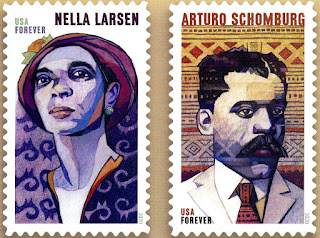
I’ve been collecting libraries and library people on postage stamps for more than 25 years.  I haven’t been as aggressive in my pursuit of these stamps in recent years so I was slow to realize the connection to libraries of two of the stamps in the United State Postal Service “Voices of the Harlem Renaissance” issue of 2020.  Both individuals on the stamps had strong connections to the New York Public Library (NYPL). The first person was Nella Larsen (1891-1964) who was honored as a novelist, but also was a librarian at the NYPL. She worked at three different branch libraries – the 135th Street Branch, the Seward Park Branch, and the Countee Cullen Branch.  She was the first black woman to graduate from the NYPL Library School.  Although not honored as a librarian, Larsen was the first (and only) person with professional librarian credentials to appear on a United States postage stamp.  Wikipedia has a comprehensive entry for Nella Larsen.  The “Little Known Black Librarian Facts” blog has an entry for Larsen with an excellent list of sources.  Bob Sink’s “NYPL Librarians” blog has an interesting post about Ernestine Rose’s role in the integration of branch library staffs including her connection to Larsen. 

Arturo Alfonso Schomburg (1874-1938) was the second person on a stamp with a library connection.  The USPS description of his contributions: “By tirelessly collecting books, documents, artwork, and other materials, Schomburg rescued black history from obscurity and preserved priceless cultural knowledge for future generations.”  His collection was acquired by the New York Public Library and was the foundation for what became the Arthur Schomburg Center for Research in Black Culture. Wikipedia has a nice entry for Schomburg. It is noteworthy that the previously mentioned Ernestine Rose also played a significant role in acquiring and building the Schomburg collection at NYPL. 

Library people especially librarians are rarely recognized on postage stamps for their contributions as library people. Those who are on postage stamps are usually recognized for some other contribution.  On my Library History Buff website which I no longer update because of obsolete software I have several sections devoted to the topic of library people on postage stamps.  They include “Library People on Postage Stamps – An Introduction”, “A Postage Stamp to Honor America’s Librarians”, “U.S. Library People on Postage Stamps”, and “World Library People on Postage Stamps”.

As a collector of libraries and library people on postage stamps I have benefited in my search for these stamps by my membership in the American Topical Association and the Graphics Philately Association.  The Graphics Philately Association publishes a comprehensive list of these and other graphics related postage stamps titled Winnegrad’s Printing on Stamps compiled by Bruce L. Johnson. The Graphics Philately Association also publishes a quarterly publication titled Philateli-Graphics which includes listing of new stamp issues of graphic interest which includes libraries.

Friday, May 5, 2017

The Great Falls (MT) Public Library and Alma Smith Jacobs


Researching a recent acquisition to my postal librariana collection I discovered the story of African American librarian Alma Smith Jacobs (1916-1997) of Montana.  The postal artifact is an envelope (shown above) with an image of the interior of the Carnegie Library in Great Falls, MT covering the entire face of the envelope.  The back of the envelope which was mailed on December 2, 1917 has the address information.  The Great Falls Public Library has an excellent history of the library on its website. It was there that I learned that after serving as a catalog librarian for eight years Alma Jacobs became head librarian in 1954, a post she held until 1973. She left Great Falls to become the Montana State Librarian in Helena where she ended her library career in 1981.  She was the first African American to hold that post. While in Great Falls she led the effort which resulted in the replacement of the Carnegie Library with a new library building in 1967.  The Women’s History Matters website has an excellent overview of Jacobs’ contributions to library and community service in Montana.  In an unusual coincidence of timing I discovered that on April 28, 2017 the Great Falls Public Library dedicated a mural of Jacobs. The library had previously named the library plaza in her honor.  Alma Jacobs was the first African American elected as President of the Montana Library Association, the first elected as President of the Pacific Northwest Library Association, and the first to serve on the Executive Board of the American Library Association. Jacobs’ sister Lucille Smith Thompson was also a prominent African American librarian (Little Known Black Librarian Facts Blog).  

Monday, February 22, 2016

Detroit and ALA

The American Library Association has held its annual conference in Detroit, Michigan on four different occasions. The first of these was in 1922 when ALA met from June 26 to July 1. The attendance at the conference totaled 1,839, and those individuals participated in thirty or more associations, sections and round tables which took place at eleven different locations. One of those locations was the newly completed Detroit Public Library’s main building. Conference attendees were also treated to a special day in Ann Arbor, Michigan where they were able to visit the new library building of the University of Michigan. A report on the conference in Library Journal for July, 1922 noted that this was the first conference where none of those who attended ALA’s first meeting in 1876 were not in attendance (although there were still nine survivors of that conference). George B. Utley took office as ALA’s 36th president at the conference. Utley had previously served as ALA’s Executive Secretary from 1911 to 1920. Among those in attendance was Sallie Lou (Mrs. Joseph A.) Thompson whose conference badge is part of my collection of librariana (see below).  On June 27 the first Newbery Medal, for the most distinguished contribution to American literature for children published in the preceding year, was awarded to Henrick Van Loon for The Story of Mankind.  A publicity committee at the conference recommended the establishment of a National Library Week, something which didn’t take place for another 36 years. At the conference Reverend Thomas Fountain Blue (1866-1935) who served as the first African American to head a branch library (Louisville Free Public Library 1905-1935) also became the first African American to give a speech before the American Library Association. ALA did not meet again in Detroit until 1965. It also met there in 1970 and 1977, two conferences which I personally attended. The 1970 conference was especially memorable for me since it was my second ALA conference and my first as an employed librarian.


Wednesday, August 26, 2015

Mary Salome Cutler Fairchild (1855 - 1921), Library Pioneer

 I recently acquired a letter on the stationery of the United States Hotel in Boston dated June 27, 1886 from George T. Cutler to his sister Mary Salome Cutler (later Mary Salome Cutler Fairchild). Salome, as she preferred to be called, was one of the outstanding American librarians of the 19th century. She was one of “40 leaders of the library movement” selected for a Library Hall of Fame by Library Journal in 1951 as part of the 75th anniversary celebration of the American Library Association. Salome Fairchild is also included in the Dictionary of American Library Biography (Libraries Unlimited, 1978) which has a comprehensive biography by Budd L. Gambee. Fairchild was hired by Melvil Dewey in 1884 as a cataloger for the Columbia College Library, and she also served as an instructor in cataloging at the library school founded by Dewey at Columbia. She followed Dewey to the New York State Library when the library school was moved from Columbia to New York in 1889. Fairchild became vice-director of the library school in 1891, and served in that capacity until 1905. As vice-director Fairchild was responsible for the day-to-day operations of the library school and also maintained a heavy teaching load at the school. In his biography of Fairchild, Gambee writes: “The inspirational quality of her teaching was highly praised by her contemporaries. Her enthusiasm and her faith in the perfectibility of mankind sustained her missionary zeal for the library movement. Her specialties were cataloging book selection, and a seminar that combined library history with a study of contemporary libraries.”  Fairchild was also in charge of the New York State Library for the Blind. In his biography about Dewey Irrepressible Reformer (ALA, 1996) Wayne A. Wiegand notes that Fairchild and Dewey had significant philosophical differences in regard to the their approach to library education. Dewey emphasized the practical aspect of instruction whereas Fairchild advocated for a more theoretical and cultural approach. Fairchild was an active member of ALA and served as vice-president in 1894-95 and 1900-1901. One of her major contributions to ALA was serving as chair of the committee which arranged the ALA exhibit at the World’s Columbian Exposition in Chicago in 1893 which included a model library. An annotated book selection list created for the exhibit was the first of several that became known as the A.L.A. Catalogs. The Wikipedia entry for Fairchild includes an interesting section on her 1904 study of “Women in American Libraries”.  The 1886 letter to Cutler/Fairchild from her brother includes advice to her about her upcoming extended trip to the Mid-west and information about financing the trip. There is only one library reference in the letter. At the end her brother writes, “I got the bulletin from Library Bureau.” I’m happy to have this artifact with a connection to this great library lady.


Monday, November 10, 2014

WI Library Hall of Fame 2014 Inductees

One of my most rewarding activities as Chair of the Steering Committee of the Wisconsin Library Heritage Center is participating in the selection of inductees into the Wisconsin Library Hall of Fame. Five individuals were inducted into the Wisconsin Library Hall of Fame on November 6 at the Wisconsin Library Association Annual Conference in Wisconsin Dells. The Library Hall of Fame is a program of the WLA Foundation and the Wisconsin Library Heritage Center. The inductees are:

Gilbert Harry Doane (1897-1980) served as Director of the University of Wisconsin – Madison General Library (1937-1943 & 1945-1956) and as Director of the UW-Madison Library School (1938-1941). He was head of the UW-Madison Archives program (1956-1962). He served in the U.S. Army’s World War II Monuments, Fine Arts, and Archives (“Monuments Men”) Project (1943-1945).

Wilbur Lyle Eberhart (1922-2010) was the first administrator of the Division for Library Services in the Wisconsin Department of Public Instruction after the Wisconsin Free Library Commission was abolished. He served in this capacity from 1965 to 1981 which included the period when Wisconsin’s public library system legislation was passed and implemented.

Peter G. Hamon (1945- ) served as Director of the South Central Library System (1981-2005). He was active in promoting statewide library legislation and funding, and served as President (1991) and as Legislative Advocate for the Wisconsin Library Association. He was honored as WLA/DEMCO Librarian of the Year in 2004.

Nolan I. Neds (1921-2006) served as Supervisor of Neighborhood Libraries and Extension and as Deputy City Librarian of the Milwaukee Public Library (1965-1982).  He was a champion of  library service to the underserved in Milwaukee County, the State, and the nation. He was active in the Wisconsin Library Association and served as President (1970-1971).

Gertrude Thurow (1906-1993) served as Director of the La Crosse Public Library (1953-1975) and was instrumental in establishing the predecessors of the Winding Rivers Library System (1965-1975). She served as President of the Wisconsin Library (1955-56). Thurow was honored as WLA Librarian of the Year in 1959, and received WLA’s Special Service Award in1975.


Monday, July 28, 2014

Gilbert H. Doane, Librarian and Monuments Man


The story of the World War II "Monuments Men", a special Army unit created to help recover art treasures looted my the Nazis, has become well known due to the George Clooney film this year. One of the monuments men was Gilbert H. Doane (1897-1980), Librarian of the University of Wisconsin - Madison from 1937 to 1956. Doane took a leave of absence in 1943-1945 to serve in what was officially known as the Army's Monuments, Fine Arts, and Archives (MFAA) program. Although I knew that Doane had served as Librarian of UW-Madison, I didn't know about the monuments men connection until I did some research as the result of a recently acquired airmail letter postal card  sent to Doane from Mexico in 1940 (see above). The letter was sent by a friend of Doane's with the initials D.P. The friend is an artist and the letter updates Doane on the friend's artistic activities including an upcoming show in San Francisco. Doane left the Army with the rank of Major. When he stepped down from his post as UW Librarian he was ordained as an Episcopal priest, and in 1957 he returned to UW as the University Archivist, a post he held until 1962. There is an excellent post about Doane on the UW Archives blog, and also a great post on the Bibliophemera blog.    

Saturday, June 21, 2014

WWI Camp Librarians Exchange Postcards


Through the generosity of a fellow collector (thanks Al) I recently acquired a group of 5 postcards which were mailed from ALA Library War Service camp librarians in WWI to the camp library in Camp Funston, KS. All of the postcards were published by the American Library Association and all depicted the camp library of the librarian mailing the card. The cards were from Camp Wheeler, GA; Camp Sevier, SC; Camp Lewis, WA; Camp Dodge, IA; and Camp Greene, NC. The librarian at Camp Funston was George W. Fuller. Three of the cards request a postcard in exchange from Camp Funston. Two just extend "Greetings". The card from Camp Wheeler (shown above) is signed by Frederick Goodell, and says, "May I ask you to send me a view of your library for a libraries exhibit?". ALA published postcards of the exterior of almost all of its camp libraries in the United States, and some postcards of the interiors of camp libraries. I have a collection that includes many of the camp library postcards. These 5 are especially nice since they are used and have a direct connection to the libraries. I have a couple of other postcards in my collection that request an exchange of postcards so I think this was a fairly common thing for camp librarians to do. Most camp librarians took a temporary leave from their regular library job to serve in this capacity. Almost all were ALA members and most continued their career as librarians after serving as a camp librarian. More information about the ALA Library War Service and its postcards can be found HERE.  

Tuesday, June 17, 2014

Harry Clemons, Representative of the ALA War Service in Siberia


On Nov. 6, 1918 Harry Clemons, Professor and Librarian at Nanking University in Nanking, China received the following cable from R.L. Raney, Director of Overseas Library Service for the ALA Library War Service in Washington, DC:
"Will you accept appointment official representative American Library Association Vladivostok to develop library service for American forces in Russia? Books being shipped steadily. Will meet all expenses and guarantee against salary loss. Cable Libcon, Washington." Clemons responded the next day with, "Will attempt library service when you direct. University desires my return by May." Thus began what must be one of the most amazing efforts by a single individual on behalf of the American Library Association. I have written previously about the work of Harry Clemons in Siberia, but recently I became aware of an envelope (shown above) mailed by Clemons shortly after his arrival in Vladivostok. This prompted me to do another post. One of the specialties in philately is the collection and study of military postal history. Examples of envelopes mailed by men in the American forces in Siberia during World War I are among the scarcest and most sought after by collectors. The envelope above may be the only envelope mailed by Clemons as ALA's representative in existence in private hands. It is part of the collection of Al Kugel, one of the world's most respected military postal historians. I appreciate his letting me use the image of the envelope in this post. Clemons mailed many letters to the American Library Association while in Siberia and they were compiled in a book titled appropriately The A.L.A. in Siberia. A copy of the book can be found on the Hathi Trust site. In the foreword to the book H. B. Van Hoesen who edited the book noted that Clemon's report on his work to the Commanding General "shows the activity as well as the activities of the A.L.A. Library War Service in Siberia; how in five months, one man was able to handle some ten thousand volumes (plus 10 boxes, 194 parcels, 75 mail sacks, not counting discarded magazines), unpacking censoring, sorting, cataloguing, and repacking; to distribute and organize these into a system of over fifty branches scattered all the way from the Yangtse Valley to no one knows how far towards the German frontier (not to mention gift distribution); and at the same time to act as reference department and superintendent of no inconsiderable circulation; and, on top of all this, to produce, in slow longhand manuscript, and in spite of obstacles like frozen ink, etc., a series of reports of real historical value among the chief literary "by-products" of the Library War Service." The compilation of Clemons letters was distributed to all the attendees of the 1919 ALA Conference in Asbury Park, NJ. After his service in Siberia Clemons returned to Nanking University where he worked until 1927. He then became Librarian of the University of Virginia Library in Charlottesville,VA where he worked until his retirement in 1950. Clemons is included in the Dictionary of American Library Biography (Libraries Unlimited, 1978).

Monday, April 28, 2014

The Library Postcard Collection of Phoebe Hayes (1905-1975)


At a postcard show in Madison, WI this past weekend I acquired a collection of 30 library postcards that were at one time part of a collection owned by Phoebe Hayes, a librarian who ended her library career around 1970 as Director of the Bibliographical Center for Research in Denver, CO. The postcards that I acquired have all been used and for the most part are addressed to Hayes or one of the libraries where she worked. They date from 1930 to 1970 and have a variety of messages mostly with a library connection. I particularly prize these kinds of postcards. I was able to cross check Hayes' entry in the 1970 edition of A Biographical Directory of Librarians in the United States and Canada published by ALA with the postcard addresses. Her education and library work included the Univ. of Wisconsin, the University of Chicago, the Univ. of Denver, the Joint Reference Library in Chicago, and the Library of the Bureau of the Budget in DC in addition to the BCR in Denver.  It is apparent that her colleagues knew of her interest in library postcards and shared postcards with her that they found or received. The postcard above was sent to Hayes in Chicago (where she was a student) from a friend in Boulder, CO on June 18, 1941. The postcard depicts the Library of the University of Colorado. The message begins with "Another 'library' for your collection." I'll probably share some other postcards from her collection in the future. I've compiled lists of current and former library postcard collectors that I know about. 

Tuesday, January 14, 2014

Robert Wedgeworth and ALA


Robert Wedgeworth served as Executive Director of the American Library Association from 1972-1985. His tenure at ALA followed that of David Clift who had served from 1951-1972. A biography on the ALA website says this about Wedgeworth's accomplishments as Executive Director: "Assuming the leadership of ALA during a turbulent period of internal strife, he led the effort to democratize the Association and gave it new visibility and credibility nationally and internationally. Under his leadership the Association grew from 28,000 members to over 40,000. He developed a new Headquarters building in a joint venture that more than doubled the value of its property and produced a $3 million windfall profit in 1999. With the demise of the National Book Committee, Wedgeworth negotiated with the publishing industry to bring the National Library Week program to the ALA. It quickly became a nationally visible marketing tool and the third major revenue source for the Association." I have a couple of artifacts in my librariana collection related to Wedgeworth. The first (shown above) is a metal admissions ticket to a reception in honor of Wedgeworth at the 104th Annual Conference of ALA in Chicago on July 6 1985 at the Chicago Public Library. The second (shown below) is a First Day Cover for the America's Libraries postage stamp that was issued on July 13, 1982 at the ALA Conference in Philadelphia. Wedgeworth along with then ALA President Betty Stone signed the cover. The signed First Day Covers were available for sale for $3 and according to an article in American Libraries they sold like hotcakes. After leaving ALA Wedgeworth became Dean of the School of Library Service at Columbia University and later served as University Librarian and Professor of Library and Information Science at the University of Illinois at Champaign-Urbana. Early in his library career Wedgeworth was one of the librarians who helped staff ALA's "Library-21" exhibit at the Seattle World's Fair in 1962. 


Thursday, December 5, 2013

John Edmands (1820-1915), Philadelphia Librarian

The Mercantile Library Company of Philadelphia which was the topic of my previous post was led by its Librarian John Edmands from 1856 to 1901, a total of 45 years. He was made Librarian Emeritus in 1901 and continued to be active in the affairs of the library until his death in 1915. I have in my collection the 1915 annual report of the Mercantile Library which includes a tribute to the contributions of Edmands. The photograph of Edmands in the reading room of the Mercantile Library shown above is from that report. When Edmands became Librarian the collection totaled 13,000 volumes. At his retirement the collection totaled 185,000 volumes. Edmands was a founding member of the American Library Association in 1876 and served as its Vice President at one point. He developed a system for classifying books for the Mercantile Library in 1882 which grouped books by subject.

Wednesday, October 9, 2013

Library Halls of Fame

There are halls of fame to recognize human accomplishment in every conceivable endeavor. There are even a few library halls of fame. Two state library halls of fame have recently announced inductees for 2013. The California Library Hall of Fame will be inducting nine individuals at the Awards Gala at the California Library Association meeting on November 3rd. The inductees are listed on the California Library Hall of Fame website. The Wisconsin Library Hall of Fame will be inducting four individuals at the Awards Reception at the Wisconsin Library Association meeting on October 23rd. The announcement of the Wisconsin inductees is located here. A full listing of current and former inductees is included on the Wisconsin Library Hall of Fame website. The Massachusetts Library Association has a Hall of Fame also. Inductees through 2012 are listed on their website. The American Association of Law Libraries also has a Hall of Fame. Inductees including 2013 inductees are listed on their website. The Oklahoma Library Association has a Library Legend Award whose purpose is to expand a list of 100 library legends that were selected in 2007 for the Association's centennial. The Library Journal compiled a list of 40 individuals in 1951 for a Library Hall of Fame. The Dictionary of American Library Biography ((Libraries Unlimited, 1978) and its two supplements (1990 and 2003) constitute for all practical purposes an American Library Hall of Fame.

Thursday, August 22, 2013

Library Power and Jean-Baptiste Colbert (1619-1683)

At the American Library Association Conference in Chicago this summer I attended the Edward G. Holley Lecture of the Library History Round Table. It waa a presentation by Jacob Soll, Professor of History and Accounting at the University of Southern California. The title of his presentation was "Library of Power, Library of Enlightenment: Libraries as Foundations to the Modern State 1400-1806". The lecture was far more entertaining than its title would indicate. A big portion of the lecture dealt with Jean-Baptiste Colbert, a 17th century Frenchman who was one of the first significant political figures to realize the power of libraries and to make use of that power.  Starting in 1661 he served in a number of capacities under King Louis XIV, most notably as Controller General and Finance. As Superintendent of Buildings he was supervisor of the Royal Library, the predecessor of the Bibliotheque Nationale.  Colbert also built an extensive personal library that he used to help administer the French State.  Soll is author of The Information Master: Jean-Baptiste Colbert's Secret Intelligence System (Univ. of Michigan Press, 2011).  According to Soll Colbert, "Believed that all knowledge had practical value for politics." I collect postage stamps stamps that depict librarians or other library people.  Colbert is one of those people. He was depicted on a French stamp issued in 1944 (see above). Thanks to Soll I know a lot more about Colbert. For my list of library people on postage stamps (outside of the U.S.) go HERE.

Thursday, May 30, 2013

Bookplates and Hiram E. Deats

Hiram Edmund Deats (1870-1963) was an important figure in both the philatelic world and the library world which makes him of special interest to a collector of postal librariana. I wrote a previous post about Deats on March 12, 2011. This post is prompted by my acquisition of two artifacts that relate to the interest of Deats in bookplates. The first is his personal bookplate (on the left). The bookplate was designed by Edmund Henry Garrett. The bookplate shows the Greek deity Hermes bowing before four women representing four continents. On the lower right of the bookplate is a group of books including a stamp album. A copy of the bookplate is included in the collection of the Rare Book & Manuscript Library of the University of Illinois Champaign-Urbana.  [Note: This bookplate also exists in a reddish color. Deats had at least three other personal bookplates at various times in his life.] The second artifact (see below) is a postal card mailed from Plymouth, England to Deats at his home in Flemington, NJ on July 20, 1893. The postal card was mailed by W. H. K. Wright, Secretary of the Ex Libris Society in London, England (which became defunct in 1908) and Editor of the Journal of the Ex Libris Society. Wright covers two topics in his message on the postal card to Deats. The first topic relates to the book Ex Libris Imaginaire which he has purchased for Deats from its author L. Joly of Paris, France. The second topic concerns a lot of 1800 bookplate examples which Wright has sent to Deats in "three packets securely fastened and sealed".  Wright refers to this lot of bookplates as the "last lot" which indicates that previous lots had been sent. I came across an entry in WorldCat for a publication authored by Deats titled The collection of American and foreign bookplates of H. E. Deats ...sold 1909. A microfilm copy is located in the New York Public Library. More about the philatelic and library connections of Hiram E. Deats can be found in this article in the American Philatelist.   I also have a page on the Library History Buff website with more information about Deats.


Wednesday, February 13, 2013

John Cotton Dana's Tenure in Springfield, MA


John Cotton Dana ((1856-1929) was one of our profession's greatest librarians and humorists (see previous blog post). Dana began his library career at the Denver Public Library with a number of innovations and ended his career at the Newark (NJ) Public Library where he established a lasting legacy. Between those two jobs he served as City Librarian for the Springfield (MA) City Library Association from January, 1898 to December, 1901. He began work in a building that was inhospitable to library users (see the image above, from a stereoview in my collection) and he made several modifications to improve access including the addition of an elevator. The City Library Association was also responsible for an Art Museum and a Museum of Natural History. When Dana accepted the job he thought that he would also be in charge of those two entities. This was not the case and it led to a conflict with the curator of the Art Museum, a wealthy art collector. While in Springfield Dana's stature in the library profession continued to grow even as he challenged the hierarchy in the American Library Association. Dana's humor was alive and well in Springfield also. In correspondence with Mary E. Ahern, editor of the Public Libraries journal, he wrote this after a trip to England: "The Duke of Devonshire and the Marquis of Salisbury were both out of town while I was in London but I talked over the back fence with their porters and so was enabled to convey to them such information as I thought they needed. In one way or another I learned things about the Prince of Wales and his set, that I consider quite scandalous. I am sure you would be quite shocked and very ready to refuse to have anything more to do with them. I am inclined myself never to go to England again for the reasons I hint at and I should advise you to stay away too." [source for quote: John Cotton Dana - A Sketch by Chalmers Hadley (ALA, 1943)]. Dana's reputation brought him regular job offers from other libraries and he finally decided to move on to Newark, NJ. The envelope shown above was sent to Dana on March 28, 1899 while he was still in Springfield. It was sent by the Egypt Exploration Fund in Boston. It's nice to have an artifact in my collection that has a direct connection to Dana.

Saturday, February 2, 2013

Patrick Magruder and the Burning of the Library of Congress

 Patrick Magruder (1768-1819) was the second Librarian of Congress and served in that capacity from 1807-1815. He served both as the Clerk of the House and as Librarian of Congress as had his predecessor. Magruder had the misfortune of serving in those capacities at the time the Capitol of the United States was burned by the British during the War of 1812. At the time of the burning of the Capitol in August of 1814 Magruder was absent from Washington, D.C. for health reasons. He left the Office of the House and the Library of Congress in the charge of his brother George Magruder and two assistants. In addition to the books in the Library of Congress Patrick Magruder's office records which included the financial records of the House of Representative were destroyed. A Congressional investigation into Magruder's handling of Congressional funds found discrepancies including a shortage of $20,000. Although Magruder managed to avoid prosecution for his actions, he resigned on January 28, 1815. I have in my collection an 1814 government publication which contains a letter from Patrick Magruder to the Speaker of the House in defense of his actions which in turn includes an account by two office assistants of the events leading to the destruction of the Office of the House and the Library of Congress. Their account says in part, "every thing belonging to the office, together with the library of congress, we venture to say, might have been removed in time, if carriages could have been procured, but it was altogether impossible to procure them, either for hire or by force." After Magruder's resignation the positions of Clerk of the House and Librarian of Congress were separated. The source of the information in this post is the Library of Congress website.

Thursday, January 24, 2013

50 Years of Working in Libraries


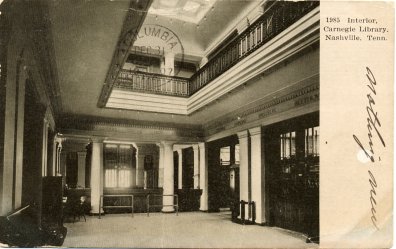
This month marks a significant personal anniversary for me. Fifty years ago this month I took a job at the Nashville (TN) Public Library (see library history), and as they say, the rest is library history. It was only by chance that I got the job as a library clerk/page. I had put in a generic application for a job with the City of Nashville several months before, and was surprised when I got a call from the public library asking me if I would be interested in working at the library. I started work in the historic Carnegie library building (shown in the postcards above), but that only lasted a few months before the library moved to temporary quarters while the Carnegie was razed and a new building was built. At the time I was a sophomore at Peabody College, and I ended up working at the public library through the summer following my graduation from Peabody. My experience at the Nashville Public Library was the major reason I became a librarian. At the time Peabody had an ALA accredited library school and I was able to take four core library science courses as an undergraduate before going to the University of Illinois for graduate library school. Over the course of the two and a half years that I worked at the Nashville Public Library I performed almost every task you can perform in a library from mending books to working on the reference desk. It was a true apprenticeship. An unusual aspect of working at the library was the arrangement that permanent full time employees only worked during week days and a part-time crew worked at night and on the weekends. At least two of my fellow part-time workers went on to hold significant library administrative positions. The children's librarian, the only professional librarian on duty in the evening, later became director of the Nashville Public Library. It was a great starting position in library work and it was an experience I will always treasure.

Thursday, December 13, 2012

John Cotton Dana and Newark Public Library Bookplates

I was very happy to add the colorful and attractive bookplate for the Newark (NJ) Public Library (shown to the left) to my collection recently. The legendary early library leader John Cotton Dana was Director of the Newark Public Library. Two posts on the blog "Confessions of a Bookplate Junkie" had made me aware of the interest of John Cotton Dana in bookplates. In the first post, Lew Jaffe, publisher of the blog, featured a bookplate for Dana's personal library and requested assistance in identifying the designer of the bookplate. In the second post, Chad Leinaweaver from Newark Public Library's Special Collections Division surmised that Dana may have designed the bookplate himself, and shared another Dana bookplate. He noted that Dana had designed bookplates for the Newark Public Library. As part of a sesquicentennial celebration of John Cotton Dana in 2006, the Newark Public Library created a publication (PDF) which highlighted some of the bookplates personally designed by Dana. On my bookplate, the name Frank M. Snyder appears in the lower right hand corner of the plate. Snyder was an architect and publisher. Dana who was greatly interested in graphic design likely recruited Snyder to design the bookplate. Click here to see my other blog posts about library bookplates and here to see my website page on library bookplates.