Showing posts with label First Day Cover. Show all posts

Friday, August 12, 2022

America's First First Day Covers

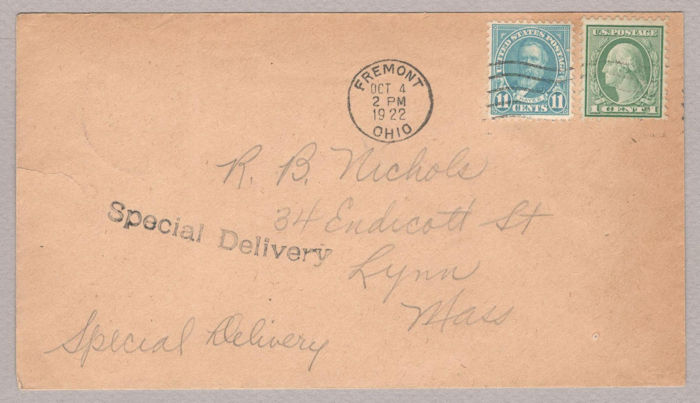
I'm a member of the United States Stamp Society. One of the most important benefits of being a member is receiving their monthly journal The United States Specialist. It is a wonderful source of philatelic information about postage stamps of the United States. The August issue for 2022 contained an especially interesting and informative article by Jay Stotts titled "One Collector's Fourth Bureau Issue Top Ten List". The Fourth Bureau set of stamps was first issued in 1922 and continued until 1938. Among Stotts' top ten list of these stamps were two that were of special interest to me. The first was the 11 cent Rutherford B. Hayes stamp which was issued by the United States Post Office Department (USPOD) on October 4, 1922. A special First Day of Issue ceremony was held for the stamp in Fremont, Ohio, the location of the Rutherford B. Hayes Presidential Library. First day covers were processed with the Hayes stamp and canceled with a Fremont, Ohio, October 4, 1922 cancel. One of those covers is shown above. The image is provided with the courtesy of Jay Stotts. According to Stotts this began the practice of holding first day of issue ceremonies and mailing first day covers at the site of the ceremony which continues to this date. I collect postal artifacts related to America's presidential libraries and have shown an exhibit of those items at several stamp shows. Jay told me that in his opinion the Fremont first day ceremony at the Hayes Library was in his eyes, a key philatelic event involving a presidential library. Which makes the Hayes first day cover a highly desirable item for my exhibit. If only I could afford one. 

Jerry Katz has a fantastic site on the  FDCs of the 11¢ Hayes Postage Stamp of 1922.

The second item in Jay's top ten list of particular interest to me is a first day cover featuring the 1923 2 cent Warren G. Harding stamp which was issued by the USPOD on September 1, 1923. This cover is considered to be America's first cacheted first day cover. It was produced by George W. Linn, the founder of Linn's Stamp News. A cachet in philately is any kind of illustration or printed information on a cover (envelope) that is not related to the cancellation, postmark, or address. The cachet on Linn's first day cover includes printed information about Harding. The cover is also a mourning cover. An example of the cover is shown below. 


Monday, August 8, 2022

Anon E Mouse Library Covers


In July I attended the Minnesota Stamp Expo. A highlight of the show was the philatelic exhibits which included a number of exhibits of first day covers. One of the first day cover exhibits was titled "How Now Brown Mouse? - The Evolution of Anon E. Mouse Cachets". The exhibit was the work of Cynthia Scott the creator of Anon E. Mouse Cachets. I collect and exhibit first day covers for library stamps and I was delighted to find a first day cover for one of those stamps in Cynthia's exhibit. It was the first day cover for the 1982 Library of Congress stamp which is shown above. I own a copy of that cover as well as Cynthia's cover for the 1982 America's Libraries stamp, also shown above. Cynthia has an amazing website which in addition to serving as a vehicle for marketing her covers also explains how she produces the covers. For the two covers above, she drew the cachet (illustration) designs using pen and pencil on a small sheet of paper which she inserted into multiple envelopes one at a time. Using a light box she then traced the original design on the envelopes. She then hand colored the designs on the envelopes. All of Cynthia's first day covers include an image of a small mouse. Cynthia received a gold medal for her exhibit in Minnesota. She has a copy of the exhibit on her website. I have a first day cover exhibit for the America's Libraries stamp which includes Cynthia's cover for that stamp.

The American First Day Cover Society (AFDCS) has lots of excellent information for anyone interested in learning more about first day covers.


Wednesday, July 13, 2022

40th Anniversary of the Stamp Honoring America's Libraries

Forty years ago on July 13, 1982 the United States Postal Service (USPS) issued a postage stamp honoring  America's libraries. It was the result of years of lobbying by the library profession for such a stamp. A first day of issue ceremony for the stamp was held in Philadelphia at the annual conference of the American Library Association (ALA). Originally the stamp was supposed to also honor the Library of Congress, but Librarian of Congress Daniel Borstin persuaded the USPS to issue a separate stamp for the Library of Congress. That stamp was issued on April 21, 1982. I previously wrote a post about that stamp. Both stamps were designed by Bradbury Thompson, one of the world's great graphic designers and typographers. ALA, led by its President Betty Stone, went all out to promote the America's Libraries stamp. This included producing a first day cover (FDC) for the stamp (shown above) which was sold in various configurations. The one above is signed by Stone and ALA Executive Director Robert Wedgeworth. The cover included an insert with information about ALA. ALA contracted with ArtCraft, the major publisher of FDCs, to design and print its FDC. Over a hundred other FDC producers (called cachet makers) also designed an FDC for the America's Libraries stamp. I collect the different FDCs for the America's Libraries stamp and I have developed an exhibit of those covers which I have shown at national level stamp shows. Among the most sought after FDCs by collectors are those that are hand drawn and painted. The one below was created by arguably the most famous cachet maker Dorothy Knapp.  I wrote an article titled "Bradbury Thompson's 1982 Library Stamps" for the July issue of PHILATELI-GRAPHICS, the publication of the Graphics Philately Association of the American Topical Association


Thursday, April 21, 2022

The 1982 Library of Congress Stamp

On this day (April 21, 1982) forty years ago the United States Postal Service issued a stamp honoring the Library of Congress. It was significant in that it was the first United States stamp to specifically honor a library. Although there had been previous postage stamps on which library buildings had appeared, those were issued to commemorate academic and other institutions or architects. Originally, the proposed stamp was to commemorate all of America's libraries collectively and the Library of Congress individually. Librarian of Congress Daniel J. Boorstin wasn't happy with the design of the stamp, however, and the Postmaster General agreed to issue a separate stamp for the Library of Congress. The stamp honoring America’s Libraries collectively was issued on July 13,1982 at the conference of the American Library Association in Philadelphia. Both stamps were designed by noted graphics designer Bradbury Thompson. I have a large collection of first day covers for both stamps. One of my favorites for the Library of Congress issue is shown above. It was the Library of Congress Philatelic Club Cachet Number 1. The illustration on the envelope (called a cachet) is a pen and ink drawing by Paul Boswell.  Boswell was a staff member at the Library of Congress where he worked for 46 years. Bowell was also a poet and in 1994 Boswell published a book of his poems and drawings titled No Anchovies on the Moon: Three Score and Ten Washington Pictures and Poems. Boswell died in 1994. The first day cover is signed by Boswell and Librarian of Congress Daniel J. Boorstin. 

The Library of Congress Philatelic Club produced first day covers for 18 different stamp issues. Their second first day cover cachet was for the America’s Libraries stamp.

I also published a blog post on the 30th anniversary of the issue of the Library of Congress stamp.


Wednesday, February 2, 2022

Charles Winter Wood, Tuskegee Institute Librarian


The un-mailed undivided back postcard above has several different stories to tell. It includes a picture of Charles Winter Wood (1869-1953) who is identified as the Librarian for the Carnegie Library of the Tuskegee Institute in Alabama. There is little information, however, about Wood's role as a librarian on the Internet. There is an article about Wood's connection with Beloit College in Wisconsin, something that caught me by surprise. Booker T. Washington hired Wood as head of Tuskegee Institute's English and Drama Departments in 1897, a capacity in which he served for over 30 years. In 1900 the Tuskegee Institute received the first of 15 grants made by Andrew Carnegie for  library buildings for  Historically Black Colleges & Universities (HBCUs). The Carnegie Library building is shown on the postcard above. Wood assumed the additional role of Librarian for the Tuskegee Institute in 1904. It is not clear how long he maintained this dual responsibility but the postcard was copyrighted in 1907. Outside of his academic responsibilities at the Tuskegee Institute, Wood is most noted for his acting career which was significant. The Charles Winter Wood Theater at Florida A&M University is named for him. Shaundra Walker has written an interesting article about Andrew Carnegie's library grants to HBCUs. There is also an interesting project at the University of Southern Mississippi about Carnegies grants for public library buildings that served African Americans. 

First day cover for the 1948 Booker T. Washington stamp. Includes a picture of the Tuskegee Institute faculty in front of the Carnegie Library. 

Tuesday, December 28, 2021

Smithsonian 175

It would be a shame to leave 2021 without acknowledging the 175th anniversary of the Smithsonian Institution, one of America’s great cultural institutions.  On August 10, 1846, the U.S. Senate passed the act organizing the Smithsonian Institution, which was signed into law by President James K. Polk. I wrote a previous post about Charles Coffin Jewett who was the first librarian of the Smithsonian. Jewett thought the Smithsonian should be a national library, but the Smithsonian’s secretary disagreed.  This led to Jewett’s dismissal in 1855.  The iconic Smithsonian building known as the “Castle” was actually designed to include a library and reading room. In 1866 the Smithsonian’s library collection was moved to the Library of Congress and became known as the “Smithsonian Deposit”.  The Smithsonian eventually reestablished a library of its own which is now the Smithsonian Libraries and Archives. The Smithsonian presents multiple opportunities to the collector of postal artifacts. These include items related to the postal history of the Smithsonian, items related to the three postage stamps issued by the United States Postal System, and postcards.  I have examples of all of these in my personal collection. Some are shown below.  For postcard collectors, there is an exceptional section of the Smithsonian website titled “Greetings from the Smithsonian” which combines the history of the Smithsonian with the history of postcards. You will need to click on the Menu at the bottom of the introductory page to see the full expanse of the history.

Cover circa 1870s mailed by Smithsonian to Chicago

First Day Cover for 1996 stamp combined with 1946 stamp

First Day Cover for 1980 stamp


Wednesday, September 14, 2016

Super Neat Library Centennial Envelopes


As those who follow this blog know, I collect library related envelopes (called covers by collectors) of all types.  My largest collection of these envelopes consists of those which have actually been sent either to or from libraries.  I also collect envelopes, however, that have been specially created for collectors to celebrate the issuance of a new stamp (first day covers) or to celebrate a special event. I have recently acquired a collection of envelopes that were created by Joshua McGee to celebrate the centennials of libraries. So far McGee has created envelopes for 25 libraries and plans to continue creating them in the future.  I’m impressed by the effort McGee, a non-librarian, has undertaken to create the envelopes.  The envelope shown above is an example that features the Paulding County Carnegie Library in Paulding, OH which was established on March 3, 1916.  After research to identify the centennial date of establishment for the library, McGee had to design the envelope, add appropriate stamps, and get the envelope to the post office in Paulding, OH to postmark the envelope on the date of establishment.  I especially like the use of the 1982 America’s Libraries postage stamp, one of my favorites.  McGee only creates six envelopes for each library. He sends one of the envelopes as a gift to the library and keeps one for himself.  The other four are available for sale on eBay or by subscription which is how I acquired my collection. The creation of the library centennial envelopes and other illustrated envelopes is a sideline for McGee who is a software engineer. All of the library centennial envelopes are shown on McGee’s website and more information about each library can be found by clicking on the images of the envelope.

Wednesday, August 17, 2016

IFLA Bibliophilately


The International Federation of Library Associations (IFLA) is holding its 82nd General Conference and Assembly in Columbus, Ohio this week.  The first such conference took place in Rome, Italy in 1928. At past conferences, several host countries have recognized the IFLA conference with postage stamps and other postal artifacts. These include:  Belgium in 1977 on the 50th anniversary of IFLA; the Philippines in 1980; Kenya in 1984; Japan in 1986; and Vatican City in 2009 when IFLA met in Milan, Italy.  Images of these items can be found in a previous post that I made about IFLA bibliophilately. Han Krol has more about the stamps on his Dutch Librariana website (translate with Google translator).  More about the history of IFLA can be found on its website. More about bibliophilately can be found HERE.

Monday, May 16, 2016

ALA Washington Office 1982 First Day Cover


On July 13, 1982 the United States Postal Service (USPS) issued a postage stamp honoring Americas’s Libraries. The first day of issue ceremony for the stamp took place in Philadelphia at the Philadelphia Civic Center in conjunction with the annual meeting of the American Library Association. Participants in the ceremony included ALA President Betty Stone, Keith Doms, Director of the Free Library of Philadelphia, and Jane F. Kennedy, General Manager of the Library Division of the USPS. It is common practice to create special first day covers (envelopes) for new postage stamps that are cancelled with a “First Day of Issue” postmark. These covers usually include a cachet (illustration) and are created by commercial companies, organizations, and individuals. The American Library Association created its own first day cover (see below) which it sold to ALA members and collectors of first day covers.  The Washington Office of ALA also created a first day cover to celebrate the occasion. I’m a collector of first day covers for the 1982 America’s Libraries postage stamp, and I recently had the good fortune to receive as a gift one of the first day cover issued by the ALA Washington Office. Thank you Gail McGovern! The really neat thing about this cover which is shown above is that it is signed by Betty Stone, ALA President, and Eileen Cook, the Director of the ALA Washington Office. The cover includes an insert “An A B C For Dealing With Your Legislators”. The content of the insert was created by Rep. John E. Fogarty of Rhode Island for an ALA Legislative Workshop in 1965.  I wrote a previous post about Eileen Cooke and the other “Extraordinary Women of ALA’s Washington Office”. 


Monday, March 9, 2015

The Extraordinary Women of ALA’s Washington Office


For Women’s History Month I’m writing about a group of women who collectively made an enormous contribution to the improvement of library service in America. These were the women who served as director of the Washington Office of the American Library Association from 1950 through 1999. They were the lobbyists for America’s libraries, and they carried out this role exceptionally well. The ALA Washington Office was established in October of 1945 and celebrates its 70th anniversary this year. Paul Howard became the first director of the office when it opened in 1946 but left in 1949 when ALA closed the office due to lack of funding. It reopened in 1950 under the leadership of Marjorie Malmberg, the first of the women featured in this article. Malmberg had relocated to Virginia with her husband after she had led a successful effort to get state funding for libraries in Wisconsin. Malmberg is credited by her successors for laying the foundation for a politically effective Washington Office and for playing an important role in the effort to secure federal legislation for libraries. Malmberg was followed as director by Alice Dunlap who served a short term (Sept, 1951-Jan 31, 1952), but continued efforts toward federal legislation. Julia Bennett Armistead headed the Washington Office from 1952 through 1957 and helped to finally secure the passage of the Federal Library Services Act (LSA) in 1956. It fell to Germaine Krettek (1907-1994) who became director of the Washington Office in November 1957 to secure the actual funding for rural library service which was authorized under LSA.  President Eisenhower recommended initial funding for LSA of only $3 million, but Krettek led efforts that resulted in an appropriation of $6 million. Also under Krettek leadership, LSA was expanded in 1964 to become the Library Services and Construction Act (LSCA) and included support for urban as well as rural libraries. When Krettek retired in 1972 federal funding for libraries under all federal legislation had increased to $200 million. For her legislative efforts Krettek was honored by ALA with the Joseph W. Lippincott medal in 1969 and was elected to Honorary Membership in ALA (ALA’s highest honor) in 1973. Eileen Cooke who had worked under Krettek in the Washington Office starting in 1964 became director in 1972. Cooke was presented with a major challenge when for fiscal year 1974 President Nixon recommended zero funding for ESEA II, LSCA, and HEA II. Librarians responded to calls from the Washington Office for action and their efforts led to $151.2 million in funding for library programs. Throughout her tenure Cooke fought for the reauthorization and funding for federal legislation that benefited millions of American. Carol Henderson, Cooke’s assistant and successor, called her boss, “the legendary library lady of Capitol Hill”. When ALA celebrated the 50th anniversary of the Washington Office in 1996, Cooke was given Honorary Mermbership in ALA for her distinguished career. Cooke retired in 1993 and was succeeded by Henderson who served until 1999. Under Henderson the Washington Office established the Office of Technology Policy and successfully worked for the passage of the Telecommunications Act of 1996. Emily Sheketoff became director of the Washington Office in 1999 and is the current director. Sheketoff has continued to build successfully on the efforts of her predecessors. The entire library community can be thankful that these enormously talented women were drawn to serve in a leadership role in the Washington Office of the American Library Association.

Friday, February 14, 2014

Exhibiting in Little Rock


I've written several posts about America's presidential libraries including one on my philatelic exhibit about these libraries. My philatelic exhibit is on display this weekend at the American Philatelic Society's Winter stamp show that is taking place in Little Rock, Arkansas. The exhibit is being shown as a non-competitive exhibit at the invitation of the American Philatelic Society. The exhibit is primarily about the presidential libraries that are administered by the National Libraries and Archives Administration (NARA). It is an appropriate exhibit since the Clinton Presidential Library is located in Little Rock. I mailed the exhibit to Little Rock and won't be attending the show myself.  The First Day Cover (FDC) shown above is for the Presidential Libraries stamp that was issued on August 4, 2005. This FDC has a postmark for the Franklin D. Roosevelt Library in Hyde Park, NY, and shows a picture of Roosevelt assisting with the mortaring of the wall of the library on Nov. 19, 1939.  A unique postmark was created for the stamp for each of the  the presidential library sites. The Presidential Libraries stamp commemorated the Presidential Libraries Act of 1955 which authorized the National Archives to take custody of the papers of U.S. presidents.

Tuesday, January 14, 2014

Robert Wedgeworth and ALA


Robert Wedgeworth served as Executive Director of the American Library Association from 1972-1985. His tenure at ALA followed that of David Clift who had served from 1951-1972. A biography on the ALA website says this about Wedgeworth's accomplishments as Executive Director: "Assuming the leadership of ALA during a turbulent period of internal strife, he led the effort to democratize the Association and gave it new visibility and credibility nationally and internationally. Under his leadership the Association grew from 28,000 members to over 40,000. He developed a new Headquarters building in a joint venture that more than doubled the value of its property and produced a $3 million windfall profit in 1999. With the demise of the National Book Committee, Wedgeworth negotiated with the publishing industry to bring the National Library Week program to the ALA. It quickly became a nationally visible marketing tool and the third major revenue source for the Association." I have a couple of artifacts in my librariana collection related to Wedgeworth. The first (shown above) is a metal admissions ticket to a reception in honor of Wedgeworth at the 104th Annual Conference of ALA in Chicago on July 6 1985 at the Chicago Public Library. The second (shown below) is a First Day Cover for the America's Libraries postage stamp that was issued on July 13, 1982 at the ALA Conference in Philadelphia. Wedgeworth along with then ALA President Betty Stone signed the cover. The signed First Day Covers were available for sale for $3 and according to an article in American Libraries they sold like hotcakes. After leaving ALA Wedgeworth became Dean of the School of Library Service at Columbia University and later served as University Librarian and Professor of Library and Information Science at the University of Illinois at Champaign-Urbana. Early in his library career Wedgeworth was one of the librarians who helped staff ALA's "Library-21" exhibit at the Seattle World's Fair in 1962. 


Tuesday, December 24, 2013

Library Lion in Winter


The two lions that grace the entrance to the New York Public Library on 5th Avenue are world famous. In 2000 the United Postal Service was set to issue a stamp to pay the pre-sorted first class postage rate that featured one of the lions without reference to the NYPL. However, the lion image is trademarked by the NYPL, and the USPS was required to identify the New York Public Library on the stamp. Among the postal librariana items that I collect are first day covers and postal uses of the NYPL lion stamp. One of the first day covers (shown above) has a cachet (illustration) by Tom's Cachet Designs which features one of the lions with a Christmas wreath around its neck. I thought this would be an appropriate item to feature on the blog at this time of the year. Season's greetings to all!

Friday, November 22, 2013

50th Anniversary of Kennedy's Assassination

Today is the 50 anniversary of the assassination of John F. Kennedy, and like many people I know exactly where I was when I heard the news. I was a part-time employee of the Metropolitan Library of Nashville and Davidson County (TN), and I was operating the library's telephone switchboard. I was a junior in college and had just turned 20 years old. I collect postal and other memorabilia related to the presidential libraries and have a number of items for Kennedy and the John F. Kennedy Presidential Library & Museum in Boston. Shown above is a first day cover for the 1984 National Archives stamp which features the collection of archival material related to the assassination of Kennedy. Almost immediately after Kennedy's death planning and fundraising for his presidential library was initiated. A thank you card from Jacqueline Kennedy for a donation to the library is shown below. Also shown below is a special event cover (envelope) for the dedication of the library. In a previous post about the 50th anniversary of the inauguration of Kennedy I included an image of a first day cover for the 1964 Kennedy commemorative stamp.


Tuesday, June 18, 2013

ALA and the 1933 World's Fair in Chicago

In 1933, as it had in 1876, 1893, and 1904, the American Library Association chose to hold its annual conference in conjunction with a world's fair.  The 1933 world's fair was the Century of Progress International Exposition in Chicago, Illinois. The conference took place on October 16-21, 1933 with an attendance of 2,986. ALA and libraries, like the rest of America, were facing tough times during the midst of the Great Depression. ALA's budget which had risen to $400,000 in 1926 had been slashed to $232,000 in 1933.  In October of 1932 over 3,000 of ALA's almost 12,000 members failed to pay their dues. Even so, attendees at the ALA Conference were greeted with hospitality and treated to a special ALA Day at the fair on October 19.  Conference attendees just missed one of the more spectacular events at the fair.  On October 26, 1933 the German airship Graf Zeppelin arrived in Chicago and circled Lake Michigan near the fair. Almost eighty years later the American Library Association will again meet in Chicago on June 27 to July 2.  This time under much more favorable circumstances.  The envelope below from my collection is a first day cover for the two postage stamps issued to celebrate the 1933 world's fair. I wrote a previous blog post about a postcard in my collection that was carried on the Graf Zeppelin.

Friday, July 27, 2012

Postal Recognition of IFLA Conferences

The World Library and Information Conference of the International Federation of Library Associations and Institutions (IFLA) will take place in Helsinki, Finland on August 11-17. This will be the 78th IFLA General Conference and Assembly. The first such conference took place in Rome, Italy in 1928. In the past, several host countries have  recognized the IFLA conference with postage stamps and other postal artifacts. These include:  Belgium in 1977 on the 50th anniversary of IFLA; the Philippines in 1980; Kenya in 1984; Japan in 1986; and more recently Vatican City in 2009 when IFLA met in Milan, Italy. Han Krol has more about the stamps on his Dutch Librariana website (translate with Google translator). Some items from my postal librariana collection are shown below.


Saturday, May 26, 2012

Mail Art


It doesn't take much to send me off on a tangent. This time it was a small label (2 3/4" x 3 1/2") which requested information about publications related to mail art. The label was distributed by John Held, Jr of the Fine arts Division of the Dallas Public Library in 1988 and was designed to be affixed to an envelope. Held's purpose was to develop "An Annotated Bibliography of Mail Art".  Held received hundreds of responses to his request and later published the results in the book Mail Art: An Annotated Bibliography (Scarecrow Press, 1991). What is mail art? [see Wikipedia's answer] [see Oberlin College's answer] Mail art encompasses a broad range of art forms. There is, of course, the official mail art of governments which takes the form of postage stamps. Artists and graphic designers from around the world design thousands of these each year. I had an earlier post about my favorite library postage stamp designer Bradbury Thompson. Another common mail art form is illustrated envelopes that are designed by cachet makers for the first day of issue of a new postage stamp. These are commonly called first day covers. I have hundreds of first day covers for library postage stamps in my collection. One of my favorite first day covers is for the 1982 Library of Congress postage stamp which is shown above. It was hand painted by cachet maker Judith Fogt. There is a more avant-garde aspect to mail art, however, and John Held is one of the foremost authorities on this genre of mail art. This format includes artistamps which are postage stamp like depictions that often carry an underlying message. Oberlin College has a collection of over 25,000 pieces of mail art. Some examples from their collection is located HERE. There's a nice variety of mail art depicted on this Pinterest site. The Library of Congress Center for the Book's Letters About Literature site has some interesting envelope art. Back for a moment to John Held, Jr. While at the Dallas Public Library, Held curated a major exhibit of library rubber stamps which I wrote about in this blog post.

Saturday, April 14, 2012

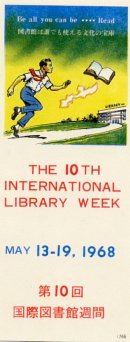
10th International Library Week, Ryukyus, 1968


In 1968 the Postal Services Agency of the Government of the Ryukyu Islands issued a postage stamp to commemorate the 10th anniversary of International Library Week. The Ryukyu Islands had been occupied by the United States since 1945 following the defeat of Japan in World War II. Okinawa is the largest island in the chain of islands. Ryukyu reverted back to Japan in 1972. The text on the first day cover for the stamp shown above reads: "International Library Week was adopted in 1959 to be observed jointly by Ryukyuan librarians, educators, booksellers, and newspapers and American military librarians on Okinawa. The importance of libraries to the community has become increasingly apparent to the public. The numbers are increasing and even small villages are establishing library rooms in their community centers." National Library Week in the United States was established in 1958. The bookmark on the left includes the same slogan used for National Library Week in 1968 - "Be all you can be ... Read".

Thursday, April 12, 2012

30th Anniversary of America's First Stamp Commemorating a Library


Thirty years ago during National Library Week in April, 1982, the United States Postal Service issued a postage stamp commemorating the Library of Congress. Although there had been previous postage stamps on which library buildings had appeared, those were issued to commemorate academic and other institutions or architects.  Originally, the proposed stamp was to commemorate all of America's libraries collectively and the Library of Congress individually. A publicity photo of that stamp is shown above. Librarian of Congress Daniel Boorstin wasn't happy with the stamp, however, and the Postmaster General agreed to issue a separate stamp for the Library of Congress. That stamp is shown at the left. The America's Libraries stamp was issued in July of 1982 during the ALA Conference in Philadelphia. Both stamps were designed by noted graphic designer Bradbury Thompson. I wrote an earlier post about Thompson on the 100th anniversary of his birth. I wrote an article about the two 1982 library stamps in the August, 2007 issue of American Libraries for the 25th anniversary of the stamps. Both stamps appear of the First Day Cover for the America's Libraries stamp shown below. It is signed by both Daniel Boorstin and the ALA President Betty Stone. To see other U.S. libraries on stamps click HERE.

Monday, February 20, 2012

World's Smallest Presidential Library?

 
It has been claimed that David Rice Atchison (1807-1886) was technically President of the United States on March 4, 1849. This claim is based on the fact that there was a one day gap between the last day of office of President James K. Polk (March 3, 1849) and the day (March 5, 1849) that Zachary Taylor was sworn in as the new President. This occurred because Taylor refused to be sworn in on Sunday (March 4, 1849). David Rice Atchison was President pro tempore of the Senate at the time, and technically acting Vice President (incoming Vice President Millard Fillmore was also not sworn in on March 4). There are those who dispute this claim including Atchison himself. A biography of Atchison and a discussion of the argument that he was President for a day is included on Wikipedia. The Atchison County Historical Museum includes a collection of information about the Atchison presidential controversy. That collection has been referred to as the world's smallest presidential library. On February 20, 2006 a special postmark was created to celebrate this distinction, and a souvenir envelope was produced by Webcraft Cachets highlighting Atchison and the "smallest presidential library". Because I collect postal items related to America's presidential libraries and museums, I acquired one of the envelopes which is shown above.  There is a page on The Library History Buff website about souvenir envelopes and special cancellations.