Showing posts with label Melvil Dewey. Show all posts

Tuesday, July 19, 2016

Florence Woodworth and Dewey's Lake Placid Club


I’ve written several previous posts about Melvil Dewey and his Lake Placid Club. I’m writing another one because of the acquisition of a postcard mailed to Florence Woodworth at the Lake Placid Club in 1903 (see above).  Florence Woodworth was one of the female librarians who were closely associated with Dewey throughout his life. Woodworth first came into contact with Dewey as one of the students at the library school he established at Columbia University and which was later moved to the New York State Library in Albany, NY.  Woodworth was employed at the New York State Library in several capacities and held the title of Director’s Assistant for a number of years.  She was a boarder in the home of Dewey and his wife in Albany.  One of her special assignments included serving as one of the librarians for the Woman’s Library at the World’s Columbian Exposition in Chicago in 1893.  She was also in charge of creating the ALA exhibit at the Paris Exposition of 1900. Woodworth was a regular guest at the Lake Placid Club created by Dewey and his wife in Lake Placid, New York. Note that the postcard above is addressed to Morningside, NY which is the name that Dewey gave to the side of Lake Placid where the club was located.  Woodworth was a stock holder in the Lake Placid Company, and I have a fragment of a  share of stock in the Company held by her (see below).  Someone evidently cut out the fragment for Dewey’s signature. An interesting account of the history of Lake Placid can be found on this website.  In his biography of Dewey Irrepressible Reformer (ALA, 1996) Wayne A. Wiegand provides an excellent account of the creation and workings of the Lake Placid Club and the Lake Placid Company. 


Friday, June 24, 2016

Library Handwriting

Early Harvard College Library catalog card
Catalog card from a small Wisconsin public library
Last year OCLC, the global library cooperative that operates the world’s largest online union library catalog, announced that it was discontinuing its service of providing printed catalog cards to libraries.  This follows decades of libraries transitioning from physical card catalogs to computerized and online catalogs.  The Library of Congress which began distributing printed catalog cards to libraries in 1902 ended this service in 1997.  Before there were printed catalog cards and typewritten library cards they were handwritten.  In 1861 the Harvard College Library became the first library in the United States to use a public card catalog instead of a printed catalog as the primary method for library users to determine what books were available in the library. Harvard created its card catalog using female assistants to hand write the cards. By the start of the 20th century almost all libraries in the U.S. used card catalogs with most of the cards handwritten.  Legible handwriting was critical and what became known as “the library hand” was fostered.  Melvil Dewey was a proponent of a standardized “library hand”, and as late as 1916 the New York State Library School founded by Dewey was teaching Library Handwriting.  David Kaminski, an independent researcher, has undertaken an in-depth study of library handwriting.  His ongoing study is titled The Varieties and Complexities of American Handwriting and Penmanship: Library Hand and is available online.  In his online compilation of information related to library handwriting, Kaminski includes an excerpt from a discussion of which took place between Melvil Dewey and other library leaders at the American Library Association Lake George Conference in 1885 concerning handwritten catalog cards and their replacement by typewritten catalog cards.  Dewey was an advocate for the Hammond typewriter. Although typewritten and pre-printed catalog cards replaced handwritten catalog cards starting in the late 19th century and early 20th century. Some small libraries continued to use handwritten cards well into the 20th century. 

Friday, June 3, 2016

Melvil Dewey’s Shorthand


Melvil Dewey was obsessed with efficiency. One of the devices that he used to improve his personal efficiency was writing in shorthand.  The form of shorthand that he used was called tachygraphy, a system promoted by David P. Lindsley.  Dewey taught himself the system while at Amherst College, and became so adept at it that he began teaching other students how to use the system.  Dewey recorded his personal diaries using tachygraphy which has posed an obstacle to his biographers.  As a collector of postal librariana I was delighted to recently acquire a postal card (see above) in which Dewey used shorthand to communicate with George W. Cole in Fitchburg, MA in 1886.  At the time Cole was working on the catalog of the Fitchburg Public Library, and he obviously was also familiar with tachygraphy. Although the postal card is pre-printed with the logo of the Columbia College Library for which Dewey was the Chief Librarian, the card was mailed from Mackinac Island, MI on September 18, 1886.  I haven’t been able to determine why he was in Michigan on that date, perhaps for a holiday. Dewey's diaries are in the archives of the Columbia University Library.

Monday, September 28, 2015

New York’s Library Week 1902


Library week in New York began not as a public celebration of libraries but as a week long retreat and conference for librarians. The week was sponsored by the New York Library Association which was founded in 1890 with the encouragement of Melvil Dewey. Initially the weeklong conference was held annually at Dewey’s Lake Placid Club in the Adirondacks. I have in my collection of postal librariana an envelope and a brochure announcing Library Week for 1902 which was held on September 20-29 of that year (113 years ago this week). They were mailed to Miss Mary Medlicott, Reference Librarian for the Springfield (MA) City Library. The content of the small brochure indicates that: “The meeting is planned to give opportunity not only for help and encouragement in library work, but for renewal of health and strength.” It further states: “The Association specially wishes to gather all New York library folk at this meeting, but all persons interested in library work, whether as trustees, librarians or assistants, whether inside or outside New York, are cordially welcome during Library Week to share its work and pleasure.” After Melvil Dewey and the Lake Placid Club fell out of favor for practices of discrimination, the week was held elsewhere. I have written previously about New York Library Week in another blog post.

Wednesday, August 26, 2015

Mary Salome Cutler Fairchild (1855 - 1921), Library Pioneer

 I recently acquired a letter on the stationery of the United States Hotel in Boston dated June 27, 1886 from George T. Cutler to his sister Mary Salome Cutler (later Mary Salome Cutler Fairchild). Salome, as she preferred to be called, was one of the outstanding American librarians of the 19th century. She was one of “40 leaders of the library movement” selected for a Library Hall of Fame by Library Journal in 1951 as part of the 75th anniversary celebration of the American Library Association. Salome Fairchild is also included in the Dictionary of American Library Biography (Libraries Unlimited, 1978) which has a comprehensive biography by Budd L. Gambee. Fairchild was hired by Melvil Dewey in 1884 as a cataloger for the Columbia College Library, and she also served as an instructor in cataloging at the library school founded by Dewey at Columbia. She followed Dewey to the New York State Library when the library school was moved from Columbia to New York in 1889. Fairchild became vice-director of the library school in 1891, and served in that capacity until 1905. As vice-director Fairchild was responsible for the day-to-day operations of the library school and also maintained a heavy teaching load at the school. In his biography of Fairchild, Gambee writes: “The inspirational quality of her teaching was highly praised by her contemporaries. Her enthusiasm and her faith in the perfectibility of mankind sustained her missionary zeal for the library movement. Her specialties were cataloging book selection, and a seminar that combined library history with a study of contemporary libraries.”  Fairchild was also in charge of the New York State Library for the Blind. In his biography about Dewey Irrepressible Reformer (ALA, 1996) Wayne A. Wiegand notes that Fairchild and Dewey had significant philosophical differences in regard to the their approach to library education. Dewey emphasized the practical aspect of instruction whereas Fairchild advocated for a more theoretical and cultural approach. Fairchild was an active member of ALA and served as vice-president in 1894-95 and 1900-1901. One of her major contributions to ALA was serving as chair of the committee which arranged the ALA exhibit at the World’s Columbian Exposition in Chicago in 1893 which included a model library. An annotated book selection list created for the exhibit was the first of several that became known as the A.L.A. Catalogs. The Wikipedia entry for Fairchild includes an interesting section on her 1904 study of “Women in American Libraries”.  The 1886 letter to Cutler/Fairchild from her brother includes advice to her about her upcoming extended trip to the Mid-west and information about financing the trip. There is only one library reference in the letter. At the end her brother writes, “I got the bulletin from Library Bureau.” I’m happy to have this artifact with a connection to this great library lady.


Monday, October 6, 2014

Happy Birthday ALA!


Today marks the 138th anniversary of the founding of the American Library Association. The founding took place on October 6, 1876 at a conference of librarians at the Pennsylvania Historical Society in Philadelphia. The events leading up to the conference are documented in the book Raking The Historic Coals, The A.L.A. Scrapbook of 1876 by Edward G. Holley (Beta Phi Mu, 1967). Although Melvil Dewey received much of the credit for the call for the conference, others including Richard Rodgers Bowker and Frederick Leypoldt played important roles. Of the 103 people who attended the conference 90 were men and 13 were women. At the end of the conference attendees who wanted to form the new association signed a register. Melvil Dewey signed as "Number one". By the end of 1876, 43 individuals had joined the association. On the evening of October 6 there was a social reception. A replica of the invitation to that affair is shown above. This anniversary of the founding of ALA highlights the fact that in two years, it will celebrate its 140th anniversary, an occasion worthy of celebration. In 2026, only twelve years away, ALA will celebrate its 150th anniversary, a major milestone for any organization.  

Tuesday, March 11, 2014

The 1894 ALA Conference in Lake Placid

Following its extremely successful annual conference in 1893 at the Chicago World's Fair the American Library Association met in 1894 at Lake Placid, New York. Melvil Dewey had pushed to hold the conference in this resort community located in the lake country of the Adirondack mountains.  He had an ulterior motive for doing so. Dewey and his wife Annie had purchased land in the area with the intent of creating a private retreat for librarians and other professionals.  The ALA conference was a perfect opportunity for showcasing the beauty of the area. The Library Journal for October, 1894 reported that "The meeting of the A.L.A. at Lake Placid will be remembered as one of the best ever held." There were 205 registered attendees with a little more than half being women. Attendees were from 18 states and Canada. The Library Journal report indicated that sessions were divided between the Grand View and Mirror Lake hotels and that the two hotels "vied with each other in making their guests comfortable and more". Melvil and Annie Dewey did succeed in creating their Lake Placid resort for professionals which I wrote about here and here. The ribbon to the left is part of my collection of ALA librariana.

Tuesday, December 10, 2013

Happy birthday Melvil Dewey (1851-1931)!

Melville Louis Kossuth Dewey (known more widely as Melvil Dewey) was born on December 10, 1851in Adams Center, New York. He is considered by many to be the father of modern American librarianship. He is most widely known as the author of the Dewey Decimal Classification System used in libraries around the world. Dewey had his personal flaws and has been strongly criticized for those by some. In any case he left many important legacies to the American library community. Several books have been written about Dewey. By far the best is Irrepressible Reformer by Wayne A. Wiegand (American Library Association, 1996). I have put together an online exhibit of some items in my librariana collection related to Dewey. Previous posts on this blog related to Dewey can be found HERE.

Wednesday, April 10, 2013

ALA and the 1893 World's Fair in Chicago

Postcard showing building where ALA exhibit was located
When the members of the American Library Association gather in Chicago on June 27th it will mark the 120th anniversary of ALA's meeting in conjunction with the World's Columbian Exposition of 1893. It was one of the most significant annual conferences in ALA's history, and it was the first of many ALA conferences in Chicago. It marked a high point in the prominence of Melvil Dewey in ALA and the library profession. Dewey was serving as President of ALA during the conference and played a major role in the Association's active involvement in the Exposition.  For the Exposition, ALA sponsored an exhibit of a model library with a collection of 5,000 of the "best" books available to libraries. A catalog of this collection was later published by the U.S. Bureau of Education as the Catalog of the A.L.A. Library [Hathi Trust link]. The model library and published catalog were the fulfillment of a Dewey idea that had been proposed in 1876. The U.S. Bureau of Education also published a book of the papers presented for what was described as the "World's Library Congress" [Hathi Trust link]. Although Dewey was a major force behind ALA's involvement in the Exposition of 1893, it was largely due to the efforts of Mary S. Cutler, one of Dewey's subordinates at the New York State Library School, that the model library exhibit was successfully implemented. For more on ALA's model library collection click HERE. Of the 250 people who registered for the ALA conference, 150 were women. Also on display at the conference were examples of all manner of library equipment and supplies. One item was of special interest. It was the "Rudolph Continuous Indexer" a machine that housed an alternative version of a card catalog. See my post on this unusual machine. Check it out yourself at the Newberry Library while in Chicago. The World's Columbian Exposition marked the beginning of the golden age of souvenirs. The "pioneer" picture postcard on the back of a government issued postal card shown above includes an image of the Government Building at the Exposition which housed ALA's exhibit. Another significant exhibit at the Exposition was the Woman's Building Library. For my online exhibit on the history of ALA click HERE. My sources: "Best Foot Forward: Representation of American Librarianship at World's Fairs 1853-1904" by Budd L. Gambee in Library History Seminar No. 3, Proceedings, 1968 (The Journal of Library History, 1968) and Irrepressible Reformer by Wayne A. Wiegand (ALA, 1996). 

Wednesday, November 28, 2012

Library Journal Envelope Circa 1880s


The American Library Journal (later the Library Journal), the first professional library magazine, began publication in 1876. It was one of several major library history events that occurred in that year including the establishment of the American Library Association. Three individuals played prominent roles in the establishment of both the Library Journal and the American Library Association. They were: Fredrick Leypoldt, editor and publisher of the periodical Publisher's Weekly; Richard Rodgers Bowker, Leypoldt's partner and later publisher of the Library Journal; and Melvil Dewey, the first editor of the Library Journal.  The Library Journal served as "The Official Organ of the Library Associations of America and the United Kingdom". It was not until 1907 that the American Library Association began publishing its own journal, the ALA Bulletin (now American Libraries). I recently acquired an early envelope mailed by the Library Journal (shown above). Based on the return address and the stamp on the envelope, it was mailed in the 1880s. The envelope included material classified as a circular which qualified it for the one cent postage rate. Because I use envelopes and other postal artifacts to tell the story of America's libraries in my philatelic exhibits, its nice to have this envelope with connections to the early history of one of the most prominent professional library periodicals and the American Library Association.  

Tuesday, May 1, 2012

How the Library Catalog Card Transformed the Business World

In his book Paper Machines: About Cards & Catalogs, 1548-1929 (MIT Press, Cambridge, MA, 2011) Markus Krajewski tells the fascinating story (to a library history buff) of how the idea of putting information on individual pieces of paper and filing them in a prescribed manner became a significant tool in the world of business in the U.S. and Europe. Krajewski's story begins with Konrad Gessner, a 16th century doctor, and the methodology he used to compile his publication Bibliotheca Universalis. It is Krajewski's description of the role played by the Library Bureau company, founded by Melvil Dewey, in transferring library catalog card methodology to the business world, however, that I found most interesting. Krajewski recounts both the development of the use of catalog cards by libraries in the U.S. and the early struggles of Library Bureau as a business.  Krajewski reveals that it was E. W. Sherman, a female accountant working for Library Bureau, and not Dewey, who recognized the practical application of library catalog card filing methodology to business. Her experimentation with the use of catalog cards for accounting records was the initial stimulus for Library Bureau's expansion into the business world which proved immensely successful. Krajewski writes: "In 1909 Library Bureau controls more that 10 factories, 32 agent offices in American and European cities, and 3,000 office workers. A small department for library supplies overcomes financial plights and turns into a thriving corporation, opening a hitherto virtually nonexistent market."  The business world adopted the methodology of the catalog card and index to such a degree that by 1929, the ending point of Krajewski's history, a card file is on practically every business desk. Krajewski quotes this testimonial from a 1929 German business equipment catalog: "Card catalogs can maintain order among tens of thousands of small and large items in the warehouse management of large industrial plants, they can structure any number of addresses in personnel departments, they can control the movement of hundreds of thousands of people in urban registration offices, they can make themselves useful in bookkeeping departments of commercial offices, i.e. as open account catalogs, etc. etc. Card catalogs can do anything!" Markus Krajewski is Associate Professor of Media History at the Bauhaus University, Weimar, Germany. I first became aware of his work when he commented on one of my most popular posts about the playing cards repurposed by the French as library catalog cards in the late 18th century. My description of Karjewski's book doesn't do it justice. I highly recommend that you read it yourself. The 18th century french catalog card repurposed from a playing card shown below is from my collection of three such cards.

Monday, April 16, 2012

Exhibit About Melvil Dewey's Postal Card


In 1898 the United States Post Office Department (now the United States Postal Service) issued a pre-stamped postal card that was the exact size of a catalog card. Melvil Dewey claimed that the issue of the postal card was the result of his lobbying of the Post Office Department for a card of that size. I have written a previous blog post about Dewey's postal card. I've been collecting examples of these postal cards used by libraries for over 15 years. Last year I put together a one frame, 16 page exhibit of these postal cards for the big stamp show in Chicago, and last month the exhibit was displayed at the St. Louis stamp show. In both cases the exhibit received a silver medal which was less than I hoped for, but I received some good feedback on improving the exhibit. Yesterday at the stamp show of the Wisconsin Federation of Stamp Clubs in Madison, the exhibit received a first place award (more than one first place awards are given). I will also be displaying the exhibit at the Denver stamp show next month. The exhibit varies considerably from traditional postal stationery exhibits in that it concentrates on library uses of a postal card instead of the postal uses. Postal cards were important tools in conducting day to day library business. The largest use for the Dewey cards in my collection was for the acknowledgment of gifts. Of course there are examples of overdue book notices and reserve book notices. Libraries also used the cards for requests to magazine publishers for missing issues of periodicals, and for requesting copies of publications. There are a host of miscellaneous uses ranging from meeting notices to the collection of library statistics. I have a previous post about the use of the card to announce a meeting of the New York Library Club, and a post about a card to collect data for the California State Library.

Sunday, December 11, 2011

Happy (belated) 160th Birthday to Melvil Dewey

Love him or hate him, Melvil Dewey (originally Melville Louis Kossuth Dewey) was one of the most fascinating and complex figures in American library history. December 10 was the 160th anniversary of his birth in Adams Center, New York. To commemorate this occasion, I've put together an online exhibit of some of my pieces of Dewey librariana on the Library History Buff website.

Thursday, November 10, 2011

Most Data Collected on a Postal Card


Melvil Dewey was largely responsible for standardizing the catalog card at 7.5 x 12.5 centimeters in 1877. Almost immediately, Dewey began lobbying the U. S. Post Office Department to issue a postal card similar in size. That became a reality in 1898 when a postal card the same size as a catalog card was issued by the USPOD. Postal cards of this size are referred to as "library cards" by the philatelic community. I've been collecting these cards for a number of years, and next week I will have an exhibit of them at the big Chicago stamp show. My exhibit focuses on the various uses that libraries made of this postal card. One use that I found to be intriguing was its use by the California State Library to collect monthly public library data. By my count this report on a postal card that is slightly smaller than a 3 x 5 inch index card contains 36 data elements.  The card above is the monthly report for the Carnegie Library in Redding, California for December, 1906.  One of the more interesting data elements is a request for the three most popular books during the month. For the Redding Carnegie Library they were My Lady from the North, The Conquest of Caanan, and Lena Rivers.  Dewey argued that all USPOD postal cards should be standardized at this size. Of course, this made little sense for most users of postal cards since postal cards only cost one cent regardless of size, and the larger the size the more information that could be communicated. Just think how much more data the California State Library could have asked for if the card had been larger. The postal card above is shown at its actual size.

Tuesday, August 16, 2011

Wayne Wiegand's Melvil Dewey Notes


Wayne Wiegand, noted library historian, is making available to an institution or an individual an invaluable library history research resource, the voluminous notes he compiled in researching Irrepressible Reformer (ALA, 1996), his definitive biography of Melvil Dewey. All that is necessary to obtain this resource is to make a modest donation to  the Ed Holley Lecture of the Library History Round Table of the American Library Association.  Wiegand had intended that the note cards be auctioned off at a fundraising event last September at Library History Seminar XII in Madison, WI, but that fell through. As one of the auction coordinators, I took temporary custody of the Dewey notes which are recorded on 4 by 6 inch note cards and housed in sturdy file boxes. Wayne recently retrieved those boxes of notes freeing up much needed space in my basement. Although Wayne is interested in obtaining some funding for one of his favorite causes, he is more interested in assisting a researcher or researchers in advancing their study of Melvil Dewey and/or American librarianship. Wayne feels that a new biography with a different take on Dewey should come out every decade or so. He thinks that with his notes a researcher would be two thirds there on such a biography.  While in my custody I had ample opportunity to explore the Dewey notes, and I can attest to the value of this historical resource. Organized in chronological order the notes follow Dewey through his entire life. Of particular value are Wayne's notes on the Dewey manuscript collection at Columbia University which provide detailed transcriptions.  Since Dewey interacted with a major portion of the library community during his life, anyone studying other aspects of library history during the Dewey era would also benefit from the notes. From my perspective, the notes provide an extraordinary glimpse into the research techniques of one of our most esteemed library history scholars.  They remind me again why I'm content to be a library history buff and not a library history scholar. A very nice article could be written just about Wayne's research approach to the Dewey biography.  A reasonable donation to the Holley Lecture would probably be in the $200 up range (plus shipping costs) with the best offer claiming the prize. Wayne can be contacted at wwiegand@fsu.edu.  Wayne Wiegand recently retired as  F. William Summers Professor of Library and Information Studies, and Professor of American Studies, School of Information Studies, Florida State University. A nice article by Christine Pawley about Wiegand and his career appeared in the Spring 2011 newsletter of the Library History Round Table.

Addendum:

Wayne Wiegand has indicated that Columbia University Libraries will be acquiring his Melvil Dewey notes.  This is a great match since Melvil Dewey's papers are also located there.

Sunday, July 31, 2011

Hammond Typewriter and Card Cataloger

A typewriter story on the 50th anniversary of the IBM Selectric Typewriter.

When the Harvard College Library decided to make its catalog more accessible to students by creating the first public card catalog in a library in 1861, it was necessary to produce the catalog cards in a hand written format. Assistant Librarian Ezra Abbot who was in charge of the project employed one of the female assistants at the library to write cards which she was able to do at a rate of twelve and one quarter an hour. More assistants were hired and in the first year 35,762 cards were written. [Source: "Boston Library Catalogues, 1850-1875" by Barbara A. Mitchell in Institutions of Reading, Univ. of Massachusetts Press, 2007] Fast forward to the March, 1887 issue of Library Notes edited by Melvil Dewey which includes an extensive article on "Library Handwriting". The noteworthy point about that article is its introduction, probably written by Dewey, which states: "The writing of the future in and out of libraries is to be done as largely by machines as sewing is now. The hand, pen, and needle will always have a mission, but the silly prejudice against legible 'writing done on a machine with no individuality' is yielding very rapidly as the machines themselves are so nearly perfected."  Included in that issue of Library Notes is an advertisement for two companies making typewriters.  One of those was for the Hammond Typewriter. In the supplement to Library Bureau's 1886 Classified Illustrated Catalog which I mentioned in my previous post, the Hammond Card Cataloger was being offered by Library Bureau. The description for the typewriter states, "Preeminently the library typewriter, and the only one thus far invented that writes catalog cards perfectly." In support for the need for typewritten catalog cards it states, "The larger the library the more numerous are the employes in the catalog department, and the more confusing to the eye of the reader the eccentricities of their individual handwritings, and the more need of the clear, simple, and uniform characters which the Hammond produces."  More on the Hammond Typewriter can be found HERE. The illustration above is from my copy of the Library Bureau catalog supplement.  As an aside, when I started working at the Greenville County Library in South Carolina, in 1974 we had a programmable IBM Selectric Typewriter that would produce a full set of multipe heading catalog cards automatically after the initial catalog information was entered. When student groups took a tour of the library we called it the "magic typewriter".  By the time I left Greenville in 1980 we had converted to a high speed enclosed microfilm catalog which eliminated catalog cards.

Saturday, December 18, 2010

Origin of Vertical Files


Research by the Early Office Museum makes a strong case that the first vertical file cabinets were produced by Library Bureau, the library and office supply company founded by Melvil Dewey.  The earliest advertisement for a vertical file cabinet was found by the Museum in a 1900 Library Bureau catalog. Information in this catalog indicates that vertical files utilized the same technology pioneered in library card catalog cabinets which were also produced by Library Bureau. I'm very impressed with the web site for the Early Office Museum which does not have an actual physical location. The site and all the information on it is compiled and maintained by three volunteers. It is a potential model for a library history museum or a component of a library history museum.  The Library History Buff web site and the Wisconsin Library Heritage Center web site are other models.

Friday, December 10, 2010

Melvil Dewey's Library Postal Card


Since today (Dec. 10) is the birthday (159th) of Melvil Dewey, I thought it would be an appropriate occasion for a post about the  postal card which the United Stated Post Office Department (USPOD) issued in 1898 as a result of lobbying by Dewey. The pre-stamped postal card which Dewey lobbied for is the same size as a library catalog card and is commonly referred to in philatelic circles as a "library card". Dewey was largely responsible for standardizing the size of the catalog card at 12.5 cm x 7.5 cm and he felt that postal cards should also be standardized at a similar size. Interestingly, it was the early government issued postal cards (the first one was issued in 1873) that influenced the size of the catalog card, specifically its height. The "p" in "p-slip" stands for postal. Dewey took credit for getting the USPOD to issue a library sized postal card in an 1898 Library Journal article. Dewey himself made heavy use of the new library size postal cards.  The unused postal card above documents Dewey's move from Albany to Lake Placid after his resignation as New York State Librarian in 1905.  Postal cards could be purchased in a single sheet of fifty to facilitate pre-printed addresses and/or messages. The New York Library Club utilized library size postal cards to send out announcements of its meetings. 

Wednesday, November 17, 2010

Frederick Leypoldt, Founder of Publishers' Weekly and Library Journal


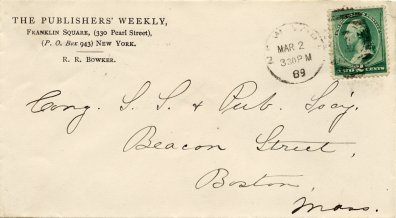
Today is the 175th anniversary of the birth of Frederick Leypoldt (1835-1884). On May 17, 1876, Frederick Leypoldt, Melvil Dewey, and Richard Rodgers Bowker met in the offices of Publishers" Weekly and mutually agreed to pursue a conference of American librarians and a library journal. Both of these objectives were accomplished in that same year. The first issue of Library Journal (under the initial title of American Library Journal) was dated September 30, 1876 and the conference of librarians which resulted in the founding of the American Library Association took place in Philadelphia in October, 1876. Dewey is often given credit for these accomplishments, but both Leypoldt and Bowker also deserve much credit. Leypoldt had successfully established Publishers' Weekly as a major source of information about books and their publishing in America, and although Dewey was the first Managing Editor of Library Journal, Leypoldt was its publisher and source of financial support. Leypoldt also published the American Catalogue and Index Medicus. Leypoldt was a poor businessman and his publishing endeavors, including Library Journal, often resulted in financial loses. His close associate R. R. Bowker was more financially astute and later purchased Publishers' Weekly. The R. R. Bowker Company developed into a major American publishing house with emphasis on the book and library trades. The envelope above was mailed in 1889, five years after Leypoldt's death. The relationships between Leypoldt, Dewey, and Bowker are fascinating. They are dealt with in several publications. These include E. McClung Fleming's R. R. Bowker: Miltant Liberal (Univ. of Oklahoma Press, 1952), Edward G. Holley's Raking the Historic Coals: The A.L.A. Scrapbook of 1876 (BETA PHI MU, 1967), and Wayne A. Wiegand's Irrepressible Reformer, A Biography of Melvil Dewey (ALA, 1996).

Wednesday, September 1, 2010

Hannah Packard James (1835-1903)

Happy 175th birthday on September 5 to early public library administrator Hannah Packard James. As noted in previous blogs I peruse the Dictionary of American Library Biography and its supplements each year to identify key birth dates for notable librarians and library supporters from the past. In doing so I am able to learn about some impressive individuals that have been previously unknown to me. Hannah James is one of those impressive individuals. In 1870, having been trained at the Boston Athenaeum, James became the first director of of the Newton, Massachusetts, Free Library. After a successful tenure at that library, she became director in 1887 of the Osterhout Free Library in Wilkes-Barre, Pennsylvania. She continued in this position until 1902. She was active in the American Library Association and served on the ALA Council and as a vice-president. The article in the Dictionary of American Library Biography was written by Joan M. Costello and Edward G. Holley. Costello and Holley write, "James was one of the early leaders in the movement to establish strong relations between the public library and schools." They also note that James, "took obvious pride in the fact that American women were not bound by precedent and had been able to become directors not only of small, but also of some large libraries, 'commanding the same salary as men in similar positions'." James was a contemporary of Melvil Dewey and lectured in his library school at Columbia. It was Dewey who recommended her for the Wilkes-Barre position. I understand that library historian Bernadette A. Lear, the current Chair of the ALA Library History Round Table, is working on an article about James. I look forward to her perspective on this impressive librarian.