Showing posts with label Women's history. Show all posts

Wednesday, March 23, 2022

Women on Library Postcards Revisited

 As a tribute to Women's History Month I'm revisiting the topic of women on library postcards which I previously posted about on March 12, 2013. The first postcard below was mailed on July 10, 1907 and depicts the female staff of the Aurora Public Library in Aurora, Illinois. The library had moved into a new building in 1904 funded by a $50,000 grant from Andrew Carnegie. With the help of more recent staff members I was able to identify the women on the post card left to right as Alice Belleau, Gladys V. Hull, Minnie J. Pooley, Matie K. Quinn, Lillian C. Miles, Kate E. Marshall, and H. Belva Hull. James Shaw, the Librarian at the time, is not shown.


Interior William Fogg Library in Eliot, ME. Unmailed RPPC circa 1907.
Librarian Gail Willis is at table in reading room.
 
Interior Adrian College Library in Adrian, MI. Mailed on 1/10/09.


Interior Hyannis (MA) Public Library. Unmailed RPPC circa 1930s.
Ora Adams, librarian from 1900 to 1943, at desk.


Bookmobile for the Library Associatin of Portland, Oregon. Unmailed circa 1920s.

Sunday, January 23, 2022

Edna Isabel Allyn and the Hawaii State Library

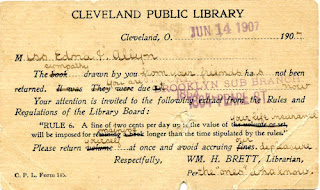
 The significance of the nondescript postal card below rests with its connection to one of the most important people in the history of the Hawaii State Library – Edna Isabel Allyn (1861-1927).  When this card was sent to Allyn by her former staff at the Brooklyn Sub Branch of the Cleveland Public Library, she had just become librarian of the Honolulu Library and Reading Room Association.  Allyn would transition this library into a free public library and then the Hawaii State Library. She would become Hawaii’s first State Librarian.  The card is a pre-printed overdue book notice that has been adapted in a humorous way – “Please return yourself at once and avoid accruing our displeasure.”  The postal card is dated June 14, 1907 and addressed to “The Truant”. It has no postage or postmark and was probably enclosed in another envelope for delivery to Honolulu.


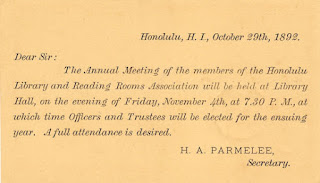
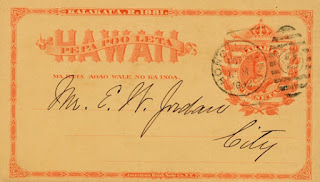
The Honolulu Library & Reading Room Association was established in 1879 when Hawaii was still a country with a king and its own postal system. H. A. Parmelee was one of the founders of the library. This postal card was mailed locally in Honolulu on Oct. 31, 1892. 


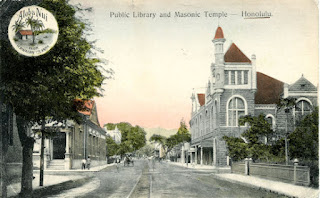
Postcard shows the library in Honolulu directed by Edna Allyn.  Message on the back reads in part: “The building on the left is the library.  We hope for a better one some day.” Mailed from Honolulu, Hawaii to the Public Library in Newark, NJ, March 16, 1908. 


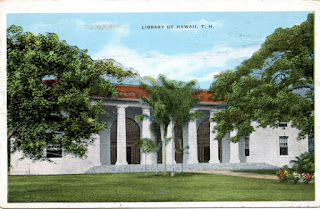
In 1909 the Hawaii Library and Reading Room Association transfered its assets to the newly formed Library of Hawaii which received a $100,000 grant from Andrew Carnegie for a building. That building opened (shown below) to the public on February 1, 1913. Edna Allyn was appointed the first librarian, a post she held until her death in 1927. The children's section of the library is named in her honor.  Postcard mailed on March 5, 1931. 


After statehood in 1959 the Library of Hawaii became the Hawaii State Library.

Tuesday, January 11, 2022

Librarians on a Postcard and Philippine Libraries


Librarians are rarely depicted on postcards so it was amazing to find one that depicted 24 librarians. It was even more amazing to discover the postcard's connection to two important librarians in Philippine library history. The librarians depicted on the postcard were the entire 1922 class of the N. Y. State Library School. That's the library school founded by Melvil Dewey at Columbia University and then moved to the New York State Library in Albany, NY. The library school subsequently moved back to Columbia University. The postcard is a Real Photo Postcard (RPPC) and the photographer was Gustave Lorey who operated a prominent photography studio in Albany. The address side on the postcard is where the two Phillipine librarians come into the story. The postcard is addressed to Miss Mary Polk, Bureau of Science Library, Manila, PI. It is signed "Sincerely yours, Isidoro Saniel". It is dated Mar. 26, 1921 but is not stamped or postmarked. This means it was probably mailed inside an envelope to Manila. I was able to locate a great article on the internet about Mary Polk and her contribution to Philippine librarianship. It was written by Bradley Brazzeal and is titiled "Science Librarianship in Colonial Philippines: Mary Polk and the Philippin Bureau of Science Library, 1903-1924". Brazzeal includes a quote in his article that Polk could "righly be called the mother of Philippine Library Science". He indicates also that the Philippine Association of Academic Research Librarians continues to provide a scholarship in the name of Polk that "honors the life and accomplishments of Mary Polk, the first librarian of the University of the Philippines, who started the first formal library science training program in the same university". Brazzeal's article also explains the connection between Mary Polk and Isidoro Saniel. Saniel was one of several individuals in the Philippines who were sent to library schools in the United States for formal library training. Saniel was sent to the N. Y. State Library School. She returned to play a prominent role in Philippine librarianship, and has written a history of the Philippine Library Association which she helped found. [Saniel, Isidoro. “Forty-Nine Years of the Philippine Library Association.” The Journal of Library History (1966-1972), vol. 7, no. 4, University of Texas Press, 1972, pp. 301–12, http://www.jstor.org/stable/25540372.] It is likely that Saniel is one of the class of 1922 depicted on the postcard. The records of the New York State Library School are now located in the Archival Collections of Columbia University Libraries. An enterprising researcher might be able to identify the other members of the class of 1922.

Thursday, January 6, 2022

Two Additional Library People on Postage Stamps


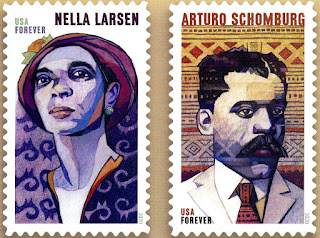
I’ve been collecting libraries and library people on postage stamps for more than 25 years.  I haven’t been as aggressive in my pursuit of these stamps in recent years so I was slow to realize the connection to libraries of two of the stamps in the United State Postal Service “Voices of the Harlem Renaissance” issue of 2020.  Both individuals on the stamps had strong connections to the New York Public Library (NYPL). The first person was Nella Larsen (1891-1964) who was honored as a novelist, but also was a librarian at the NYPL. She worked at three different branch libraries – the 135th Street Branch, the Seward Park Branch, and the Countee Cullen Branch.  She was the first black woman to graduate from the NYPL Library School.  Although not honored as a librarian, Larsen was the first (and only) person with professional librarian credentials to appear on a United States postage stamp.  Wikipedia has a comprehensive entry for Nella Larsen.  The “Little Known Black Librarian Facts” blog has an entry for Larsen with an excellent list of sources.  Bob Sink’s “NYPL Librarians” blog has an interesting post about Ernestine Rose’s role in the integration of branch library staffs including her connection to Larsen. 

Arturo Alfonso Schomburg (1874-1938) was the second person on a stamp with a library connection.  The USPS description of his contributions: “By tirelessly collecting books, documents, artwork, and other materials, Schomburg rescued black history from obscurity and preserved priceless cultural knowledge for future generations.”  His collection was acquired by the New York Public Library and was the foundation for what became the Arthur Schomburg Center for Research in Black Culture. Wikipedia has a nice entry for Schomburg. It is noteworthy that the previously mentioned Ernestine Rose also played a significant role in acquiring and building the Schomburg collection at NYPL. 

Library people especially librarians are rarely recognized on postage stamps for their contributions as library people. Those who are on postage stamps are usually recognized for some other contribution.  On my Library History Buff website which I no longer update because of obsolete software I have several sections devoted to the topic of library people on postage stamps.  They include “Library People on Postage Stamps – An Introduction”, “A Postage Stamp to Honor America’s Librarians”, “U.S. Library People on Postage Stamps”, and “World Library People on Postage Stamps”.

As a collector of libraries and library people on postage stamps I have benefited in my search for these stamps by my membership in the American Topical Association and the Graphics Philately Association.  The Graphics Philately Association publishes a comprehensive list of these and other graphics related postage stamps titled Winnegrad’s Printing on Stamps compiled by Bruce L. Johnson. The Graphics Philately Association also publishes a quarterly publication titled Philateli-Graphics which includes listing of new stamp issues of graphic interest which includes libraries.

Thursday, March 23, 2017

Ruth Warncke, American Library Association Leader


Ruth Warncke (1910-1998) was a national leader in adult education and served as Deputy Director of the American Library Association from 1965 to 1972.  Her colleagues described her as “a professional feminist long before it was popular”.  When the next supplement to the Dictionary of American Library Biography comes out she will undoubtedly be included. My decision to write about Warncke during Women’s History Month was prompted by a postcard (see above) I recently acquired for my collection of librariana. The postcard was mailed to Warncke in 1971.  Warncke began her career as a teacher and school librarian in Glenview, IL and later held positions in public libraries in New York and Michigan. She was hired by ALA in 1955 to lead the American Heritage Project funded by the Ford Foundation to assist public libraries in discussions of American heritage.  In 1956 she became director of another ALA national level project, the Library Community Project, which was designed to strengthen adult education activities and services in public libraries in the United States. In 1960 she left ALA and served on the faculty of Case Western University Library School until 1965 when she became Deputy Director of ALA.  I’m always delighted to obtain a postcard that has a personal link to a librarian. This postcard was mailed by a friend of Warncke who was traveling in the Southwest U.S.. The picture side of the postcard is a spectacular view of Zion National Park in Utah. I got the postcard at a stamp show from a dealer who was aware of my interest in library related postal items. 

Saturday, March 18, 2017

Helen Marot, Progressive Librarian & Labor Activist


Helen Marot (1865-1940) was a librarian who worked to improve the working conditions of women.  She helped to establish the Free Library of Economics & Political Science in Philadelphia in 1897.  In my collection of library related postal cards I have a postal card (see above and to the left) that was mailed by Marot from the Free Library of Economics & Political Science on November 23, 1898 to a London publisher.  In trying to find out more about Marot I was delighted to find a well written and researched article about her on Wikipedia. The article has a good description of the Free Library of Economics and Political Science which provided a specialized collection of government publications, labor society reports, magazines, and pamphlets related to economics and political science. Later Marot served as executive secretary of the New York branch of the national Women’s Trade Union League.  Her labor activism included organizing the strike of the shirtwaist makers and dressmakers in 1909.

Tuesday, July 19, 2016

Florence Woodworth and Dewey's Lake Placid Club


I’ve written several previous posts about Melvil Dewey and his Lake Placid Club. I’m writing another one because of the acquisition of a postcard mailed to Florence Woodworth at the Lake Placid Club in 1903 (see above).  Florence Woodworth was one of the female librarians who were closely associated with Dewey throughout his life. Woodworth first came into contact with Dewey as one of the students at the library school he established at Columbia University and which was later moved to the New York State Library in Albany, NY.  Woodworth was employed at the New York State Library in several capacities and held the title of Director’s Assistant for a number of years.  She was a boarder in the home of Dewey and his wife in Albany.  One of her special assignments included serving as one of the librarians for the Woman’s Library at the World’s Columbian Exposition in Chicago in 1893.  She was also in charge of creating the ALA exhibit at the Paris Exposition of 1900. Woodworth was a regular guest at the Lake Placid Club created by Dewey and his wife in Lake Placid, New York. Note that the postcard above is addressed to Morningside, NY which is the name that Dewey gave to the side of Lake Placid where the club was located.  Woodworth was a stock holder in the Lake Placid Company, and I have a fragment of a  share of stock in the Company held by her (see below).  Someone evidently cut out the fragment for Dewey’s signature. An interesting account of the history of Lake Placid can be found on this website.  In his biography of Dewey Irrepressible Reformer (ALA, 1996) Wayne A. Wiegand provides an excellent account of the creation and workings of the Lake Placid Club and the Lake Placid Company. 


Wednesday, August 26, 2015

Mary Salome Cutler Fairchild (1855 - 1921), Library Pioneer

 I recently acquired a letter on the stationery of the United States Hotel in Boston dated June 27, 1886 from George T. Cutler to his sister Mary Salome Cutler (later Mary Salome Cutler Fairchild). Salome, as she preferred to be called, was one of the outstanding American librarians of the 19th century. She was one of “40 leaders of the library movement” selected for a Library Hall of Fame by Library Journal in 1951 as part of the 75th anniversary celebration of the American Library Association. Salome Fairchild is also included in the Dictionary of American Library Biography (Libraries Unlimited, 1978) which has a comprehensive biography by Budd L. Gambee. Fairchild was hired by Melvil Dewey in 1884 as a cataloger for the Columbia College Library, and she also served as an instructor in cataloging at the library school founded by Dewey at Columbia. She followed Dewey to the New York State Library when the library school was moved from Columbia to New York in 1889. Fairchild became vice-director of the library school in 1891, and served in that capacity until 1905. As vice-director Fairchild was responsible for the day-to-day operations of the library school and also maintained a heavy teaching load at the school. In his biography of Fairchild, Gambee writes: “The inspirational quality of her teaching was highly praised by her contemporaries. Her enthusiasm and her faith in the perfectibility of mankind sustained her missionary zeal for the library movement. Her specialties were cataloging book selection, and a seminar that combined library history with a study of contemporary libraries.”  Fairchild was also in charge of the New York State Library for the Blind. In his biography about Dewey Irrepressible Reformer (ALA, 1996) Wayne A. Wiegand notes that Fairchild and Dewey had significant philosophical differences in regard to the their approach to library education. Dewey emphasized the practical aspect of instruction whereas Fairchild advocated for a more theoretical and cultural approach. Fairchild was an active member of ALA and served as vice-president in 1894-95 and 1900-1901. One of her major contributions to ALA was serving as chair of the committee which arranged the ALA exhibit at the World’s Columbian Exposition in Chicago in 1893 which included a model library. An annotated book selection list created for the exhibit was the first of several that became known as the A.L.A. Catalogs. The Wikipedia entry for Fairchild includes an interesting section on her 1904 study of “Women in American Libraries”.  The 1886 letter to Cutler/Fairchild from her brother includes advice to her about her upcoming extended trip to the Mid-west and information about financing the trip. There is only one library reference in the letter. At the end her brother writes, “I got the bulletin from Library Bureau.” I’m happy to have this artifact with a connection to this great library lady.


Monday, March 9, 2015

The Extraordinary Women of ALA’s Washington Office


For Women’s History Month I’m writing about a group of women who collectively made an enormous contribution to the improvement of library service in America. These were the women who served as director of the Washington Office of the American Library Association from 1950 through 1999. They were the lobbyists for America’s libraries, and they carried out this role exceptionally well. The ALA Washington Office was established in October of 1945 and celebrates its 70th anniversary this year. Paul Howard became the first director of the office when it opened in 1946 but left in 1949 when ALA closed the office due to lack of funding. It reopened in 1950 under the leadership of Marjorie Malmberg, the first of the women featured in this article. Malmberg had relocated to Virginia with her husband after she had led a successful effort to get state funding for libraries in Wisconsin. Malmberg is credited by her successors for laying the foundation for a politically effective Washington Office and for playing an important role in the effort to secure federal legislation for libraries. Malmberg was followed as director by Alice Dunlap who served a short term (Sept, 1951-Jan 31, 1952), but continued efforts toward federal legislation. Julia Bennett Armistead headed the Washington Office from 1952 through 1957 and helped to finally secure the passage of the Federal Library Services Act (LSA) in 1956. It fell to Germaine Krettek (1907-1994) who became director of the Washington Office in November 1957 to secure the actual funding for rural library service which was authorized under LSA.  President Eisenhower recommended initial funding for LSA of only $3 million, but Krettek led efforts that resulted in an appropriation of $6 million. Also under Krettek leadership, LSA was expanded in 1964 to become the Library Services and Construction Act (LSCA) and included support for urban as well as rural libraries. When Krettek retired in 1972 federal funding for libraries under all federal legislation had increased to $200 million. For her legislative efforts Krettek was honored by ALA with the Joseph W. Lippincott medal in 1969 and was elected to Honorary Membership in ALA (ALA’s highest honor) in 1973. Eileen Cooke who had worked under Krettek in the Washington Office starting in 1964 became director in 1972. Cooke was presented with a major challenge when for fiscal year 1974 President Nixon recommended zero funding for ESEA II, LSCA, and HEA II. Librarians responded to calls from the Washington Office for action and their efforts led to $151.2 million in funding for library programs. Throughout her tenure Cooke fought for the reauthorization and funding for federal legislation that benefited millions of American. Carol Henderson, Cooke’s assistant and successor, called her boss, “the legendary library lady of Capitol Hill”. When ALA celebrated the 50th anniversary of the Washington Office in 1996, Cooke was given Honorary Mermbership in ALA for her distinguished career. Cooke retired in 1993 and was succeeded by Henderson who served until 1999. Under Henderson the Washington Office established the Office of Technology Policy and successfully worked for the passage of the Telecommunications Act of 1996. Emily Sheketoff became director of the Washington Office in 1999 and is the current director. Sheketoff has continued to build successfully on the efforts of her predecessors. The entire library community can be thankful that these enormously talented women were drawn to serve in a leadership role in the Washington Office of the American Library Association.

Wednesday, December 24, 2014

An Interesting Bookmobile Postcard


The postcard above depicting the bookmobile of the Albuquerque (NM) Public Library was given to me by Norman Stevens, one of the world's greatest library postcard collectors. Norman donated his collection of approximately 25,000 library postcards to the Canadian Centre for Architecture and it is now part of the Norman D. Stevens Collection of Library Architecture. This one got left out of the CCA donation. I'm grateful to have the postcard since it was part of Norman's collection. It also has several other aspects that are of interest to me. I collect bookmobile postcards so obviously that's the first aspect that is of interest. The postcard is larger than the usual postcard of this period (1950s). It is 6 1/4 inches wide instead of the usual 5 1/2 inches, and it is 4 1/2 inches high instead of the usual 3/12 inches. It is an advertising postcard from The Gerstenslager Co. of Wooster, OH, the largest maker of bookmobiles for several decades. The postcard was mailed to Lucille Morsch of the Library of Congress and received by LC on Jan. 26, 1959. Since I am also a collector of postal librariana related to the Library of Congress, this is also of special interest to me. In Norman D. Stevens' book A Guide to Collecting Librariana (Scarecrow Press, 1986) he mentions that Lucille Morsch was a collector of library postcards and that she donated her collection to him before her death. This is probably why the bookmobile postcard was in his collection. It also means that the postcard is now in the hands of the third library postcard collector (me). 

Wednesday, November 19, 2014

A Library Postcard With Multiple Personal Connections


As I have mentioned in previous posts about my library postcard collecting interests, I am particularly interested in the message side of postcards especially if the message relates to libraries or library postcard collecting. One such postcard in my collection has multiple personal and library related connections. The postcard (shown above) depicts the interior of the Greenville County (SC) Library. I served as Director of the library from 1974 to 1980, and I have a number of these postcards which are unused. This postcard was mailed on Dec. 5, 1983 by Martha Jane Zachert from Columbia, SC to Dan Lester in Durango, CO. At the time Martha Jane was on the faculty of the University of South Carolina Library School and Dan was Director of the Fort Lewis College Library in Durango. I've shared an interest in collecting librariana with Dan for a number of years and I recently wrote about his library postcard collection. Although our careers overlapped in South Carolina, it has only been recently that I have connected with Martha Jane and discovered out shared interest in library history and philately. My final connection to this postcard is the America's Libraries stamp. I'm an avid collector of first day covers and other postal items with this stamp, and have even created an exhibit of those items. It's use on a postcard during this time period is unusual in that it is a first class postage stamp and overpays the postcard rate. 

Monday, April 28, 2014

The Library Postcard Collection of Phoebe Hayes (1905-1975)


At a postcard show in Madison, WI this past weekend I acquired a collection of 30 library postcards that were at one time part of a collection owned by Phoebe Hayes, a librarian who ended her library career around 1970 as Director of the Bibliographical Center for Research in Denver, CO. The postcards that I acquired have all been used and for the most part are addressed to Hayes or one of the libraries where she worked. They date from 1930 to 1970 and have a variety of messages mostly with a library connection. I particularly prize these kinds of postcards. I was able to cross check Hayes' entry in the 1970 edition of A Biographical Directory of Librarians in the United States and Canada published by ALA with the postcard addresses. Her education and library work included the Univ. of Wisconsin, the University of Chicago, the Univ. of Denver, the Joint Reference Library in Chicago, and the Library of the Bureau of the Budget in DC in addition to the BCR in Denver.  It is apparent that her colleagues knew of her interest in library postcards and shared postcards with her that they found or received. The postcard above was sent to Hayes in Chicago (where she was a student) from a friend in Boulder, CO on June 18, 1941. The postcard depicts the Library of the University of Colorado. The message begins with "Another 'library' for your collection." I'll probably share some other postcards from her collection in the future. I've compiled lists of current and former library postcard collectors that I know about. 

Tuesday, March 12, 2013

Women on Library Postcards

Library, Washington Normal School, Ellensburg, WA
Library, Baptist Missionary Training School, Chicago
Guthrie (OK) Carnegie Library
I've put together a group of library postcards from my collection that include women. The first card shows the interior of the library at Washington Normal School in Ellensburg, WA. It was mailed in 1916. The second card shows the interior of the Harris Library of the Baptist Missionary Training School in Chicago. It was mailed in 1909. The third card features the "GUTHRIE BELLES" of Guthrie, OK along with the Carnegie Library. It was mailed in 1910 and is a Tuck's Postcard. Not surprisingly, Tuck's published postcards depicting pretty belles from towns and cities across the country, and they were all "most fair". The final postcard (to the left) depicts women as viewed by much of society in 1906 when the postcard was copyrighted. Check out the woman in Vol. 1. One of my most popular previous posts showed women on postcards for ALA's Library War Service. I also have a previous post that includes a postcard of women library workers at the Aurora (IL) Public Library and another post that includes a postcard showing women using the Milwaukee State Normal School Library.

Tuesday, December 11, 2012

Women Librarians and ALA's Library War Service in WWI

Mary Josephine Booth


By 1917 women librarians in the United States had begun to exert more and more leadership in a profession previously dominated by men.  With the decision of the American Library Association to play an active role in providing reading materials to America's armed forces during World War I, it was only natural that women would seek to be involved in that enterprise.  Their efforts, however, to be part of ALA's Library War Service was thwarted to a large degree by Herbert Putnam, the Librarian of Congress and the General Director of the Library War Service. In particular Putnam opposed women serving as the head of the camp libraries operated by ALA. At the ALA Conference in Saratoga Springs in the summer of 1918, seven women including Theresa Elmendorf, ALA's first woman president, petitioned ALA's War Service Committee which had oversight over the Library War Service to modify the policy against women serving as camp librarians. Interestingly, Blanche Galloway had become the first woman to direct an ALA camp library (at the Pelham Bay Naval training Station in NY) in May of 1918 just prior to the ALA Conference. Even before that, female librarians had played other roles in the ALA Library War Service including serving as hospital librarians on military bases. Two prominent women librarians, Gratia A. Countryman and Electra C. Doren, served on the Library War Service Committee.  Female librarians also served in ALA libraries overseas including Portland librarian Mary Frances Isom who served in hospitals in France. She wrote to her Portland library staff: "I can stand anything now. I can even look on the most horrible wounds without flinching." By the summer of 1919 women were in charge of eight camp libraries.  The source for most of the information in this post is Arthur P. Young's Books for Sammies: The American Library Association and World War I (Beta Phi Mu, 1981). Also consulted was Cultural Crusaders: Women Librarians in the American West, 1900-1917 by Joanne E. Passet (Univ. of New Mexico Press, 1994).  The photograph of a Library War Service worker in Europe shown above was recently sold on eBay. Robert V. Hillman, University Archivist at Eastern Illinois University has identified her as Mary Josephine Booth. According to Hillman, Booth was on leave for a couple of years (1917-1919) from her position as library director at Eastern Illinois State Normal School (now Eastern Illinois University.)  During those years she served overseas, first as a Red Cross volunteer, and then as a member of ALA’s Library War Service.  When she returned to Eastern she resumed her duties as library director here, a position she held for a total of 41 years. The library building at Eastern is now named in her honor. The postcard showing the  World War I military hospital library in New Haven, CT with a female librarian is from my collection. 

Thursday, November 29, 2012

Mystery Woman on Postcards


Enlarged detail of postcard above.
I came across three real photo postcards (2 shown above) showing an unknown woman in a library/study/office/museum? I thought she might be someone of note. The framed print abover her head on the first postcard depicts the first reading of the Emancipation Proclamation by Lincoln before the cabinet.  Any ideas about her identity?


Friday, October 26, 2012

WI Library Hall of Fame Inducts 7

Zona Gale
Pulitzer Prize winning author Zona Gale (1874-1938) was one of seven individuals inducted into the Wisconsin Library Hall of Fame on October 25 at the Wisconsin Library Association Conference in La Crosse, WI. Gale was a champion of libraries and served as Chair of the Wisconsin Free Library Commission. Also inducted was former American Library Association Adult Education Specialist John Miller Chancellor (1896-1980). Chancellor resigned from ALA to become a Wisconsin farmer, but ended up playing a leadership role on the Wisconsin Free Library Commission at a critical juncture in its history. Chancellor was made an Honorary Member of ALA (the Association's highest honor) in 1962. Others inducted included: former Milwaukee Public Library City Librarian Richard E. Krug (1905-1983); Wisconsin Free Library Commission instructor and later Oregon State Librarian Cornelia Marvin Pierce (1873-1957); former Brown County Library (Green Bay) Director Gerald A. Somers (1921-2003); former Secretary of the Wisconsin Free Library Commission Clarence Brown Lester (1877-1951); and former Wisconsin Library School Director Rachel Katherine Schenk (1899-1973). This was the fifth class of Library Hall of Fame inductees which now total thirty-six. The Wisconsin Library Hall of Fame is a project of the Wisconsin Library Heritage Center which is a program of the Wisconsin Library Association Foundation. It's been my pleasure to Chair the Steering Committee of the Wisconsin Library Heritage Center that selects the Library Hall of Fame inductees each year.

Photo: Wisconsin Historical Society Digital Collection.

Monday, September 10, 2012

Mrs. Thompson's ALA Conference Badges


As a collector of library ephemera and memorabilia I'm always happy to find items that connect me to library workers of the past who engaged in the same kinds of activities that I took part in during my library career. I recently acquired three badges for American Library Association conferences that took place in Detroit, MI (1922); Hot Springs, AR (1923); and Saratoga Springs, NY (1924). All three of the badges belonged to Mrs. Joseph A. Thompson. It took a little Internet sleuthing, but I found out a few things about Mrs. Thompson other than the fact that she attended at least three ALA Conferences. Mrs. Thompson was the first Librarian of the Chickasha (OK) Public Library starting with the completion of Chickasha's Carnegie library building in 1905 when it was still part of the Indian Territory. She was a charter member of the Oklahoma Library Association which was founded in 1907, the same year that Oklahoma Territory and the Indian Territory became the state of Oklahoma. She served as Secretary of the Oklahoma Library Association for a period. Mrs. Thompson's ALA activities included serving on the 1921-1922 Membership Committee which presented a report at the 1922 Detroit conference. It is interesting sign of that period that all the references for Mrs. Thompson used her husband's name and I couldn't find any reference to her own given name [thanks to Barb for discovering Mrs. Thompson's given name was Sallie Lou]. The three metal badges are interesting. There is a slot for the name tag to be inserted. The hand written name tags for Mrs. Thompson were pretty small and you would definitely have to look hard to read them. The name tag for the Saratoga Springs Conference is missing. A brief history of the Chickasha Public Library is located HERE.

Wednesday, July 25, 2012

Early Aurora (IL) Library Workers Identified


L to R: Alice Belleau, Gladys V. Hull, Minnie J. Pooley, Matie K. Quinn, Lillian C. Miles, Kate E. Marshall, and H. Belva Hull
My post for July 8 showed two photographs that included a large number of unidentified early women library workers. One of the photographs was on a postcard which was mailed from Aurora, Illinois. The current staff of the Aurora Public Library have now identified the photograph as one that shows an earlier group of staff members at the Aurora Public Library.  The image above is an enlarged detail of the women on the postcard with their names. One of the women pictured is Lillian C. Miles, the Assistant Librarian. James Shaw, the Librarian, is not shown. The Aurora Public Library was founded in 1881. James Shaw became the Librarian in 1884. In 1904 the library moved into a new building (shown on the postcard below) funded with a $50,000 grant from Andrew Carnegie. The photograph of the women library workers was taken sometime between the date the Carnegie library opened and the date the postcard was mailed (July 10, 1907). The building was drastically remodeled and expanded in 1969. The remodeling included a new facade for the building.

Sunday, July 8, 2012

Unidentified Early Women Library Workers


I have two early artifacts (see above) showing images of unidentified women library workers. The first is a photograph of ten women and one man. There is no clue as to which library they work in. The second artifact is a Real Photograph Postcard which shows seven women. The postcard was mailed on July 10, 1907 from Aurora, Illinois to Newkirk, Oklahoma. There's a good bet that the library in the postcard is located in Illinois. Perhaps the University of Illinois Library. Both images are evidence of the feminization of the library profession in the United States. There were hardly any library workers in U.S. libraries in the mid-19th century. Barbara A. Mitchell in a chapter titled "Boston Library Catalogues, 1850-1875" in the book Institutions of Reading: The Social Life of Libraries in the United States (Univ. of Massachusetts Press, 2007) relates the hiring of women to create catalogues by Boston area libraries. The Boston Public Library was the first to hire women for this purpose in 1853. The initial salary for these women was $4 per week. In the first national library conference in 1853 there were eighty-two men present and no women. When the 1876 conference of librarians that resulted in the formation of the American Library Association took place in Philadelphia thirteen women were among the 103 attendees. In the next four decades major advances in the role that women played in library services took place. One significant aspect of these advances was the involvement of women in library education starting with the library school created at Columbia University by Melvil Dewey in 1887. Dewey later moved the school to Albany, NY when he became New York State Librarian. One of the first graduates of that school, Katharine Sharp, established a similar school at the Armour Institute in Chicago in 1893. That school moved to the University of Illinois in 1897 where Sharp became director of both the library and the library school. Because of health reasons she left Illinois in 1907, the same year as the postcard above was mailed. I don't think Sharp is one of the women in the postcard, but I can't be sure. Any help with identifying the libraries in which the photographs were taken will be appreciated.

Update: The women in the photograph on the postcard mailed from Aurora, IL have now been identified. See my post for July 25.

Saturday, June 2, 2012

A Branch and a Bookmobile for African Americans in Carrollton, GA

I recently acquired a postcard (see above) which shows the Delta Sigma Theta bookmobile in front of the King St. Branch Library of of the West Georgia Regional Library in Carrollton, GA. The caption on the back of the postcard indicates that the bookmobile served Carroll, Douglas, Haralson, and Heard Counties in Georgia. The postcard was mailed on September 5, 1956. The Delta Sigma Theta sorority was founded in 1913 at Howard University and has a long history of public service as it relates to the African American community. In 1937 it initiated the  National Library Project which had the goal of providing library service to African Americans in the rural South.  In doing some background research on the postcard I came across a history of the West Georgia Regional Library titled Yonder She Comes! A Once Told Li'bry Tale by Edith Foster (Gateway Printing Co., 1985) which has been placed online in pdf format. Edith Foster was the original director of the West Georgia Regional Library and served in that capacity from 1944 to 1976. Chapter 8 of the book tells about Foster's efforts to establish the King Street Branch Library and the bookmobile service to serve the African American community at a time when the South was still segregated. For two years Foster drove the Delta Sigma Theta bookmobile herself and set up service points for African Americans in all counties. Foster recounts that in order to be prepared to respond to the question "Are you mixing the books?" each book for the King Street Branch was marked with a triangle symbol. The King Street Branch Library ceased operation in 1967 with the completion of the Neva Lomason Memorial Library in Carrollton which served the entire community.