Forty years ago on July 13, 1982 the United States Postal Service (USPS) issued a postage stamp honoring America's libraries. It was the result of years of lobbying by the library profession for such a stamp. A first day of issue ceremony for the stamp was held in Philadelphia at the annual conference of the American Library Association (ALA). Originally the stamp was supposed to also honor the Library of Congress, but Librarian of Congress Daniel Borstin persuaded the USPS to issue a separate stamp for the Library of Congress. That stamp was issued on April 21, 1982. I previously wrote a post about that stamp. Both stamps were designed by Bradbury Thompson, one of the world's great graphic designers and typographers. ALA, led by its President Betty Stone, went all out to promote the America's Libraries stamp. This included producing a first day cover (FDC) for the stamp (shown above) which was sold in various configurations. The one above is signed by Stone and ALA Executive Director Robert Wedgeworth. The cover included an insert with information about ALA. ALA contracted with ArtCraft, the major publisher of FDCs, to design and print its FDC. Over a hundred other FDC producers (called cachet makers) also designed an FDC for the America's Libraries stamp. I collect the different FDCs for the America's Libraries stamp and I have developed an exhibit of those covers which I have shown at national level stamp shows. Among the most sought after FDCs by collectors are those that are hand drawn and painted. The one below was created by arguably the most famous cachet maker Dorothy Knapp. I wrote an article titled "Bradbury Thompson's 1982 Library Stamps" for the July issue of PHILATELI-GRAPHICS, the publication of the Graphics Philately Association of the American Topical Association.
Promoting the appreciation, enjoyment, and preservation of our library heritage
Showing posts with label American Library Association. Show all posts
Wednesday, July 13, 2022
Tuesday, February 8, 2022
Hampton Institute's Library School
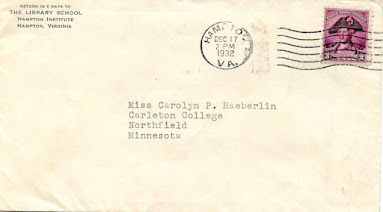
The otherwise unremarkable envelope above which I recently added to my collection of postal librariana has an interesting black history connection. Hampton University (formerly Hampton Institute) in Hampton, VA is one of America's Historically Black Colleges and Universities (UBCUs). The envelope was mailed from The Library School Hampton Institute in Hampton, VA on Dec. 17, 1932 to Northfield, MN. A cooperative effort involving the American Library Association (ALA), the Carnegie Corporation, and other philanthropic foundations resulted in the establishment of a library school at the then Hampton Institute in 1925. It was the nation's first and only library school to serve African Americans. The library school was initially funded with a grant from the Carnegie Corporation and was accredited by the American Library Association to issue a bachelor's degree in library science. The library school lasted until 1939 when it was cut due to lack of funding. An article on "The Passing of the Hampton Library School" by S.L. Smith appeared in the January, 1940 issue of the Journal of Negro Education. Also under consideration for the library school were Fisk University in Nashville, TN and Atlanta University in Atlanta, GA. The decision to select the Hampton Institute for the library school is explored in an article titled "Hampton, Fisk, and Atlanta: The Foundations, the American Library Association, and Library Education for Blacks, 1925-1941" by Robert Martin and Lee Shiflett in the Spring 1966 issue of Libraries and Culture. After the demise of the library school at Hampton Institute a library school was established at Atlanta University in 1941. That library school ceased to exist in 1991. A history of the Atlanta University school is located HERE.
In 2018 when Hampton University celebrated its 150th anniversary the University's Library conducted a forum on "Minority Recruitment and Retention in the Library & Information Science Field."
Thursday, April 6, 2017
World War I Library Postcard
Wednesday, April 5, 2017
World War I & the American Library Association
April 6 marks the centennial of the U.S. entry into World War I. Almost all history related organizations in the U.S. will do something to commemorate the U.S. participation in the war. The involvement in the war by the American Library Association through its Library War Service has been a longtime interest of mine and I have written many posts on this blog about that involvement. I’m helping to commemorate the work of ALA’s Library War Service with two different exhibits this year. I have an exhibit at the Middleton (WI) Public Library this month which features some of the larger artifacts in my collection related to the Library War Service (see photo above). I hope to share this exhibit with other Wisconsin libraries also. My other exhibit (see photo below) is one that I have developed for stamp shows and includes postal items and other paper artifacts about the Library War Service. I have already shown the exhibit at two stamp shows and expect to show it in several more this year.
The American Library Association Archives which has an outstanding collection of archival materials related to the Library War Service will be doing a number of things to commemorate ALA’s involvement in the war. The Archives has already posted several outstanding articles on its blog. More general online exhibits about the U.S. involvement in World War I have been created by the Library of Congress and the Smithsonian National Postal Museum.
Thursday, March 23, 2017
Ruth Warncke, American Library Association Leader
Ruth Warncke (1910-1998) was a national leader in adult education and served as Deputy Director of the American Library Association from 1965 to 1972. Her colleagues described her as “a professional feminist long before it was popular”. When the next supplement to the Dictionary of American Library Biography comes out she will undoubtedly be included. My decision to write about Warncke during Women’s History Month was prompted by a postcard (see above) I recently acquired for my collection of librariana. The postcard was mailed to Warncke in 1971. Warncke began her career as a teacher and school librarian in Glenview, IL and later held positions in public libraries in New York and Michigan. She was hired by ALA in 1955 to lead the American Heritage Project funded by the Ford Foundation to assist public libraries in discussions of American heritage. In 1956 she became director of another ALA national level project, the Library Community Project, which was designed to strengthen adult education activities and services in public libraries in the United States. In 1960 she left ALA and served on the faculty of Case Western University Library School until 1965 when she became Deputy Director of ALA. I’m always delighted to obtain a postcard that has a personal link to a librarian. This postcard was mailed by a friend of Warncke who was traveling in the Southwest U.S.. The picture side of the postcard is a spectacular view of Zion National Park in Utah. I got the postcard at a stamp show from a dealer who was aware of my interest in library related postal items.
Tuesday, January 17, 2017
ALA’s Atlanta Conference 1899
Later this week the American Library Association will hold its Midwinter Meeting in Atlanta, GA. The first ALA conference in Atlanta took place on May 8-12, 1899. It was also ALA’s first conference in the South. William C. Lane, Director of the Harvard University Library, was President of ALA. Attendance at the conference was 215. The conference hotel was the Kimball House (see postcard below). The rationale for an ALA conference in the South was stated in the conference brochure (see cover illustration above): “It is to be hoped that this southern meeting will be the means of largely increasing the membership [in ALA] from a section hitherto almost entirely without representation.” The brochure included a section touting Andrew Carnegie’s bequest in 1898 for new library buildings in Atlanta. This section which was written by someone with the initials A.W. included the following statement: “The people of the South, perhaps the purest strain of the Anglo-Saxon to be found on this continent, are conservative, intelligent, and need only the educational advantages that wealth can bestow to reach a degree of culture heretofore unrivaled.” No mention of the African American population of the South. Andrew Carnegie’s bequest, however, did include funds for a separate library for African Americans. The racial climate in the South was reflected in ALA’s planning for the 1899 Atlanta conference. There was an initial proposal for a presentation on “How to Make the Library Do Its Part in Negro Education” by W. E. B. Du Bois. According to Dennis Thomison in his A History of the American Library Association 1876-1872, a decision was made not to have the presentation “to avoid the risk of angering the association’s southern hosts”. It was not until the 1922 ALA conference in Detroit that an African American gave a speech at an ALA conference. The lineup of featured speakers at this year’s Midwinter meeting shows the dramatic change in ALA’s 21st century outlook on diversity in its programming and membership.
Thursday, October 6, 2016
Happy 140th Birthday ALA
One hundred and forty years ago today the American Library Association was created in Philadelphia, PA. Below are some links to online exhibits that help celebrate this milestone in the history of ALA.
Celebrating the Organizers - 140 Years of Library Conference Planners in Letters and Images at the ALA Archives
Pinterest - ALA 140th Anniversary (American Libraries magazine)
Highlights in the History of the American Library Association - Library History Buff website
Previous LHBB posts about the American Library Association
Tuesday, October 4, 2016
ALA at Saratoga Springs, NY in 1918
I’ve recently added a name badge for R. L. Walkley (Raymond L. Walkley) at the American Library Association conference in Saratoga Springs, NY in 1918 to my collection of librariana. The ALA conference ran from July 1 to July 6 and had 620 attendees. It’s nice to be able to tie a library artifact to a specific librarian. Walkley served as Assistant Librarian of the Minneapolis Public Library from 1914-1920. He took a leave from MPL to serve in ALA’s Library War Service in 1917-1918. Obviously a major topic of discussion at the 1918 conference was the war effort of ALA. The 1918 conference hotel was the Grand Union Hotel in Saratoga Springs. Walkley later served as Librarian of Tufts College. See some other early ALA conference name badges HERE.
Monday, August 15, 2016
ALA Pinback Buttons
If you’ve ever attended a library conference the odds are that you’ve brought home a few of the pinback buttons that vendors give away in the exhibits. I have an enormous library button collection that I’ve accumulated at library conferences and which have been given to me by other collectors. Below are a few buttons from my collection related to the American Library Association. More examples from my collection can be found HERE.
Monday, May 16, 2016
ALA Washington Office 1982 First Day Cover
Sunday, April 10, 2016
National Library Week and Meter Mail
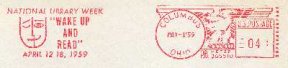
Today is the first day of National Library Week with a national theme of “Libraries Transform”. In 1957 the National Book Committee, a joint committee of the American Library Association and the American Book Publishers Council, recommended the establishment of a National Library Week. The first National Library Week was observed May 16-22, 1958 with the theme "Wake Up and Read". It has continued every year since 1958. In 1974, the American Library Association became the sole sponsor of the event. Libraries and other organization that used meter postage machines for their mail were able to add slogans for special events such as National Library Week. Below are some examples of these slogans for previous National Library Week campaigns.
Wednesday, March 30, 2016
Where are my breeches? Library War Service, 1918
I recently came across a packet of correspondence related to uniform problems of a worker in the WWI ALA Library War Service. The 1918 correspondence involved Alvin W. Clark at the Camp Sevier South Carolina Library, the ALA Library War Service Headquarters in Washington, DC, and the contractor engaged by ALA to provide uniforms. The gist of the matter relates to the fact that Clark was entitled to two pairs of breeches for his uniform and he only received one pair. Further, the measurements for the first pair were not satisfactory, and finally according to Clark the leggings he received “have now become creased or wrinkled in two or three places and consequently they look bad”. Poor guy. The letter above from LWS Executive Director George B. Utley, who was simultaneously ALA’s Executive Director, advises Clark of how he can correct his problems. Interesting example of the practical logistics involved in the operation of ALA’s Library War Service.
Monday, February 22, 2016
Detroit and ALA
The American Library Association has held its annual conference in Detroit, Michigan on four different occasions. The first of these was in 1922 when ALA met from June 26 to July 1. The attendance at the conference totaled 1,839, and those individuals participated in thirty or more associations, sections and round tables which took place at eleven different locations. One of those locations was the newly completed Detroit Public Library’s main building. Conference attendees were also treated to a special day in Ann Arbor, Michigan where they were able to visit the new library building of the University of Michigan. A report on the conference in Library Journal for July, 1922 noted that this was the first conference where none of those who attended ALA’s first meeting in 1876 were not in attendance (although there were still nine survivors of that conference). George B. Utley took office as ALA’s 36th president at the conference. Utley had previously served as ALA’s Executive Secretary from 1911 to 1920. Among those in attendance was Sallie Lou (Mrs. Joseph A.) Thompson whose conference badge is part of my collection of librariana (see below). On June 27 the first Newbery Medal, for the most distinguished contribution to American literature for children published in the preceding year, was awarded to Henrick Van Loon for The Story of Mankind. A publicity committee at the conference recommended the establishment of a National Library Week, something which didn’t take place for another 36 years. At the conference Reverend Thomas Fountain Blue (1866-1935) who served as the first African American to head a branch library (Louisville Free Public Library 1905-1935) also became the first African American to give a speech before the American Library Association. ALA did not meet again in Detroit until 1965. It also met there in 1970 and 1977, two conferences which I personally attended. The 1970 conference was especially memorable for me since it was my second ALA conference and my first as an employed librarian.
Friday, October 2, 2015
The Inside Inn and ALA’s 1904 Conference Revisited
In 1904 (Oct. 17-22) the American Library Association held its annual conference in conjunction with the World’s Fair (Louisiana Purchase Exposition) in St. Louis, MO. George Eberhart, Senior Editor of American Libraries’ AL Direct, wrote a wonderful article about the 1904 St. Louis conference for the CentenniAL Blog which celebrated the centennial of American Libraries. Most of the attendees of the conference stayed at the Inside Inn which was the only hotel located inside the fair grounds. I was recently able to obtain a postcard of the Inside Inn (shown above), a postcard which I have coveted for some time. The postcard is special because it is a "hold to light" card. When you hold it up to a light the windows of the hotel glow. The postcard was actually mailed from the Exposition Station of the Post Office during the fair. I previously wrote about the Inside Inn in a blog post on July 7, 2011. Rates for staying at the Inside Inn started at $1.50 per day European plan and $3.00 per day American plan including admission to the fair. According to Eberhart, there were 26 former and future ALA presidents in attendance at the conference including Melvil Dewey, Herbert Putnam, and Gratia A. Countryman. The conference meetings took place at the fair’s Hall of Congresses, a building which exists today as Ridgley Hall of Washington University. Ridgley Hall housed the University Library until the 1960s (see postcard below).
Wednesday, August 26, 2015
Mary Salome Cutler Fairchild (1855 - 1921), Library Pioneer
I recently acquired a letter on the stationery of the United States Hotel in Boston dated June 27, 1886 from George T. Cutler to his sister Mary Salome Cutler (later Mary Salome Cutler Fairchild). Salome, as she preferred to be called, was one of the outstanding American librarians of the 19th century. She was one of “40 leaders of the library movement” selected for a Library Hall of Fame by Library Journal in 1951 as part of the 75th anniversary celebration of the American Library Association. Salome Fairchild is also included in the Dictionary of American Library Biography (Libraries Unlimited, 1978) which has a comprehensive biography by Budd L. Gambee. Fairchild was hired by Melvil Dewey in 1884 as a cataloger for the Columbia College Library, and she also served as an instructor in cataloging at the library school founded by Dewey at Columbia. She followed Dewey to the New York State Library when the library school was moved from Columbia to New York in 1889. Fairchild became vice-director of the library school in 1891, and served in that capacity until 1905. As vice-director Fairchild was responsible for the day-to-day operations of the library school and also maintained a heavy teaching load at the school. In his biography of Fairchild, Gambee writes: “The inspirational quality of her teaching was highly praised by her contemporaries. Her enthusiasm and her faith in the perfectibility of mankind sustained her missionary zeal for the library movement. Her specialties were cataloging book selection, and a seminar that combined library history with a study of contemporary libraries.” Fairchild was also in charge of the New York State Library for the Blind. In his biography about Dewey Irrepressible Reformer (ALA, 1996) Wayne A. Wiegand notes that Fairchild and Dewey had significant philosophical differences in regard to the their approach to library education. Dewey emphasized the practical aspect of instruction whereas Fairchild advocated for a more theoretical and cultural approach. Fairchild was an active member of ALA and served as vice-president in 1894-95 and 1900-1901. One of her major contributions to ALA was serving as chair of the committee which arranged the ALA exhibit at the World’s Columbian Exposition in Chicago in 1893 which included a model library. An annotated book selection list created for the exhibit was the first of several that became known as the A.L.A. Catalogs. The Wikipedia entry for Fairchild includes an interesting section on her 1904 study of “Women in American Libraries”. The 1886 letter to Cutler/Fairchild from her brother includes advice to her about her upcoming extended trip to the Mid-west and information about financing the trip. There is only one library reference in the letter. At the end her brother writes, “I got the bulletin from Library Bureau.” I’m happy to have this artifact with a connection to this great library lady.
Tuesday, June 30, 2015
Another California ALA Conference, 1911
The American Library Association is concluding a successful conference in San Francisco today. I have a postcard (see above) in my collection that is related to a previous ALA conference in California. The postcard announces the travel arrangements for the 1911 ALA Conference in Pasadena, California. It was mailed on March 2, 1911. A report on the train trip to the conference and the sessions of the conference appeared in the June issue of the magazine Public Libraries. The train trip included a two day stay at the Grand Canyon. "A number of the men properly garbed went down to the river's brink afoot and tried to look happy over it during the next 36 hours, likewise did those who rode the mules. Less active persons sat and gazed for hours at the changing colors of the gorges, chasms and peaks , heedless of the lobster pink the open air bestowed on their faces." James Wyer, President of the Association and Director of the New York State Library, was unable to attend the conference because of a tragedy at the State Library. On March 29, 1911, a fire destroyed most of the library and its collection. On a happier note at the conference, ALA elected the first woman as president. As stated in Public Libraries: "Mrs. Theresa West Elmendorf, the first woman to be honored by the association with its presidency, comes into the office by right of achievement greater than that of any other woman in the library field and of an equal grade with that of any man. Her wholesome, sympathetic attitude toward library work and workers has been a distinct contribution to the craft and her freedom from personal ambition has made her a valuable aid in developing the power of the A. L. A. Her election to the presidency is a well-earned, a well-deserved honor, marking an epoch in which the A. L. A. honored itself in honoring her." Elmendorf was inducted into the Wisconsin Library Hall of Fame in 1908.
Saturday, May 30, 2015
ALA in San Francisco 1891 Revisited
The blog of the American Library Association Archives recently had an excellent post about ALA's 1891 meeting in San Francisco. That reminded me of an earlier post that I made on this blog about that same ALA meeting. I'm reposting it below.
My collection of postal libraiana consists primarily of envelopes that have no contents. Occasionally, however, I will come across the contents with no envelope, and sometimes those contents contain an interesting story. Such is the case with a three page letter (partially shown above) written by George T. Clark to his cousin Ida on November 10, 1891. At the time he wrote this letter, Clark was Deputy Librarian for the California State Library in Sacramento. The most interesting part of the letter is a paragraph in which he discusses the 1891 Conference of the American Library Association in San Francisco. It reads in part:
"Last month the American Library Association held its annual conference in San Francisco, one of the same kind that I attended at the Thousand Islands [1887 ALA Conference]. But California is so far away that not so many attended this year as usual. Only about fifty came from afar but they represented states all along the line from Massachusetts to Colorado. A Worcester man, S. S. Green, was president. The week they were here I spent with them in San Francisco, and enjoyed witnessing the effect upon them of a little experience of California. Local committees had arranged for their reception here in Sacramento, San Francisco and at other places they visited so I hope they carried pleasant memories of their visit home with them. Even nature exerted herself to entertain them and the very first night showed her appreciation of their presence by touching us up with the liveliest earthquake we have had in years.”
Clark went on to become Librarian of the San Francisco Public Library in 1894 where he served for thirteen years. In a strange flashback to his mention of the 1891 San Francisco earthquake in the letter above, he was Librarian of the SFPL during the 1906 San Francisco earthquake that destroyed the central library along with two of its branches. He became Librarian of Stanford University in 1907 where he completed his career. Clark helped found the California Library Association and served as its second president in 1898.
My collection of postal libraiana consists primarily of envelopes that have no contents. Occasionally, however, I will come across the contents with no envelope, and sometimes those contents contain an interesting story. Such is the case with a three page letter (partially shown above) written by George T. Clark to his cousin Ida on November 10, 1891. At the time he wrote this letter, Clark was Deputy Librarian for the California State Library in Sacramento. The most interesting part of the letter is a paragraph in which he discusses the 1891 Conference of the American Library Association in San Francisco. It reads in part:
"Last month the American Library Association held its annual conference in San Francisco, one of the same kind that I attended at the Thousand Islands [1887 ALA Conference]. But California is so far away that not so many attended this year as usual. Only about fifty came from afar but they represented states all along the line from Massachusetts to Colorado. A Worcester man, S. S. Green, was president. The week they were here I spent with them in San Francisco, and enjoyed witnessing the effect upon them of a little experience of California. Local committees had arranged for their reception here in Sacramento, San Francisco and at other places they visited so I hope they carried pleasant memories of their visit home with them. Even nature exerted herself to entertain them and the very first night showed her appreciation of their presence by touching us up with the liveliest earthquake we have had in years.”
Clark went on to become Librarian of the San Francisco Public Library in 1894 where he served for thirteen years. In a strange flashback to his mention of the 1891 San Francisco earthquake in the letter above, he was Librarian of the SFPL during the 1906 San Francisco earthquake that destroyed the central library along with two of its branches. He became Librarian of Stanford University in 1907 where he completed his career. Clark helped found the California Library Association and served as its second president in 1898.
Monday, March 9, 2015
The Extraordinary Women of ALA’s Washington Office
For Women’s History Month I’m writing about a group of women who collectively made an enormous contribution to the improvement of library service in America. These were the women who served as director of the Washington Office of the American Library Association from 1950 through 1999. They were the lobbyists for America’s libraries, and they carried out this role exceptionally well. The ALA Washington Office was established in October of 1945 and celebrates its 70th anniversary this year. Paul Howard became the first director of the office when it opened in 1946 but left in 1949 when ALA closed the office due to lack of funding. It reopened in 1950 under the leadership of Marjorie Malmberg, the first of the women featured in this article. Malmberg had relocated to Virginia with her husband after she had led a successful effort to get state funding for libraries in Wisconsin. Malmberg is credited by her successors for laying the foundation for a politically effective Washington Office and for playing an important role in the effort to secure federal legislation for libraries. Malmberg was followed as director by Alice Dunlap who served a short term (Sept, 1951-Jan 31, 1952), but continued efforts toward federal legislation. Julia Bennett Armistead headed the Washington Office from 1952 through 1957 and helped to finally secure the passage of the Federal Library Services Act (LSA) in 1956. It fell to Germaine Krettek (1907-1994) who became director of the Washington Office in November 1957 to secure the actual funding for rural library service which was authorized under LSA. President Eisenhower recommended initial funding for LSA of only $3 million, but Krettek led efforts that resulted in an appropriation of $6 million. Also under Krettek leadership, LSA was expanded in 1964 to become the Library Services and Construction Act (LSCA) and included support for urban as well as rural libraries. When Krettek retired in 1972 federal funding for libraries under all federal legislation had increased to $200 million. For her legislative efforts Krettek was honored by ALA with the Joseph W. Lippincott medal in 1969 and was elected to Honorary Membership in ALA (ALA’s highest honor) in 1973. Eileen Cooke who had worked under Krettek in the Washington Office starting in 1964 became director in 1972. Cooke was presented with a major challenge when for fiscal year 1974 President Nixon recommended zero funding for ESEA II, LSCA, and HEA II. Librarians responded to calls from the Washington Office for action and their efforts led to $151.2 million in funding for library programs. Throughout her tenure Cooke fought for the reauthorization and funding for federal legislation that benefited millions of American. Carol Henderson, Cooke’s assistant and successor, called her boss, “the legendary library lady of Capitol Hill”. When ALA celebrated the 50th anniversary of the Washington Office in 1996, Cooke was given Honorary Mermbership in ALA for her distinguished career. Cooke retired in 1993 and was succeeded by Henderson who served until 1999. Under Henderson the Washington Office established the Office of Technology Policy and successfully worked for the passage of the Telecommunications Act of 1996. Emily Sheketoff became director of the Washington Office in 1999 and is the current director. Sheketoff has continued to build successfully on the efforts of her predecessors. The entire library community can be thankful that these enormously talented women were drawn to serve in a leadership role in the Washington Office of the American Library Association.
Saturday, December 27, 2014
Welcome Back to Chicago ALA Midwinter!
The American Library Association will hold its Midwinter Meeting in Chicago in 2015 for the first time since 1991. Many aren't looking forward to a meeting in Chicago in the middle on winter. Prior to 1991 ALA midwinter meetings in Chicago were the rule, not the exception. In fact, prior to 1965, all midwinter meetings dating back to 1908 (with only 7 exceptions) were held in Chicago. Starting in 1965 midwinter meetings were also held in Washington, D.C. every four years. Midwinter meetings were held at only a few locations other than Chicago or D.C. through 1991. But after 1991, ALA said "Goodbye" to Chicago as a midwinter meeting site. The rationale was obvious. Too often terrible winter weather greeted meeting goers in Chicago. Prior to 1980 all my library jobs were in the South, and I certainly complained about the Chicago midwinter location. There are lots of tales of meeting goers arriving late or leaving late because of weather in Chicago. Of course, there were also good times at midwinter meetings in Chicago. One year a group of librarians stranded at the Palmer House in Chicago created a fake organization called the ALA Players. I personally have many fond memories of midwinter meetings in Chicago. I'm sure there will be many complaints about the return to Chicago, but lets face it you take your chances traveling anywhere in the U.S. in the middle of winter. I now live about 150 miles northwest of Chicago, and I'll be weighing the pros and cons of driving down for a day at Midwinter. The button above was distributed at the ALA midwinter meeting in Chicago in 1991.
(Source for Midwinter meeting data: http://www.ala.org/conferencesevents/past/pastmidwinters )
Wednesday, November 12, 2014
The Daniel W. Lester Library Postcard Collection
![]() |
| Dan on the left, me on the right |
![]() |
| Lester library postcard collection sorted by state & community ready to load up for the trip to Urbana. |
![]() |
| Loaded & ready for delivery. |
![]() |
| Archives Research Center at the Univ. of Illinois, new home to the Lester library postcard collection. |
Subscribe to:
Posts (Atom)