Showing posts sorted by date for query military libraries. Sort by relevance Show all posts

Tuesday, June 17, 2014

Harry Clemons, Representative of the ALA War Service in Siberia


On Nov. 6, 1918 Harry Clemons, Professor and Librarian at Nanking University in Nanking, China received the following cable from R.L. Raney, Director of Overseas Library Service for the ALA Library War Service in Washington, DC:
"Will you accept appointment official representative American Library Association Vladivostok to develop library service for American forces in Russia? Books being shipped steadily. Will meet all expenses and guarantee against salary loss. Cable Libcon, Washington." Clemons responded the next day with, "Will attempt library service when you direct. University desires my return by May." Thus began what must be one of the most amazing efforts by a single individual on behalf of the American Library Association. I have written previously about the work of Harry Clemons in Siberia, but recently I became aware of an envelope (shown above) mailed by Clemons shortly after his arrival in Vladivostok. This prompted me to do another post. One of the specialties in philately is the collection and study of military postal history. Examples of envelopes mailed by men in the American forces in Siberia during World War I are among the scarcest and most sought after by collectors. The envelope above may be the only envelope mailed by Clemons as ALA's representative in existence in private hands. It is part of the collection of Al Kugel, one of the world's most respected military postal historians. I appreciate his letting me use the image of the envelope in this post. Clemons mailed many letters to the American Library Association while in Siberia and they were compiled in a book titled appropriately The A.L.A. in Siberia. A copy of the book can be found on the Hathi Trust site. In the foreword to the book H. B. Van Hoesen who edited the book noted that Clemon's report on his work to the Commanding General "shows the activity as well as the activities of the A.L.A. Library War Service in Siberia; how in five months, one man was able to handle some ten thousand volumes (plus 10 boxes, 194 parcels, 75 mail sacks, not counting discarded magazines), unpacking censoring, sorting, cataloguing, and repacking; to distribute and organize these into a system of over fifty branches scattered all the way from the Yangtse Valley to no one knows how far towards the German frontier (not to mention gift distribution); and at the same time to act as reference department and superintendent of no inconsiderable circulation; and, on top of all this, to produce, in slow longhand manuscript, and in spite of obstacles like frozen ink, etc., a series of reports of real historical value among the chief literary "by-products" of the Library War Service." The compilation of Clemons letters was distributed to all the attendees of the 1919 ALA Conference in Asbury Park, NJ. After his service in Siberia Clemons returned to Nanking University where he worked until 1927. He then became Librarian of the University of Virginia Library in Charlottesville,VA where he worked until his retirement in 1950. Clemons is included in the Dictionary of American Library Biography (Libraries Unlimited, 1978).

Saturday, January 11, 2014

Multiview Postcards With Libraries


Ft. Wayne, IN. Public Library
is right center.
A multiview postcard is a postcard with a collage of more than one photograph or illustration. These postcards often illustrate multiple views of buildings in a community, on an academic campus, or in other entities such as a military base. I'm, of course, interested in multiview postcards that include an image of a library among the views. That libraries are included in these multiview postcards is an indication of their significance to the community or campus. Multiview postcards represent a small percentage of all postcards, probably less than two percent. In the universe of library postcards, multiview postcards represent a similar small percentage. In my collection of more than twothousand library postcards, I only have a couple of dozen multiview postcards. I've included some of my favorites in this post. To see more click HERE.


Buck Memorial Library (upper left) Bucksport, ME.


Cornell University Library (lower left), Ithaca, NY


Camp Lee, VA during WWI. ALA Library in Center


Wednesday, June 5, 2013

Military Libraries Division, SLA 60th Anniversary


This year, the Military Libraries Division of the Special Libraries Association is celebrating its 60th anniversary so I thought I would feature a couple of artifacts in my collection to honor this occasion.  The first artifact (shown above) is a letter written by J. H. Offley, the Librarian of the War Department Library, on November 11, 1839 to Hilliard Gray in Boston in regard to several missing volumes of the Works of Benjamin Franklin which the library had previously ordered. The War Department Library was established in 1832. The War Department existed from 1790 to 1947 and is now the Defense Department. The successor to the War Department Library is the Pentagon Library which was created in 1944 when 28 departmental libraries and information centers were consolidated into a single library. The second artifact is a reprint of an article about the Pentagon Library and other military libraries in Library Journal for February 16, 1966 for National Library Week (see below). See some of my other posts about military libraries.

Friday, March 1, 2013

German POW Camp Libraries in WWI


I have a special interest in military libraries during wartime. Most of the items in my collection on this topic are about U.S. libraries, but in this post I am featuring two items for German prisoner of war libraries during World War I. By the end of World War I the number of prisoners held in camps operated by Germany reached almost two and a half million prisoners. Dealing with this overwhelming number of prisoners led to some atrocious conditions in the camps. However, many of the camps had libraries by 1915. Most of the books came from donations by organizations set up to provide aid to prisoners. The postcard above shows prisoners using the library in the camp at Heuberg, Germany. The envelope shown above was mailed by the librarian of the library at the Parchim, Germany camp to Paris, France. The Wikipedia article on German prisoner of war camps provides a good overview of the camps.

Tuesday, December 11, 2012

Women Librarians and ALA's Library War Service in WWI

Mary Josephine Booth


By 1917 women librarians in the United States had begun to exert more and more leadership in a profession previously dominated by men.  With the decision of the American Library Association to play an active role in providing reading materials to America's armed forces during World War I, it was only natural that women would seek to be involved in that enterprise.  Their efforts, however, to be part of ALA's Library War Service was thwarted to a large degree by Herbert Putnam, the Librarian of Congress and the General Director of the Library War Service. In particular Putnam opposed women serving as the head of the camp libraries operated by ALA. At the ALA Conference in Saratoga Springs in the summer of 1918, seven women including Theresa Elmendorf, ALA's first woman president, petitioned ALA's War Service Committee which had oversight over the Library War Service to modify the policy against women serving as camp librarians. Interestingly, Blanche Galloway had become the first woman to direct an ALA camp library (at the Pelham Bay Naval training Station in NY) in May of 1918 just prior to the ALA Conference. Even before that, female librarians had played other roles in the ALA Library War Service including serving as hospital librarians on military bases. Two prominent women librarians, Gratia A. Countryman and Electra C. Doren, served on the Library War Service Committee.  Female librarians also served in ALA libraries overseas including Portland librarian Mary Frances Isom who served in hospitals in France. She wrote to her Portland library staff: "I can stand anything now. I can even look on the most horrible wounds without flinching." By the summer of 1919 women were in charge of eight camp libraries.  The source for most of the information in this post is Arthur P. Young's Books for Sammies: The American Library Association and World War I (Beta Phi Mu, 1981). Also consulted was Cultural Crusaders: Women Librarians in the American West, 1900-1917 by Joanne E. Passet (Univ. of New Mexico Press, 1994).  The photograph of a Library War Service worker in Europe shown above was recently sold on eBay. Robert V. Hillman, University Archivist at Eastern Illinois University has identified her as Mary Josephine Booth. According to Hillman, Booth was on leave for a couple of years (1917-1919) from her position as library director at Eastern Illinois State Normal School (now Eastern Illinois University.)  During those years she served overseas, first as a Red Cross volunteer, and then as a member of ALA’s Library War Service.  When she returned to Eastern she resumed her duties as library director here, a position she held for a total of 41 years. The library building at Eastern is now named in her honor. The postcard showing the  World War I military hospital library in New Haven, CT with a female librarian is from my collection. 

Sunday, November 11, 2012

A Postcard Tribute to Military Libraries on Veterans Day

For Veterans Day 2012 I've put together a collection of my World War II era military library postcards. Also see my 11-11-11 tribute, my 11-11-10 post, and my 11-11-09 post.


Fort McClellan, AL
San Diego Marine Corp Base
San Diego Naval Training Station
Camp Livingston, LA
Library, USO Club, Spartanburg, SC

Tuesday, July 3, 2012

People in Libraries on Postcards

Virginia State Library, Richmond

School children in Manchester, NH Public Library
Reading Room, Boston Public Library
Piney Woods School Library, MS

Milwaukee State Normal School Library
In the universe of library postcards a relatively small percentage show the interior of a library and an even smaller percentage show people inside of a library. Based on a recent examination of library postcards for sale on eBay, less than one percent depict people in a library. That makes this category of library postcards an excellent choice for a selective library postcard collector which I happen to be. The bad news is that postcards that depict people in conjunction with a particular topic such as libraries are much pricier.  Some of the postcards in this category in my postcard collection are shown above. I have found that military library postcards are more likely to show library users than other types of library postcards. The library users of a special library such as a state library are likely to be much different that the library users of a public library or school library.

Monday, May 28, 2012

A Postcard for Memorial Day

Ninety-five years ago young men all across America were being mobilized to go to a far off war in Europe. The postcard above depicts some of these men at a YMCA library and mail station at Camp Dix, New Jersey. The caption on the back reads: "On the left are bundles of civilian clothing to be sent home by the new soldiers. On the right are soldiers sending home letters and purchasing postcards at the Y.M.C.A. Also library well stocked with good books." A postcard that combines the topics of mail, postcards, and a library - a nice find for a collector of postal librariana. A major appeal of the postcard, of course, is the soldiers themselves. A large number of library postcards show only relatively sterile buildings. I'm particularly interested in library postcards that show people using libraries. A surprising percentage of military library postcards do this. Although the American Library Association played a major role in providing libraries for service men in World War I, the YMCA, a much larger organization, also played a significant role in this area. Though there was some rivalry between the two organizations, ALA and the YMCA collaborated to a significant degree in providing reading matter for our troops in WWI. ALA maintained a full fledged camp library at Camp Dix during WWI (see postcard below).  In 1939 Camp Dix became Fort Dix and a permanent Army post. On a personal aside, my father went through Fort Dix on his way to Europe during World War II.

Saturday, April 14, 2012

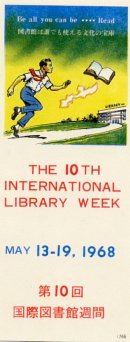
10th International Library Week, Ryukyus, 1968


In 1968 the Postal Services Agency of the Government of the Ryukyu Islands issued a postage stamp to commemorate the 10th anniversary of International Library Week. The Ryukyu Islands had been occupied by the United States since 1945 following the defeat of Japan in World War II. Okinawa is the largest island in the chain of islands. Ryukyu reverted back to Japan in 1972. The text on the first day cover for the stamp shown above reads: "International Library Week was adopted in 1959 to be observed jointly by Ryukyuan librarians, educators, booksellers, and newspapers and American military librarians on Okinawa. The importance of libraries to the community has become increasingly apparent to the public. The numbers are increasing and even small villages are establishing library rooms in their community centers." National Library Week in the United States was established in 1958. The bookmark on the left includes the same slogan used for National Library Week in 1968 - "Be all you can be ... Read".

Friday, March 23, 2012

Library War Service Map Poster, 1918


I'm working on an exhibit of my ALA WWI Library War Service memorabilia in one of Wisconsin's public libraries for April. I've exhibited this collection on one previous occasion. I've added a very nice item for the upcoming exhibit. It is a poster of a map of the United States (see above) which documents the extent of ALA's Library War Service. It proclaims, "Every Dot on the Map Means a Special War Library for Our Fighting Men". A larger square dot indicates camps with libraries, and a smaller round dot indicates libraries in other buildings. It includes an impressive list of statistics for the Library War Service. They include: 41 camp library buildings in operation; 143 hospitals and Red Cross houses supplied; 243 librarians maintained in the Service; 315 small military camps and posts supplied with books; 600,000 books purchased; 1,030,458 books shipped overseas; and 5,000,000 gift magazines distributed. One of the purposes of the poster is to promote the United War Work Campaign during the week of November 11, 1918 in which ALA actively participated. The poster is 20" x 25" and was probably distributed widely to libraries among other entities. The paper which it is printed on is not the best, and I feel fortunate to have a surviving copy. It is the only one I've seen.

Sunday, December 18, 2011

Happy 125th Birthday Althea Warren


Today is the 125th anniversary of the birth of Althea Hester Warren (1886-1958), a former president of the American Library Association (1943-1944) and Los Angeles City Librarian (1933-1947). I learn about significant birth anniversaries of former library leaders from the Dictionary of American Library Biography (Libraries Unlimited, 1978) and its two supplements. The excellent entry in the DALB for Warren was written by Martha Boaz. Warren also served as Head Librarian for the San Diego Public Library (1916-1926). The book Turning the Pages: San Diego Public Library History (1882-1982) by Clara E. Breed (Friends of the San Diego Public Library, 1983) has a nice chapter about Warren and her time at San Diego. For an online biography of Warren by Leeanne Morrow check HERE. Althea Warren's career spanned two world wars and she played a significant role in each. Under Warren's leadership at the San Diego Public Library during World War I, the library provided a wide range of services to the members of the armed forces. These included supporting branch libraries at nearby military bases. During World War II Warren took a leave as Los Angeles City Librarian to head up the national Victory Book Campaign supported by the American Library Association. That effort resulted in the collection of millions of books for men and women in the armed services.  While president of ALA, Boaz indicates that Warren worked hard to get federal aid for libraries and for changes in the ALA organization. One of her major concerns was the discrimination against African Americans in hotels of some cities that hosted ALA meetings. Breed includes several quotes from Warren that reflect her administrative philosophy. I liked this one: "The welcoming attitude of a library staff is fortunately contagious, and once a librarian has rooted out all assistants with drooping mouths and snappy voices, she will find that new employees quickly absorb an equable atmosphere. Never hesitate to discharge the most competent of workers if she is incurably sulky, for one will corrupt a multitude, and only she rightly belongs in our profession who is not only willing, but glad to 'smile off her face and run off her feet for the minimum wage.'"  The postcard above showing the Central Library of the Los Angeles Public Library was mailed in 1942 while Warren was City Librarian.

Friday, November 11, 2011

Tribute to a Veteran and to a Library Historian on 11-11-11

As a Veteran myself, I take note when I come across information about another librarian who has served in the Armed Forces. In reading David Kaser's Books and Libraries in Camp and Battle: The Civil War Experience (Greenwood Press, 1984), I was taken with his reminisces about his reading experiences during World War II. Kaser served with a tank battalion in the European theater. He writes in part: "I recalled purchasing forty years ago a copy of Street & Smith's pulp Western Stories magazine in the bus station in Hattiesburg, Mississippi, to carry with me on maneuvers at Camp Shelby.  I remember reading the Stars and Stripes by the light of a candle in a stable in Alsace and trying to use my schoolboy German to puzzle out the cartoons in an issue of Simplicissimus that I had 'liberated' from a chalet in the Tyrol.... I remembered the copy of the Pocket Book of English Verse that I carried in the turret of my tank until the volume literally fell apart, but by then it did not matter because I had learned all of the poems by heart anyway."  Kaser would have been in the European theater at the same time as my father who served in a artillery battalion. After his military service Kaser completed his education and became an academic library administrator.  He served as the Director of the Joint University Libraries in Nashville, TN which served Vanderbilt University and George Peabody College from 1960 to 1967. His tenure overlapped my undergraduate years at Peabody where he also taught. He joined the faculty of the School of Library and Information Science at Indiana University-Bloomington in 1973 where he became Distinguished Professor in 1986. He retired in 1991 and was designated Distinguished Professor Emeritus. Kaser is responsible for some excellent library history research and publication including his book A Book For A Sixpence: The Circulating Library in America (Beta Phi Mu, 1980). There have been many tributes to Kaser and his scholarship by those who have known him including this one by Haynes McMullen. He has been honored with an endowed lectureship at Indiana University-Bloomington.

Sunday, June 13, 2010

William Howard Brett (1846-1918), Cleveland Librarian

In August 1918 Cleveland Public Library Librarian William Brett was killed by a drunken driver while trying to board a street car in front of the library. Vice-librarian Linda Eastman who was with Brett barely avoided being hit by the drunk driver. As biographer C. H. Cramer (Dictionary of American Library Biography, Libraries Unlimited, 1978) put it: "This irresponsible tippler almost succeeded in wiping out the two greatest librarians in the history of the Cleveland Public Library." I was motivated to find out more about Brett after acquiring a fragile letter written by him in May 1918 on the letterhead of the American Library Association Library War Service. It is an example of a seemingly un-impressive paper artifact leading to some interesting stories about a great library leader. Just three months before his death at age 72 Brett was taking a leave from the Cleveland Public Library to serve as the Dispatch Agent at the Newport News, VA Dispatch Office of the ALA Library War Service. It evidently had been Brett's desire to serve overseas with the Library War Service, but he had settled for the position in Newport News. This was not Brett's first involvement with the military. According to Cramer, in 1865 during the last year of the Civil War he had enlisted in the Army at age 18 only to be captured by Morgan's Raiders and taken as a prisoner to Kentucky. These interesting aspects of Brett's life serve only as a backdrop to his stellar career at the Cleveland Public Library. Part of that career is recorded on a webpage devoted to Brett Hall in the Cleveland Public Library. The image of the bust of Brett is from the Cleveland Public Library Image Collection. Other images of Brett during this period can be found HERE. It is not often that a librarian is memorialized by both a bust and a hall.

Tuesday, December 8, 2009

ALA Hospital Service WWI


During World War I the American Library Association (ALA), through it's War Library Service, provided books and magazines to soldiers and sailors in military hospitals. It placed over 200 libraries in hospitals. In 1920, after the war, ALA's Hospital Library Service was transferred to the U. S. Public Health Service but ALA continued to staff the hospital libraries for a period. Hospital library service was a major legacy of ALA's involvement in World War I. ALA produced a number of postcards to advertise its library service in hospitals. The postcard above shows soldiers reading in the library located in the Red Cross House at Camp Custer, Michigan. To see more postcards click here.

Monday, November 16, 2009

Books for Sailors

Charles Seavey has an impressive website Books for Swabbies: Ship's Libraries in the "New" Steel Navy, 1880s - 1930s. As Seavey points out, books on ships in the United States date back to at least 1820 with the various book collections on the U.S.S. Franklin. This is the same year that the first mechanics libraries and mercantile libraries for young men were established in the United States. I have an interest in libraries that served the military and have a collection of postcards on this topic. The first postcard above shows a group of sailors in the Library of the Brooklyn Branch of the Naval Y.M.C.A. in Brooklyn, NY which was mailed in 1910. The American Library Association (ALA) took an active role in supplying books and magazines to sailors in World War I through its Library War Service. The second postcard shows sailors of a merchant marine vessel enjoying books from the ALA Library War Service. More postcards depicting ALA's service to merchant marine sailors are shown on the Library History Buff website. The third postcard shows a group of sailors in front of an ALA World War I Camp Library at the Great Lakes Naval Training Station in Illinois. Historical documents relating to US Navy Libraries are located on the Navy Department Library website.

Wednesday, November 11, 2009

Librarian Veterans

When Veterans Day comes around each year and America pays homage to those who serve and have served in the military, I often reflect on my own military experience during the Vietnam Conflict/War. Part of that reflection is my identification with all the others who have shared the experience of serving one's country in the military. As I have written in an earlier post, my own service was involuntary as was the service of many of those in the Vietnam era. My experience was unusual in that I was already a professional librarian when I went into the Army. Librarians have served in the military and have provided service to the military in times of war throughout our library past. Librarian of Congress John G. Stephenson from 1861-1864 spent much of his tenure serving in the Union Army during the Civil War. Librarians both male and female participated in the American Library Association's Library War Service during World War I. During World War II many librarians disrupted their library careers to serve their country in uniform. Edwin Castagna, former Director of the Enoch Pratt Free Library in Baltimore, voluntarily joined the Army during World War II and served as a company commander in the 771st Tank Battalion in several key World War II campaigns. He was awarded the Purple Heart and Bronze Star for heroism. A group of female librarians who were in supervisory roles in military libraries during World War II became leaders in state library agencies in the years following the war. They included Estellene Walker, Nettie Taylor, and S. Janice Kee. There aren't many librarians who served in the military during the Vietnam Conflict/war, but there were some. There are also many librarians in military libraries that serve the armed forces on an ongoing basis .