Showing posts sorted by date for query lake placid. Sort by relevance Show all posts

Tuesday, July 19, 2016

Florence Woodworth and Dewey's Lake Placid Club


I’ve written several previous posts about Melvil Dewey and his Lake Placid Club. I’m writing another one because of the acquisition of a postcard mailed to Florence Woodworth at the Lake Placid Club in 1903 (see above).  Florence Woodworth was one of the female librarians who were closely associated with Dewey throughout his life. Woodworth first came into contact with Dewey as one of the students at the library school he established at Columbia University and which was later moved to the New York State Library in Albany, NY.  Woodworth was employed at the New York State Library in several capacities and held the title of Director’s Assistant for a number of years.  She was a boarder in the home of Dewey and his wife in Albany.  One of her special assignments included serving as one of the librarians for the Woman’s Library at the World’s Columbian Exposition in Chicago in 1893.  She was also in charge of creating the ALA exhibit at the Paris Exposition of 1900. Woodworth was a regular guest at the Lake Placid Club created by Dewey and his wife in Lake Placid, New York. Note that the postcard above is addressed to Morningside, NY which is the name that Dewey gave to the side of Lake Placid where the club was located.  Woodworth was a stock holder in the Lake Placid Company, and I have a fragment of a  share of stock in the Company held by her (see below).  Someone evidently cut out the fragment for Dewey’s signature. An interesting account of the history of Lake Placid can be found on this website.  In his biography of Dewey Irrepressible Reformer (ALA, 1996) Wayne A. Wiegand provides an excellent account of the creation and workings of the Lake Placid Club and the Lake Placid Company. 


Monday, September 28, 2015

New York’s Library Week 1902


Library week in New York began not as a public celebration of libraries but as a week long retreat and conference for librarians. The week was sponsored by the New York Library Association which was founded in 1890 with the encouragement of Melvil Dewey. Initially the weeklong conference was held annually at Dewey’s Lake Placid Club in the Adirondacks. I have in my collection of postal librariana an envelope and a brochure announcing Library Week for 1902 which was held on September 20-29 of that year (113 years ago this week). They were mailed to Miss Mary Medlicott, Reference Librarian for the Springfield (MA) City Library. The content of the small brochure indicates that: “The meeting is planned to give opportunity not only for help and encouragement in library work, but for renewal of health and strength.” It further states: “The Association specially wishes to gather all New York library folk at this meeting, but all persons interested in library work, whether as trustees, librarians or assistants, whether inside or outside New York, are cordially welcome during Library Week to share its work and pleasure.” After Melvil Dewey and the Lake Placid Club fell out of favor for practices of discrimination, the week was held elsewhere. I have written previously about New York Library Week in another blog post.

Tuesday, September 2, 2014

Autographs of Famous Librarians


One of the categories of librariana that Norman D. Stevens discusses in his book A Guide to Collecting Librariana (Scarecrow Press, 1986) is autographs of librarians. He highlights the James I. Wyer (1869-1955) Autograph Collection which is housed in the American Library Association Archives. Wyer served as President of ALA in 1910-1911. His autograph collection includes letters from 46 ALA presidents as well as correspondence from other librarians. Stevens notes that autograph collecting was once a popular hobby, but has gone out of favor. He provides tips on autograph collecting. Although, I don't specifically seek autographs of librarians, famous or not, I have managed to accumulate a nice selection. Some of those are shown below.

Melvil Dewey (1851-1931), ALA Leader & President Lake Placid Club

Herbert Putnam (1861-1955), 8th Librarian of Congress
Susan Grey Akers (1889-1984), Library School Dean

Ainsworth Spofford (1835-1908), 6th Librarian of Congress
Justin Winsor (1831-1897), ALA's First President
Norman D. Stevens, Molesworth Institute Director Emeritus
                                       
George M. Eberhart, American Libraries Direct Editor
Betty Stone & Rogert Wedgeworth, Former ALA President & ALA Executive Director

Tuesday, March 11, 2014

The 1894 ALA Conference in Lake Placid

Following its extremely successful annual conference in 1893 at the Chicago World's Fair the American Library Association met in 1894 at Lake Placid, New York. Melvil Dewey had pushed to hold the conference in this resort community located in the lake country of the Adirondack mountains.  He had an ulterior motive for doing so. Dewey and his wife Annie had purchased land in the area with the intent of creating a private retreat for librarians and other professionals.  The ALA conference was a perfect opportunity for showcasing the beauty of the area. The Library Journal for October, 1894 reported that "The meeting of the A.L.A. at Lake Placid will be remembered as one of the best ever held." There were 205 registered attendees with a little more than half being women. Attendees were from 18 states and Canada. The Library Journal report indicated that sessions were divided between the Grand View and Mirror Lake hotels and that the two hotels "vied with each other in making their guests comfortable and more". Melvil and Annie Dewey did succeed in creating their Lake Placid resort for professionals which I wrote about here and here. The ribbon to the left is part of my collection of ALA librariana.

Thursday, February 16, 2012

Henry Carr's Collection of ALA Memorabilia


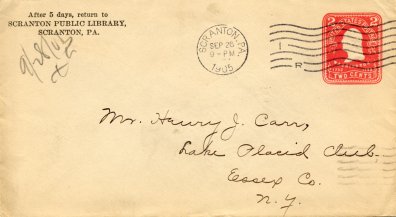
Henry James Carr (1849-1929) was appointed the first library director of the newly completed Albright Memorial Library in Scranton, PA (now part of the Lackawanna County Library System) in 1891. He served in that capacity until his death in 1929. Carr was extremely active in the American Library Association. His offices in ALA included: treasurer (1886-1893); recorder (1894-1895); vice-president (1895-1896); secretary (1898-1900); and president (1900-1901). During his 55 years of membership in ALA he missed attending only eight conferences. While attending these conferences he collected many mementos. Those items now form the bulk of the Conference Badges and Artifacts Collection of the American Library Association Archives. In his book A Guide to Collecting Librariana (Scarecrow Press, 1986) , Norman D. Stevens describes the ALA collection as follows: "There are attendee ribbons from the meetings of 1889 and 1892-1901, as well as some later meetings.  Among the ribbons are those of 1897 (Philadelphia), to which is attached a small United States flag, and 1930 (Grand Canyon), which is made of copper. There is at least one badge, button, or pin in the collection for most of the meetings of 1897-1941.  These items include stick pins from the 1889 Atlanta and 1900 Montreal meetings (Carr calling the latter the 'most beautiful pin' in the collection); the imitation bronze badge in the shape of a badger attached to a medallion from the 1901 Waukesha meeting; the 1902-1914 buttons that were printed with attendee registration numbers; the ornate badges from 1917-1920; and the 1920-1941 badges that were little more than cards on which to write names." I have my own collection of ALA memorabilia, some of which is displayed on the Library History Buff website. It's nice to know that my obsession was shared by one of ALA's pioneers. Wouldn't it be great if the ALA Archives would put together an exhibit (physical or digital) of its collection of conference badges and artifacts. The envelope above was mailed by the Scranton Public Library on September 26, 1905 to Carr while he was evidently on vacation at Melvil Dewey's Lake Placid Club. The source for some of the information in this post is Carr's entry in the Dictionary of American Library Biography (Libraries Unlimited, 1978) written by Wayne Wiegand.

Friday, December 10, 2010

Melvil Dewey's Library Postal Card


Since today (Dec. 10) is the birthday (159th) of Melvil Dewey, I thought it would be an appropriate occasion for a post about the  postal card which the United Stated Post Office Department (USPOD) issued in 1898 as a result of lobbying by Dewey. The pre-stamped postal card which Dewey lobbied for is the same size as a library catalog card and is commonly referred to in philatelic circles as a "library card". Dewey was largely responsible for standardizing the size of the catalog card at 12.5 cm x 7.5 cm and he felt that postal cards should also be standardized at a similar size. Interestingly, it was the early government issued postal cards (the first one was issued in 1873) that influenced the size of the catalog card, specifically its height. The "p" in "p-slip" stands for postal. Dewey took credit for getting the USPOD to issue a library sized postal card in an 1898 Library Journal article. Dewey himself made heavy use of the new library size postal cards.  The unused postal card above documents Dewey's move from Albany to Lake Placid after his resignation as New York State Librarian in 1905.  Postal cards could be purchased in a single sheet of fifty to facilitate pre-printed addresses and/or messages. The New York Library Club utilized library size postal cards to send out announcements of its meetings. 

Tuesday, July 27, 2010

New York's Library Week


In 1890 the New York Library Association (NYLA) was established as the first statewide library association in the United States making this year its 120th anniversary. Melvil Dewey played a significant role in the establishment of the NYLA. He also was involved in the creation of New York's Library Week in 1899. Library Week in New York was not created to promote libraries, it was an expanded library conference that included recreation as well as library continuing education. Library Week was initially hosted annually at Dewey's Lake Placid Club in the Adirondacks where attendees could take advantage of the offerings of the resort. It was during Library Week in 1903 that NYLA member Henry M. Leipziger by chance came across a publication of the Lake Placid Club that stated "No one shall be received as member or guest, against whom there is physical, moral, social or race objection." The publication further stated "It is found impracticable to make exceptions to Jews or others excluded, even when of unusual personal qualifications." Leipsizer, a Jew, was outraged and initiated events that ultimately led to Dewey's resignation from his various responsibilities at the New York State Board of Regents including serving as State Librarian. Library Week was hosted at the Lake Placid Club again in 1920 but a controversy relating to Dewey's relationship with women caused a rejection of an offer to hold Library Week in Lake Placid in 1924.

The poster stamp or "cinderella" above was created to promote New York Library Week in 1917 which took place at the Lakewood Farm Inn at Roscoe, New York. NYLA President Edward F. Stevens wrote about the meeting: "Notwithstanding the critical times and the engrossing concerns of country and of an abnormal daily life, the spirit manifest in the membership of the association promises a conference comparable in interest, enthusiasm and attendance to the best Library Week the association has known." Controversy involving the NYLA and Lake Placid arose again over a decision to hold the NYLA Conference in 1969 at Lake Placid.

Wayne A. Wiegand's book about Melvil Dewey Irrepressible Reformer (American Library Association, 1996) provides extensive coverage about Dewey and the Lake Placid Club. Previous blog posts about Dewey and Lake Placid are located HERE and HERE.

Wednesday, May 26, 2010

Fremont Rider, Editor-Publisher-Academic Librarian-Dewey Biographer

Yesterday was the 125th anniversary of the birth of Arthur Fremont Rider (1885-1962). I didn't want to let this anniversary pass without some acknowledgement of Rider's contribution to librarianship. Although Rider is often linked to his well known mentor Melvil Dewey, his own achievements are exceptional. They are well recorded in the Dictionary of American Biography (Libraries Unlimited, 1978) by Wyman W. Parker. Rider attended the New York State Library School (1907) founded by Dewey and then worked with Dewey at the Lake Placid Club on a Revision of Dewey's Decimal System. There followed a very successful career in publishing. He didn't actually start his library career until 1933 when he became Librarian of Wesleyan University Library in Middletown, Connecticut. Although a history of the Olin Memorial Library at Wesleyan omits any mention of Rider, he was responsible for expanding the size of the library's collection from 174,000 volumes to 389,000 volumes during his 20 year career at the library. To help deal with this growth in the collection, Rider implemented a somewhat controversial compact book storage system which sometimes involved shaving off parts of books. Rider was the inventor of the microcard, another device created to deal with the growth of academic libraries. This article in the Association of Research Libraries Newsletter goes into more detail in regard to Rider's contribution to academic libraries. Rider was the founder of the Godfrey Memorial Library, a genealogical research library. He was also the creator of the American Genealogical-Biographical Index. Back to Melvil Dewey. In 1944 Rider's highly favorable biography of Melvil Dewey was published by the American Library Association.

Thursday, December 10, 2009

Dewey and Lake Placid

Melvil Dewey was born on December 10, 1851 in Adams Center, New York. I thought I would acknowledge his birthday today with a post about Dewey and his Lake Placid organizations. Dewey who is considered by many to be the father of American librarianship is most noted for his decimal classification system which is still used by thousands of libraries. Dewey was also controversial because of his complex relationship with women and accusations of anti-Semitism. The stock certificate above is for the Lake Placid Company which was a sister organization to the Lake Placid Club. Dewey was the founder of both entities. The stock certificate is for fourteen shares issued to the Lake Placid Club Education Foundation, another Dewey enterprise established in 1922. After leaving the New York State Library under a cloud in 1905, Dewey devoted all of his energy to the Lake Placid trilogy of organizations. Wayne A. Wiegand has a very interesting chapter in his book Irrepressible Reformer, A Biography of Melvil Dewey (ALA, 1996) about Dewey's Lake Placid years. I have written a previous post about Katharine Sharp, a Dewey protégé, and the Lake Placid Club. It was the admission policies of the Lake Placid Club which excluded Jews which led to the justifiable anti-Semitism charges against Dewey.

Tuesday, July 7, 2009

Charles Francis Gosnell, New York Librarian

Today is the 100th anniversary of the birth of Charles Francis Gosnell ( 1909-1993). Gosnell was Librarian of the Queen College Library (1937-1945), Director of the New York State Library (1945-1962), and Director of the New York University Libraries (1962-1974). Gosnell is one of 77 individuals included in the Second Supplement of the Dictionary of American Library Biography (Libraries Unlimited, 2003) which was edited by library historian Donald G. Davis, Jr.. The Dictionary of American Library Biography and its supplements are the most comprehensive and authoritative compilations of information about individuals who have made the most significant contributions to the development of America's libraries. The entry about Gosnell was written by Christopher J. Prom. As State Librarian of New York, Gosnell's major achievement was the development of the regional library system in New York. At the New York University Libraries, Gosnell oversaw the construction of the Elmer Homes Bobst Library building. This building replaced the library building designed by Stanford White which is shown on the postage stamp above. Gosnell served as President of the New York Library Association in 1969. His presidency of the NYLA was marked by a controversy over a decision to hold the 1969 conference in Lake Placid. After his retirement in 1974, Gosnell played a major role in the creation of the Chancellor Robert R. Livingston Masonic Library in Manhattan. Click here for the New York Times obituary for Gosnell.

Sunday, May 31, 2009

Katharine Sharp and the Lake Placid Club


The "Library Cover Story" for June on the Library History Buff website involves Katharine Sharp and the Lake Placid Club. A bookplate collector in Oberstdorf, Germany sent this postal card above to Katherine Sharp at the School of Library Science at the University of Illinois in Champaign-Urbana on June 22, 1906. The card arrived in Champaign, Illinois on July 5, 1906. It was then forwarded to the Lake Placid Club in New York. The cover story most pertinent to the library history buff relates to the link between Katharine Sharp and the Lake Placid Club. The Lake Placid Club was established by Melvil Dewey and his wife Annie in the 1890s as a summer community in the Adirondack Mountains for professional people. Katharine Sharp was a protégé of Dewey and a summer resident of Lake Placid. She was director of both the library and library school at the University of Illinois from 1897 to 1907. When she left the University of Illinois in 1907 she moved to Lake Placid and became Vice-President of the Lake Placid Club. The anti-Semitic practices at the Lake Placid Club were a major factor leading to Melvil Dewey's resignation as New York State Librarian in 1905. Lake Placid became a major success as a resort community and was the site of the Winter Olympics in 1932 and 1980. Sharp was killed in an automobile accident in 1914 at the age of 49.

The other story related to this cover involves the collection and exchange of bookplates. The writer of the postal has learned that Sharp may have bookplates for exchange and offers to exchange some of his various bookplates with her. He also indicates that if she is interested in exchanging bookplates with others he will put her address in the German Ex Libris journal for September. More on bookplate collecting is located here.