Happy birthday to the man who put the hole in library catalog cards. Today marks the 175th anniversary of the birth of Otis Hall Robinson who served as Librarian of the University of Rochester Library from 1868 to 1889. Robinson is noted more for his advocacy for library instruction than for his idea for dealing with the annoying tendency of library users to remove catalog cards and put them back in the wrong order (or to keep them for later reference). But lets not underestimate the importance of that idea. How often has a single idea or practice been adopted by every library in America. Robinson's plan called for punching a hole in the lower left corner of each catalog card and running a rod through all the holes to prevent the removal of the cards. Later with the development of standard catalog cabinet drawers the hole was moved to the center of the catalog card. Although French librarian M. Pincon had similar thoughts, Robinson's holes (which were larger than the rod) were more effective. The catalog card above (a Harvard sized catalog card) started out with the hole to the left but was moved to the center later.
Robinson is listed in the Dictionary of American Library Biography (Libraries Unlimited, 1978) where there is an excellent article about him by Edward G. Holley. There is also actually some information on the University of Rochester Library website about Robinson (although it is easier to find through Google than their website). Both sources provide a good picture of the challenges and limitations of academic librarianship in the 19th century. Robinson was exceptional in his views on serving the library and information needs of students. Even so, the library was only open a few hours each day.
Promoting the appreciation, enjoyment, and preservation of our library heritage
Friday, December 3, 2010
Thursday, December 2, 2010
New York Society Library Charging Ledger 1789-1792
Earlier in the year there was a great deal of publicity about a couple of overdue books at the New York Society Library (NYSL) which had been borrowed by George Washington. I even did a blog post about it here. The NYSL has recently launched a new component on its website which makes available a digitized copy of its first charging ledger which covers the period 1789-1792. In addition to the digital images of the pages of the charging ledger, there is a link to each individual user in the ledger which takes you to more information about the individual including a listing of the books checked out by the individual. Users of the NYSL who are listed in the ledger include George Washington, John Adams, Alexander Hamilton, and Aaron Burr. There is also a link to each book checked out by the user with information about the book and who else checked out the book. All in all, it is an extremely well done project. In September of this year, I attended Library History Seminar XII, a national meeting of library historians, and a thread which ran throughout the conference was the historical importance of preserving library circulation records. Noted library historian Wayne Wiegand promotes an approach to library history which emphasizes the library in the life of the user in contrast to the user in the life of the library. Historians are able to utilize charging ledgers such as the one at the NYSL to approach library history in this manner. The online charging ledger of the NYSL can be utilized as a research tool and also as learning tool for library school students and those interested in library history. As is noted on their website, there are additional charging ledgers for later years that have also been preserved at the NYSL. When you visit the NYSL website take time to look around, it is an excellent website. Permission to use the image of the first page of the charging ledger shown above was granted by the NYSL.
Wednesday, December 1, 2010
MA State Library Recalls Law Books 1855
The State Library of Massachusetts was established in 1826. By the 1840s the space in the Massachusetts State House for the library was greatly overcrowded. One solution was to "farm out" duplicate materials to other libraries on the condition that the material could be recalled at a later date. Between 1853 and 1856 an addition to the State House was constructed which provided additional space for the State Library. The pending availability of this additional space prompted the State Library Board of Trustees to recall its loaned material in 1855. The envelope and enclosed letter featured here were sent to the Law Library of Harvard University requesting the return of materials loaned to that library. An additional reason for the return of the books was the preparation of a new catalog for the State Library. The envelope above is a pre-stamped envelope. These envelopes became available from the United States Post Office Department starting in 1853. They were heavily used by libraries. This postal item is the "Library Cover Story" for December on the Library History Buff website.
Tuesday, November 30, 2010
American Library in Paris Celebrates 90th Anniversary
The American Library in Paris is celebrating its 90th anniversary with a special display featuring images, books, and archives from its 90 year history. The display will run from today (Nov. 30) through January 30, 2011. The envelope above is one of two that I have that were mailed by the American Library in Paris. I did a previous post on the other envelope on January 20 of this year. The American Library in Paris is one of the legacies of the American Library Association's Library War Service during World War I. A history of the library is located on its website. The envelope above was mailed on November 20, 1934 to the Card Division of the Library of Congress. There is a Library of Congress date received stamp showing that it was received on November 30, 1934.
Monday, November 22, 2010
Thankful to Carnegie on Thanksgiving
Andrew Carnegie's 175th birthday will fall on Thanksgiving Day. This is an appropriate day for those 1412 communities in the United States that received funding from Carnegie to build 1679 public library buildings to be thankful to Carnegie for the generosity which impacted their communities in such a positive way. Although many of the buildings no longer exist and others have been repurposed, all of the buildings, for a significant period, were a place where lives were changed for the better. Many of the Carnegie library buildings, some after over a hundred years, still function as public libraries. My first library job was in a Carnegie building that served as the central library for Nashville, TN. I also spent many enjoyable and profitable hours in the Carnegie building that housed the George Peabody College Library in Nashville, TN. To help celebrate Carnegie's 175th birthday, I put together a tribute on the Library History Buff website, and also prepared an exhibit on Andrew Carnegie's Wisconsin Library Legacy which is on display this month at the Meade Public Library in Sheboygan, WI. It was previously on display in September in Middleton, WI. There are also a number of other posts on this blog about Carnegie libraries.
Sunday, November 21, 2010
Globe Wernicke Bookcases and Bookplates
I came across this promotional item for the Globe-Wernicke Co. at the CHICAGOPEX stamp show this weekend. It is not a perfect fit for my postal librariana collection but it was too neat an item to pass up. The top part of the item is a detachable postcard which can be mailed to the Globe-Wernicke Co. in Cincinnati to receive free bookplates and and a booklet "The World's Best Books". The objective of this advertising ephemera is probably to get your name and address so one of their "Bookcase Agents" can try to sell you one or more bookcases. The bookcases are advertised on the bottom of one side of the card which includes the statement, "An Individual Globe-Wenicke Bookcase Encourages Self Culture". News-Antique.com has a lengthy article about the Globe-Wernicke Company and its stackable bookcases. These bookcases originated in the 1890s and were extremely popular for the early half of the 20th century. They continue to be highly desirable to antique collectors.
Saturday, November 20, 2010
British Museum Library Reading Room Ticket
Friday, November 19, 2010
William S. Dix, Princeton Librarian
Today is the 100th anniversary of the birth of William Shepherd Dix (1910-1978), Princeton University Librarian (1953-1975). Dix was serving as President of the American Library Association when I attended my first ALA Conference in Atlantic City, NJ in 1969. It was a volatile and exciting time in ALA with lots of calls for change. Dix was credited with calming the troubled waters within ALA during this period. Unlike some of the previous library notables highlighted in this blog, there is a considerable amount of information about Dix on the Internet. His papers are located at the Mudd Manuscript Library at Princeton and they have a nice biographical sketch along with a photograph of Dix which is shown here. Dix is included in the Supplement to the Dictionary of American Library Biography (Libraries Unlimited, 1990). There is also a nice entry in the World Encyclopedia of Library and Information Services (ALA Editions, 1993). All of the information about Dix leads to the conclusion that he was one of the most highly regarded librarians of his generation.
Thursday, November 18, 2010
Celebrating Two Years of Blogging
Today marks the end of two years of blogging by me on The Library History Buff Blog. Time flies ... . This is blog post number 260. Highlights of this past year were the selection of LHBB as one of "10 Library Blogs to Read in 2010" by LISNEWS, its selection as second in the Quirky Library Blogs category of Salem Press' best library blogs competition, and its inclusion by George Eberhart on The Librarian's Book of Lists' "Top 10 Library Blogs" list. It's nice to get recognition for the blog, but I'm most grateful for the approximately 1,700 unique visitors who visit the site each month.
Wednesday, November 17, 2010
Frederick Leypoldt, Founder of Publishers' Weekly and Library Journal
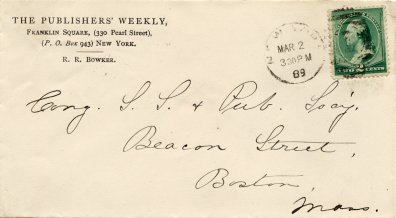
Today is the 175th anniversary of the birth of Frederick Leypoldt (1835-1884). On May 17, 1876, Frederick Leypoldt, Melvil Dewey, and Richard Rodgers Bowker met in the offices of Publishers" Weekly and mutually agreed to pursue a conference of American librarians and a library journal. Both of these objectives were accomplished in that same year. The first issue of Library Journal (under the initial title of American Library Journal) was dated September 30, 1876 and the conference of librarians which resulted in the founding of the American Library Association took place in Philadelphia in October, 1876. Dewey is often given credit for these accomplishments, but both Leypoldt and Bowker also deserve much credit. Leypoldt had successfully established Publishers' Weekly as a major source of information about books and their publishing in America, and although Dewey was the first Managing Editor of Library Journal, Leypoldt was its publisher and source of financial support. Leypoldt also published the American Catalogue and Index Medicus. Leypoldt was a poor businessman and his publishing endeavors, including Library Journal, often resulted in financial loses. His close associate R. R. Bowker was more financially astute and later purchased Publishers' Weekly. The R. R. Bowker Company developed into a major American publishing house with emphasis on the book and library trades. The envelope above was mailed in 1889, five years after Leypoldt's death. The relationships between Leypoldt, Dewey, and Bowker are fascinating. They are dealt with in several publications. These include E. McClung Fleming's R. R. Bowker: Miltant Liberal (Univ. of Oklahoma Press, 1952), Edward G. Holley's Raking the Historic Coals: The A.L.A. Scrapbook of 1876 (BETA PHI MU, 1967), and Wayne A. Wiegand's Irrepressible Reformer, A Biography of Melvil Dewey (ALA, 1996).
Subscribe to:
Posts (Atom)